
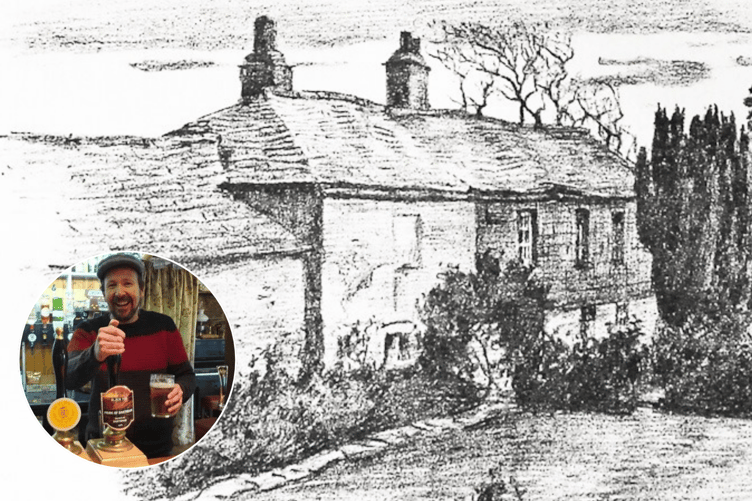
Launceston has been called The Haunted Capital of Cornwall because it boasts the region’s most haunted house, most haunted castle, most haunted churchyard and most haunted hotels, writes Lawrence McNeela former haunted pub landlord and spooky enthusiast.
It’s also home to Cornwall’s most famous ghost story, which was once so celebrated that Daniel Defoe, author of Robinson Crusoe, and Charles Dickens both published versions.
The original tale was written by Reverend John Ruddle, a 17th-century rector of St Mary Magdalene Church, and a man we know is real because his memorial tablet still hangs on his old church’s wall.
One Sunday lunchtime after Mass was over, Ruddle was invited to dine at the home of a local worthy. This was Mr Bligh of Botathan House near South Petherwin. While there, he was told Bligh’s son Sam had become sullen and withdrawn. The explanation Sam gave for his moods surprised the clergyman, for he claimed he was being haunted by a ghost on the way to and from school every day. The ghost even had a name! Sam recognised her as Dorothy Dingley, a woman from the village who’d died some eight years earlier.
John Ruddle agreed to walk with Sam to school the next morning. To his astonishment, the lad’s story proved true because Dorothy did indeed appear to the pair. Ruddle was rendered speechless by shock but he set out the following day determined to talk with the wraith.
When Dorothy then approached the pair, Ruddle described the way she moved as, “a kind of gliding, as children upon ice, or as a boat down a river.” He also wrote about her manner of speaking, saying she answered his questions, “in a voice neither audible nor very intelligible.”
Nevertheless, the pair engaged in conversation and Dorothy’s troubled spirit agreed to leave this world. The clergyman’s work complete, he expressed his confidence that her ghost, “neither doth appear now, nor hath appeared since, nor ever will more to any man's disturbance.”
Like any good priest hearing confession, Ruddle kept Dorothy’s reasons for haunting young Sam to himself. Yet other people haven’t been so reticent, and so we learn that she was an unmarried mother dying in childbirth around the time his elder brother fled Cornwall. The implication being that the older lad seduced and ruined the poor woman before abandoning her completely.
As an appendix to this tale, I should tell you that Dingley was a name made up by John Ruddle to protect the identity, and therefore reputation, of the slighted party in this affair. Her real name was Derrant, Dorothy Derrant, and the smallest research proves that she also really existed. Indeed, the Derrants were residents of Botathan House itself before the Blighs moved in.
There is a second, darker, version of the tale which I share during the ghost walks I host through Launceston. The next walks are planned for Halloween and during Tarosvan – The Cornwall Festival of Ghost Stories in mid-November. However, I’ll leave you with another story involving John Ruddle.
.jpg?width=209&height=140&crop=209:145,smart&quality=75)

I’ll set the scene by sharing the news that, in days gone by, people used to party atop trees! Yes, believe it or not, folk did just that in our region. The canopies of large, pollarded elms were surrounded by poles, with sturdy wooden platforms then built atop the flattened crowns for dancing.
One at Trebursye had to be cut down after a reveller fell to her death, for the woman’s ghost continued dancing there, frightening those travelling by to such an extent that man and horse alike began avoiding the road. Posing a huge problem, sitting as Trebursye did in those days on the main turnpike between London and Lands End.
John Ruddle’s ghost-laying expertise was therefore called on again, to banish the spectre and restore peace to the region. Having done so, he had the tree cut down to ensure the dancing phantom couldn’t return for a curtain call.
Comments
We've recently changed our login process. If you have an account for commenting, you will need to re-register on the login window.
This article has no comments yet. Be the first to leave a comment.