
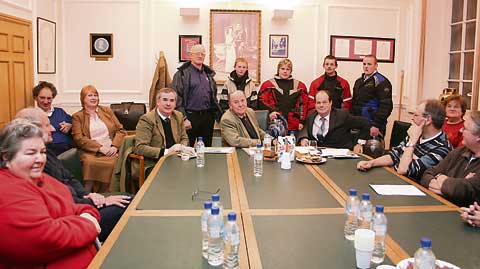
The story of a woman from Frithelstock, who could see Torrington two miles away from her window but who could not get there and back the same day, so had to spend a night in Bideford, was related to Stephen Hammond MP, the Shadow Transport Minister who was in Holsworthy last Friday evening, writes Christine Williams, our Holsworthy correspondent.
Mr Hammond was spending the day in the area with Geoffrey Cox MP for Torridge and West Devon finding out about the state of rural transport and meeting representatives of community transport associations from North Tamar, Torridge, Okehampton and Tavistock as well as the Wheels to Work scheme in Holsworthy's Council Chamber.
For most of the meeting Mr Hammond was in listening mode and was left in no doubt about the problems people face in isolated rural communities. Andy Lyle of Tavistock Area Support Services highlighted the problems of getting to hospital appointments. With the demise of the hospital car service many faced a long and arduous journey by what public transport there was or could not afford the cost of the voluntary car service. Consequently they missed appointments and their health deteriorated.
Max Jowett of 'Wheels 2 Work' had brought along four young men who, thanks to the scheme were able to hire motorcycles to get to work in Holsworthy and enjoy some kind of social life with friends. He said their biggest challenge was finance since the South West Regional Development Agency had pulled out, leaving them with a shortfall this year of £108,000.


David Perkin, the chairman of North Tamar Community Transport Association (NTCTA), who was presiding, said in the long run the community transport services were cost effective for the government. What they needed was secure funding for three years so they could increase provision. Protracted negotiations had taken place with Devon County Council to pilot four trips a day by minibus for six months to enable patients to get to appointments at North Devon Hospital and allow people to visit, but so far without result.
Accompanying Duncan Goodman of Torridge CTA was Mrs Jane Wilson of Woolsery who told the minister what a boon the Ring and Ride service had been to her. The failure of hospitals to appreciate transport difficulties by scheduling appointments at 7.30am was highlighted by Bev Tree, coordinator of the NTCTA.
Ken Crawford of the Devon Senior Council said more and more was being thrust on the volunteer drivers who were "unsung heroes", sometimes getting up at 5am to take patients to Bristol and hanging around for four or five hours before returning. He wondered whether they could access funding from the Kick Start programme for improved bus services.
The vexed question of the over-60s and disabled bus passes, which in Devon, unlike in Cornwall and most other places, cannot be used until after 9.30am was raised.
In response Mr Hammond said he had not realised what a problem hospital transport had become. If his party were elected, they would be committed to supporting the voluntary sector and enhancing the role of community rural transport associations. RDAs were too remote. Funding had to be more local and more easily accessible.
Bus passes were a huge problem with some authorities receiving too much and others not enough. He would change the funding formula as well as the rules which prevented local bus operators from cooperating without running foul of competition rules. As for railways, his party would allow small scale schemes such as the Tavistock to Plymouth line.
Mr Cox thanked everyone for their contributions and the valuable jobs they were doing. Mr Hammond would take back to Westminster what he had learnt from the meeting and would be reporting back. They were determined that promises made would be kept. During the coming months he would be bringing a number of policymakers in his party to the constituency.
Geoffrey Cox said: "The meeting was very valuable indeed in bringing home to the Shadow Minister just how thin on the ground our public transport system is, and just how vital are the Community Transport Associations to the wellbeing of so many of our neighbours. He went away with plenty to follow up on."
He continued: "With the withdrawal by the South West Ambulance Trust of its Patient Transport Service, which has hurt so many local people, and dwindling bus services, it is the volunteers of the CTAs who have had to fill the gaps. Yet they receive inadequate support from the PCT and other Health Trusts and almost no recognition from the Government.
"It is essential that we should rectify this unsatisfactory situation. We cannot expect the voluntary sector to step into the breach unless we give them the respect and support they need as equal partners in delivering rural transport services."
Stephen Hammond said: "Community Transport Associations are some of the unsung heroes of rural communities. Out meeting was very useful in flagging up both how the CTAs have been asked to take on more responsibility, without a proper conception of how they fit in as partners into the delivery of rural transport services, and ideas to support their essential work. I was very grateful to those who attended."
Comments
This article has no comments yet. Be the first to leave a comment.