
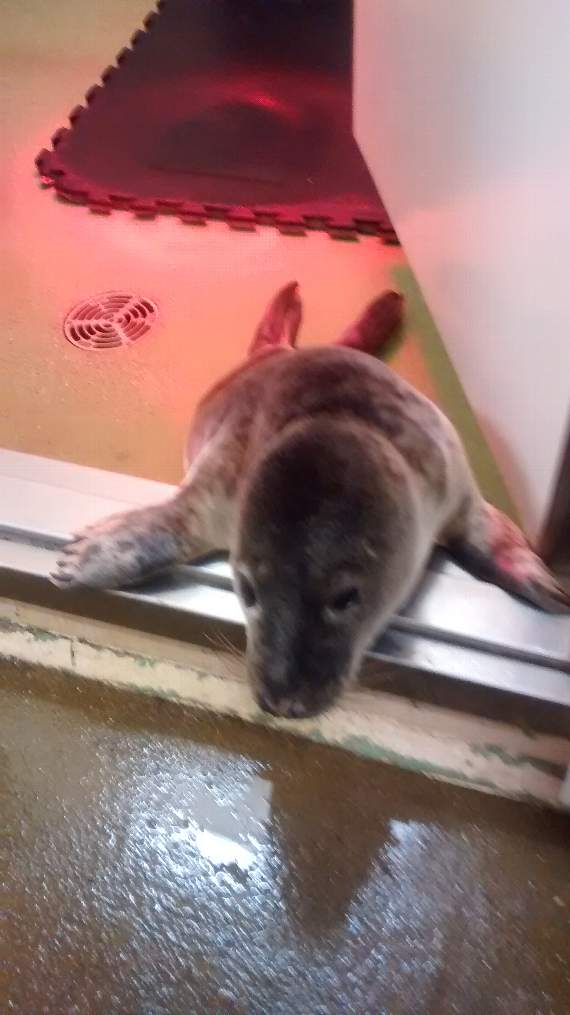
A SEAL pup was rescued in Tintagel in October, after being washed up on the Castle beach.
The pup, found in a bad way but not underweight, was rescued by Ado Shorland and Michelle Robinson Clement, members of the beach clean group Widemouth Task Force.
Described on the Widemouth Task Force Facebook page as ‘very poorly but chunky’, the seal pup was rescued after Ado and Michelle climbed through the rocks in complete darkness on the evening of October 6, and with a tide rising rapidly, the pair realised they needed to rescue the pup immediately.
With the help of Peter and Charlotte Stocker, the rescuers managed to get hold of the pup and ‘bag the pup’ before climbing back up to the car park to assess the injuries and state of the seal pup.




Mucus was cleared from the eyes and Michelle tube fed it, before the pup was transported to Gweek for continued care.
Following further analysis of the pup, it was revealed that the pup weighed 27kg and was a female. She suffered with respiratory problems and bite wounds, but has, according to Ado on a update post on the Facebook page, ‘made good progress’, having now been relocated to West Hatch Somerset for continued care.
The pup was renamed Cheetara and featured on last week’s Autumn Watch programme on BBC Two.
Ado has issued some advice for those who might spot a marine stranding during the winter months. It is advised to watch the animal from a distance, and do not approach it.
Seals, in particular, regularly visit local coasts, as part of their normal behaviour. They spend more time out of water, digesting their food and resting.
Finding a seal on a beach does not mean there is necessarily a problem, and they should not be chased back into the sea, as this may stop them from resting, which they need to survive. The advice states, ‘a healthy seal should be left well alone’.
After stormy weather and high tides, seals will haul onto beaches to rest and regain their strength. Many do not need first aid, but if there is a problem, there are a number of things that can be spotted.
If a seal is seen with a white, long-haired coat in the autumn and winter, or a small seal is seen, less than three feet in length, along between June and August, then it is probably still suckling from its mother. The sea should be checked regularly for any sign of an adult seal.
If a thin seal is spotted, signs of malnutrition include visible ribs, hips and neck, and perhaps baggy, wrinkled skin.
Signs of ill health in a seal include coughing, sneezing, noisy or rapid breathing and possibly thick mucus coming from the nose, wounds or swellings, particularly on the flippers, and possibly favouring one flipper when moving, although it should be remembered that a healthy seal will often lie and ‘hunch along’ on their sides.
Cloudy eyes, or thick mucus around them, or possibly one eye kept closed most of the time, and a seal showing little response to any disturbance going on around it, could also be signs of ill health.
For anyone who sees a seal that may be abandoned, thin or ill, they should call for advice and assistance by ringing the BDMLR hotline on 01825 765546 during office hours, or 07787 433412 for out of hours.
Comments
This article has no comments yet. Be the first to leave a comment.