
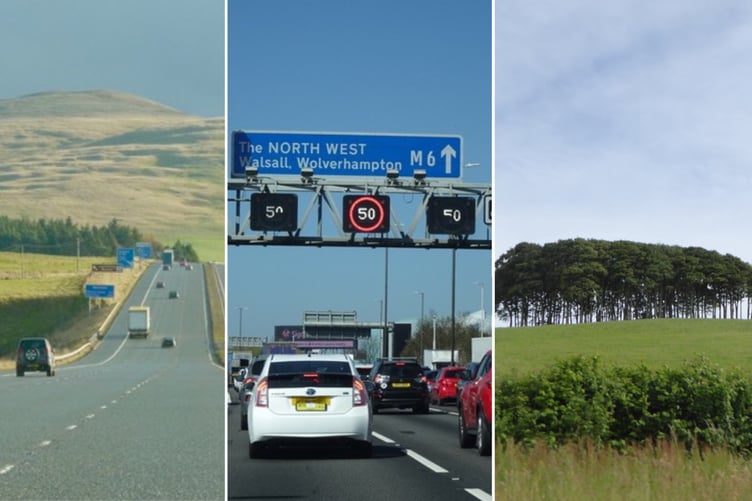
From the arrival of Costa drive-thrus and SMART motorways to automated toll roads, incessant congestion and EV chargers, a personal account of Britain’s changing roadscapes is captured in a new book.
Britain’s Changing Roadscapes: Mobility, Place, Attachment, Loss, written by professor of cultural theory and Cornish author Lynne Pearce, tells the unfolding story of road journeys by car with a focus on the shifting cultural, social, political, and economic landscapes of Britain,
The motivation behind the book is a lifetime of driving by the author, specifically the long and often not-so-winding road between her current home in the Highlands of Scotland and the south-west of Cornwall where she was born and grew up.
Drawing on her trusted road diaries, the book centres on a route which follows the A85, A82, M8, M74, M6, M5, A30 and Cornwall’s narrow country lanes demonstrating the ‘sheer variety and idiosyncrasy’ of Britain’s road network.




The book is also concerned with how mundane change on the road makes its presence felt, the author arguing that this often depends upon the ‘yardstick’ of the human life as travellers compare the road today with what it was like formerly.
Alongside the ‘new arrivals’ to the British roadscape, Professor Pearce captures significant departures including the disappearance of the roadside cafes, filling stations, phone boxes, lay-bys and snack bars associated with twentieth century motoring.
She reflects on why people develop powerful attachments for particular routes and roadside landmarks such as a significant group of ‘homecoming’ trees on the Cornish border.
This, in turn, relates to one of the book’s key findings - how change on the road can result in profound disorientation for drivers and other road users.
While this may begin as bodily disorientation, it can also provoke a powerful emotional response.
Along the way, the author identifies seven categories of change that have made their presence felt on Britain’s roads over the past 30 years - including the transformation of the driver-passenger experience as a result of the re-scaling of vehicles, and the impact of extreme weather as the result of climate change.
She notes that the latter is probably the book’s most consequential research finding.
Weather events have made driving in the UK so much more unpredictable, while extreme heat can make long journeys much more uncomfortable.
Academically, the book addresses long-standing geographical debates on place, place-attachment and aesthetics, as well as the unique properties of ‘journeying’, and is aimed at those working in geography, sociology history, and literary and cultural studies.
Reflecting on the experience of writing the book, Professor Pearce said: “During that time, I’ve seen the gleaming white concrete of Britain’s new motorway network discolour and decay, even while the mundane features of the twentieth-century A-road (phone boxes, lay-bys, snack bars, roadside cafes), and the habits and routines associated with them, slowly fade from view.
“Day to day, these transformations are imperceptible, but every so often we mark the change and, in the process, reconnect with landmark moments in our own lives as well the social and cultural milieux to which we have belonged.”
Comments
This article has no comments yet. Be the first to leave a comment.