
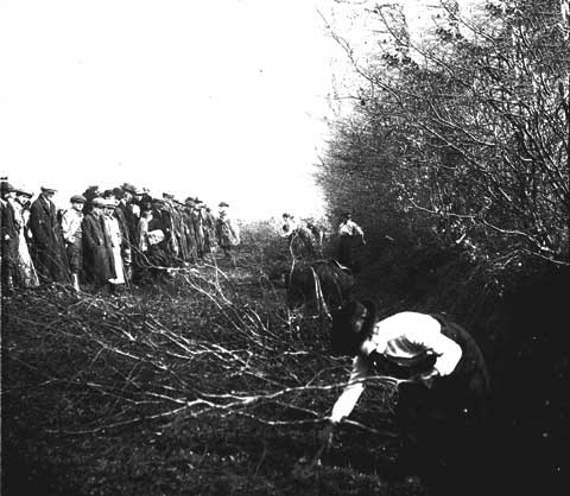
RECORDS of women beating down the stereotypes and helping towards the war efforts in Launceston during the early 20th century have come to light, writes Rosie Cripps.
Jim Edwards, who lives in Launceston, illustrated his findings of an ancient farmhouse in the town, which would see a group of determined women from Launceston and the surrounding parishes take to the farmland to prove to the men who doubted their strength that they too were able to contribute to Britain’s war efforts during the Great War.
The First World War, deemed the ‘Great War’ lasted from August 1914 to November 1918.
Men were encouraged to serve their king and country, and as conscription came into force, the majority were left struggling for resources and food. As farmers and farm-labourers were called up to serve in the war, many farms became virtually inoperable.
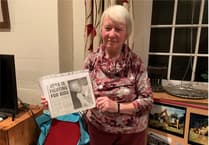
At a meeting of the Launceston, Camelford and Stratton District War Agricultural Committee in December 1915, it was suggested that women be used as farm labourers, but the response was scoffed at and the men on the committee claimed that women were ‘too weak in the head and body’ to undertake such work.
A week later, a letter written by a woman appeared in the Post, stating that it was quite possible for women to do the work to the same standard and perhaps, even, the same time as men.
This woman was Mary Francis Vivian Lobb, from Egloskerry, who proved her strength and determination as a woman for the rest of her life.
Thomas Hicks, a farmer and owner of Scarne Farm, Launceston, finally offered some of his land for a series of competitions that were designed to determine if the women in question could, or could not, do the work of a farmer.
At another meeting, Mr H Paynter from Week St Mary said there were plenty of farmers in the area who would want to receive women to help out on their land, and that perhaps instructions could be provided to any women interested in doing this work.
Additionally, Mr F Horne, the commissioner of the committee from the Board of Agriculture and Fisheries, suggested that instructions should be provided to the women a month before the men left, otherwise the work may fall on children, which Mr Horne described as a ‘disgrace’.
A challenge, set by a Mr Martin, was offered to women wanting to show what they could do. Three prizes were offered, and a number of women showed an interest, including May Billing from Linkinhorne; M S Dinnis from Trecarrell, Lezant; Louise Thomas from Warbstow Cross; Harriett Baker from Kelly, Lifton; sisters Mary and Alberta Wood from Clawton; Maude Annie Mason from St Stephens, and C Reddicliffe from Stowford, Lewdown.
The challenge presented was that of five women binding 12 faggots of wood each — 60 in total — which was considered a good day’s work for a man. If they were able to complete the challenge, the ladies would win £5 for the Red Cross Society.
However, after some sharp words in letter form seen in the Post, written by Mary Lobb, a new arrangement was made with first prize offering £1, second prize 10s and third prize 5s.
With words coming from various farmers that ‘women are no good on our soil’ and that they would take too long to do the work, nevertheless the first Launceston demonstration for the newly formed Women’s Agricultural Demonstration was planned for March 9, 1916.
Mr J Colwill from Lifton and Mr James Moyse from South Petherwin both agreed to judge the events. Four categories were arranged — wood binding, hedge paring, manure spreading and wood sawing.
For wood binding, the names of Harriet Baker, Kelly; M Billing, Callington; M S Dinnis, Lezant; C Reddicliffe, Stowford; Louisa Thomas, Warbstow Cross; Mary Wood, Clawton; Alberta Wood, Clawton and Emma Butler, Pyworthy, were put down.
In hedge paring or manure spreading, Letty Wickett, St Gennys; Mrs Burgoyne, St Gennys and Mrs Hodge, St Gennys, were put forward.
Manure spreading and wood sawing saw Mary Bartlett, Tavistock Road; Mrs Burgoyne, St Gennys and Mrs Jury, Northgate Street in Launceston, put their names down. Mrs Bailey from Broadwood was put down for hedge paring.
The names of Mary Skitch, Rosecare; S Webber, North Tamerton; Mrs Toll, Grinnacombe and Beatrice Evely from Kelly were put down for wood sawing.
Prizes were to be distributed by Ingeborg, Lady Molesworth St Aubyn, and the event was believed to be the first of its kind in Cornwall.
The Post reported on March 4, 1916, that other women’s agricultural demonstrations across the county were ‘likely to follow’ Launceston’s example.
The event on March 9 was a great success, with 728 people from Launceston and the surrounding area turning out to witness the revolutionary change in their local area, and 24 of the 28 women participating.
Lady St Aubyn was said to have been ‘astonished and delighted’ and ‘proud of her fellow women’ after watching the ladies get stuck in with the work.
The two-hour wood binding competition resulted in first prize going to Miss Dinnis with seven binds; second to Alberta Wood with six binds; third to Mary Wood with seven binds and fourth to Mrs H Baker with 11 binds.
Miss Dinnis was first, Mrs Boney was second and Mrs Hodge was third in the one-hour hedge paring event. Meanwhile, in manure spreading, requiring 12 heaps, eight spaces apart, Miss Hancock came first with one hour and 22 minutes; Mrs Burgoyne came second with one hour, 35 minutes; and Miss Gay came third with one hour, 50 minutes. Wood sawing witnessed Mrs Penny win first prize, completing in 33 minutes; second and third were Miss Stella Webber and Mrs Burgoyne with 34 minutes each; fourth was Mrs Jury with 38 minutes and fifth was Mrs Brown with 40 minutes.
Following the event, the president of the Cornwall Farmers’ Union, who was unable to attend and sent his apologies for his absence, said: “In these strenuous times, it is necessary to emphasise that all labour is noble and that every man, woman and child must do their part in the great task that lies before us.”
A total of £30 and 10 shillings was raised for the Red Cross Society from the event, for which grateful thanks were extended by the charity’s chairman of the collection committee, Charles Russell.
Mary Francis Vivian Lobb, born in 1879, attended St Thomas College on St Thomas Road, and, following her father’s death in 1908, she continued to live with her mother Emma and brother George in their home at Trenault.
During the early 20th century, Mary wore men’s-style clothing, which was seen as unusual and astonishing at the time. She was a strong character, pushing her forward to stand up for her gender when many scoffed at the idea of women working on farms.
With the formation of the Land Army, Mary was posted to work on a farm near Lechlade, which was run by a Mr Hobbs. During her time there, Mary worked the tractor. However, having fallen asleep during her working hours one day, she was found by Mr Hobbs and sent away.
Mary then found work as a lady gardener at Kelmscott Manor for May Morris.
It is believed that a strong friendship formed between Mary and May, and Mary was asked to sleep in May’s bedroom with a shotgun next to the bed to make her feel safe.
l Do you know any more about the Women’s Agricultural Demonstration at Scarne Farm, Launceston? Do you have any pictures, or perhaps have a relative who was involved in the movement? Do get in touch by emailing [email protected].
Comments
This article has no comments yet. Be the first to leave a comment.