

Coad’s Green
Women on Wednesdays
Coad’s Green ‘Women on Wednesdays’ were privileged to hear a very special talk given by ex teacher,Margaret Barker, at their November meeting.
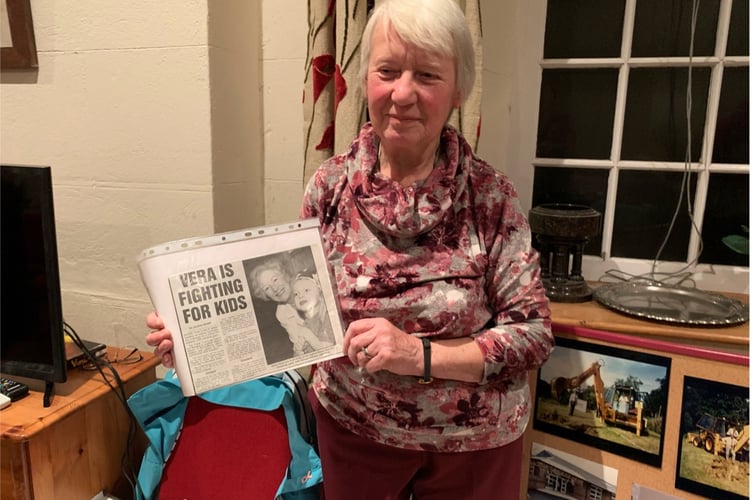
Margaret’s career and vocation had been centred around improving the lives of young disabled children with cerebral palsy, as well as supporting their parents.

Her work began in 1965, when she started as a classroom assistant at the specialist school, Ingfield Manor, Billingshurst. Cerebral palsy effects children in different ways, more generally with speech, movement and coordination. The school developed links with the Peto Institute in Budapest, where pioneering work was taking place in this particular field of child development and best practice was shared. Margaret became the head of the Conductive Education Unit at Ingfield Manor and adopted the Peto approach.
Ingfield’s School for Parents was established to help and to train parents to work with their children for two and a half hours each week . Weekly residential training was also offered.
The funding for the teaching and development of children with cerebral palsy went from strength to strength with an increasing media profile and celebrity endorsement. Involvement of a key supporter, Vera Lynn, and household names, such as Cliff Richard gave the charity, now known as Scope, a huge boost. There was a new build at Ingfield Manor in 1992 and the School for Parents spread its net all over the country.
Margaret developed links and supported the newly formed National Institute of Conductive Training in Birmingham , which also adopted the Peto approach. The philosophy was to develop what children could do, rather than focusing on what the children could not do.
Margaret was honoured with two awards. The Peto Institute made her an honorary conductor in 1995. The second honorary award came from the Birmingham Institute in 2012.
It was good to see photographs of children literally taking their very first steps towards moving independently. Many of them went on to mainstream education.
Alison Gribble thanked Margaret for her inspiring talk about her years of teaching children with disabilities, all of them with their own individual needs.
‘Women on Wednesdays’, (WoW),held their inaugural dinner at the Archer’s Arms in Lewannick at the end of October. Christine Walters thanked Daphne Tucker and Janet Ham for organising the event and the staff at the ‘Archer’s Arms’ for an excellent meal.
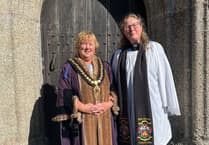
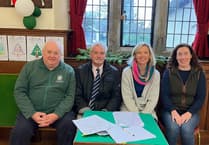
The group meet again in the Coad’s Green Village Hall on Wednesday, December 10, at 7pm, when Barbara Sleep will be demonstrating and leading members in the traditional Christmas wreath-making workshop. This will be followed by a shared festive supper.
Bude
Women’s Institute
Bude Women's Institute held its meeting in the evening of Armistice Day.
The guest speaker was Mr Paul Martin, who was accompanied with his wife.
Paul was the body double for Martin Clunes in the hit series Doc Martin. It was a very interesting night whereby we were all shown photos of the various location shoots across Cornwall, Actors who played various parts and of course Port Wen (Port Issac).
Thanks were expressed to Paul for sharing his experiences with members.
Members handy work was also on display as they had knitted an environmentally friendly wreath to remember the fallen.
The winners of the savoury scones Bake Off competition were: 1st, Brenda Dunstan; 2nd, Sally Alexander; 3rd, Eileen Harris.
Flower of the month winners: 1st, Linda Piper; 2nd, Geraldine Edwards; 3rd Cynthia May.
Marhamchurch
Women’s Institute
Marhamchurch WI welcomed Robert Bond to their meeting to talk about his career in broadcasting.
Robert puts some of his success to his purchase of a very expensive linen jacket he purchased some 25 years ago. He had been looking for something that would stand out and make producers remember him when they were assigning jobs and believes he found one in a £320 jacket which he still has and can still wear.
It appears the jacket worked as while working in the motor trade he was asked by the BBC to talk about buying a used car. His career in broadcasting blossomed from there and he was soon having cars sent for him and appearing on broadcasts which include MPs and international news.
Robert was thanked for his entertaining talk and enjoyed a cuppa with Marhamchurch members as the meeting came to a close.
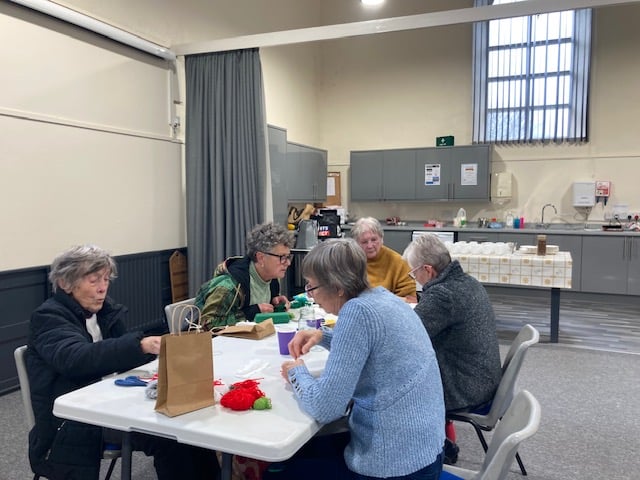
The following week Marhamchurch WI members enjoyed an afternoon crafting. In what is fast becoming a regular Christmas Craft meeting members enjoyed on another’s company as they made a whole platoon of gnomes and some fine Christmas cone trees.
Next month’s meeting is the Christmas party with quizzes, games and Secret Santa.
Week St Mary
Bonaventures WI
By popular demand, the speaker last month was a return visit for Frances Stuart, an ambassador for Lundy who came to talk about Lundy’s most famous shipwreck, that of the HMS Montagu. This took place in 1906 but why were Captain Adair and the navigator Lieutenant Dathan court-marshalled?
HMS Montagu, the first of a new Duncan-class pre-dreadnought battleship of the Royal Navy was built in Devonport and launched in 1903. It weighed 14,000 tons and had a crew of 751. Built to counter a group of fast Russian battleships, HMS Montagu and her sister ships were capable of steaming at 19 knots making them the fastest in the world. It was deployed to the Bristol Channel while taking part in secret trials of what would become known as radio communication. It is important to remember that the Bristol Channel has the second highest tide race in the world.
On May 29, 1906 she was anchored off Lundy, but could not pick up the messages from the test station, so the ship weighed anchor to steam to the Isles of Scilly. Heavy fog forced her to reverse course and steam back to North Devon after four hours, but her navigator miscalculated the course, placing her some two miles off her original track. Montagu encountered a pilot cutter cruising in the vicinity of Lundy, slowed to a stop, and came alongside the cutter to request a distance and bearing for Hartland Point on the mainland. Though the cutter supplied these accurately, the voice from the battleship's bridge replied that they must be wrong and that the pilot cutter must have lost her bearings. Having ignored the advice at 2.12pm the ship hit rocks and wedged onto the rocky ledge of Shutter Point, Lundy. A small boat was lowered to try and find Hartland Point. At 5.40am, having found land, some crewmen climbed up the cliffs. If they had turned left at the top they would have discovered the southern lighthouse. Unfortunately, they turned right and marched the length of the island before they reached Lundy’s northern lighthouse who had great difficulty in convincing the sailors that they were not at Hartland lighthouse. Eventually, a message was sent notifying Lloyd's Register for Shipping and a second message sent to the Admiralty. The sick men and valuables were removed from the ship and all the remaining crew were taken off. Miraculously, there were no fatalities.
An Admiral was in charge of the ensuing salvage, presumably because it was such an important ship. Initially, the salvage was carried out by Liverpool Salvage Company advising Admiral Sir Arthur Wilson but, as the operations were not very efficient, they were replaced in 1907 by the Western Marine Salvage Company of Penzance. A series of steps were cut into the cliff face to help with salvage operations – now known as the “Montagu” steps. A reinforced suspension bridge comprising of over 10 tons of material was taken from the ship to these cliff steps. This ensured that passage to the stricken vessel was possible in any weather and at any state of the tide. Remarkably, the bridge was completed in just 32 hours. The company completed the salvage of the wreck for scrap metal over the next 15 years. The shipwreck made headline news and spectators came over from Devon and Wales. Photographers produced postcards which were sold in their hundreds.
The wreck was finally sold for £4,250 in January 1907. A total of £85,000 of goods was removed but an estimated £48,000 was lost due to the bottom half of the ship being underwater. The Admiralty announced that the total loss was £1,200. The wreck is now a scheduled ancient monument but divers, ex servicemen supported by Help for Heroes, have been exploring the wreck. The Court Marshal blamed the thick fog and faulty navigation for the wreck. Captain Thomas Adair and the navigator Lieutenant James Dathan were severely reprimanded with both men being dismissed from HMS Montagu. Dathan also lost two years of seniority in rank. The photograph shows HMS Montagu stranded on Shutter Point. We should remember that this was one of hundreds of wrecks around Lundy’s coast.
Comments
This article has no comments yet. Be the first to leave a comment.