
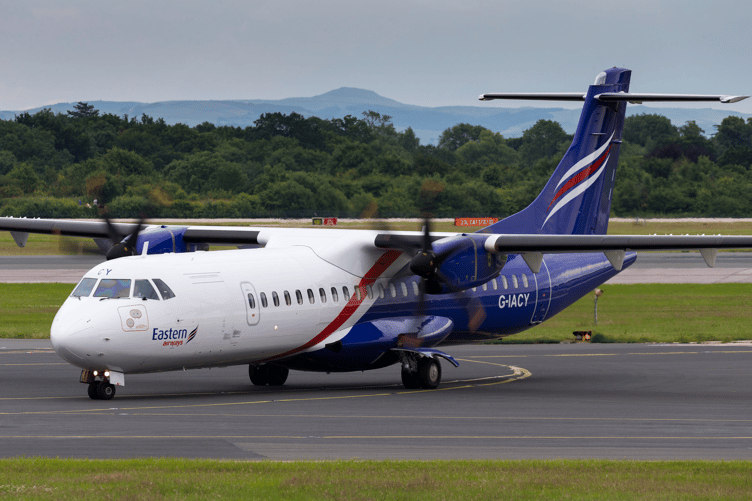
QUESTIONS are still being asked about why Cornwall Council and its company Corserv did not seize an Eastern Airways aircraft before the struggling airline went bust owing the local authority £1.6 million.
It was revealed at a council meeting last week that Corserv – which operates Newquay airport on behalf of the local authority – considered a lien, or legal seizure, of an Eastern Airways’ plane on two occasions. The £1.6 million debt is now being shouldered by Cornish taxpayers.
Whether senior council officers and/or Corserv board members agreed to seize an aircraft and then possibly order its release has been a hot topic of conversation in the corridors of power at Lys Kernow (County Hall) in Truro. We have made a Freedom of Information (FOI) request to the council asking for correspondence and further information on the matter.
Eastern Airlines went into administration in November 2025 forcing all its flights from Cornwall to London to cease until a replacement could be found. It ran the publicly subsidised Public Service Obligation (PSO) route to Gatwick. Cornwall Council’s administration decided to scrap the PSO route in February this year after it was estimated that continued taxpayer costs would reach £14m to £16m over four years.
The thorny issue of Eastern Airways’ debt was raised again at an extraordinary council meeting last week, which discussed ways Newquay airport could be run more effectively without a huge drain on taxpayer money. It was revealed that £10m from the public purse will be needed to help run the airport this year.
Cllr Andrew Mitchell said at the meeting: “It appears to me that we have no credit control at Newquay airport. To allow Eastern Airways to go bankrupt owing us £1.6 million beggars belief. It was three times what they owed Heathrow and here we are, a small regional airport.”
When asked about credit control at the airport, Paul Cooper, Corserv’s director of resources – whose retirement was announced a few days after the meeting – told the extraordinary meeting: “Eastern is a very specific issue. Whenever one makes decisions about escalation, you make them in a balanced way around the business and the issues being faced at the time.
“We took every step we could with Eastern – we had escalation meetings with Eastern’s finance director, we had payment plans agreed, parts of which were delivered but not all.
“Cornwall Council were paying Eastern under the PSO contract and our charges with Eastern were their landing fees, etc, at the airport. There was a mechanism under that contract to enable us to [direct] some of the fees that were being paid by Cornwall Council to Eastern straight to the airport.
“We did a really clear risk assessment about the impact of no longer allowing them to provide the PSO service and we also looked at the amount we were earning from passengers because sometimes taking that hard line can ultimately mean you are slightly worse off in the long term.


“We were also in a situation at that time when the PSO contract was coming to an end and Eastern were involved in the potential re-tender. We were making decisions in the light of that being an ongoing thing and if we pull the plug at that point in time might we end up with no PSO at all, which would be worse for the airport and also the residents of Newquay in the long run.”
He added: “We actually sat as an executive leadership team and looked at a risk and benefit statement of what we should do, which was shared with the council, and we made a balanced decision on that basis.
“On two occasions we made decisions equally informed by that risk assessment as to whether we should lein [seize] an aircraft that was on the ground. For the same reasons on both occasions, we chose not to.
“With what we knew at the time, I think on balance they were the right decisions. Sometimes, unfortunately, in business and life events change and it turns out not to have been. It’s important that you view that through the lens of what was known at the time rather than how they transpired 18 months later.”
Cllr Peter Channon, himself a former pilot, responded: “That was definitely the right decision. Putting liens on aircraft, especially during PSOs, would have sent all the wrong messages to other airlines; awkward situation.”
“I understand hindsight is a wonderful thing,” added Cllr Mitchell, “but from the point of view of a normal council taxpayer I don’t understand the logic of not chasing £1.6 million worth of debt … I think it’s a shame that we didn’t take control of an aircraft. Other places did. Heathrow certainly did.”
Mr Cooper said: “We never stopped chasing, we absolutely never stopped chasing. What we didn’t do was pull the trigger on legal action.”
A spokesperson for Corserv said this week: “Paul Cooper will be retiring from Corserv Solutions at the end of September following a long-standing agreement and handover process. His replacement has joined the business this week and is looking forward to continuing the great work Paul has delivered during his time with us. We wish Paul all the best for his well-deserved retirement.”
Comments
We've recently changed our login process. If you have an account for commenting, you will need to re-register on the login window.
This article has no comments yet. Be the first to leave a comment.