
WHEN we read about later life, the focus is usually on what has been lost, rarely on what can be regained. The stories tend to be of older people losing their independence, declining health and the difficulties that follow hospital and nursing home admissions.
What is said less often are the stories of people who recover, regain abilities they had lost and begin taking control of their everyday lives again.
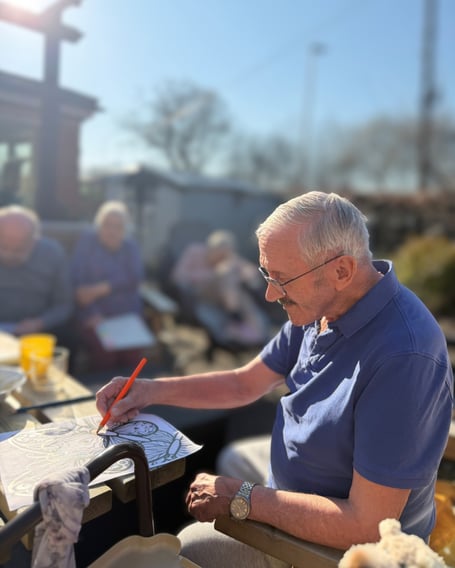
Brian Stacey, known to family and friends as Bunny, is one of those stories. Bunny arrived at Hatherleigh Nursing Home for end-of-life care. Since then, he has made considerable progress, regaining much of his mobility and independence, along with the ability to make everyday choices for himself.
His story offers a different perspective on life in a nursing home, and on what is possible even when someone’s future initially looks very uncertain.
Long before his arrival at Hatherleigh, Bunny had spent his life in Devon. Born and raised in Merton, he spent his whole life working practical, hands-on roles, from sawmills to maintenance and gardening at Clinton Estates for 50 years.
Married to Julie since 1974, Bunny is a father to Michelle and Kevin and a grandfather to Tyler, whom he adores. He has always had an interest in classic cars, particularly his own beloved BMW 635 CSi, and enjoys watching television with a cup of black Twinings Earl Grey tea.
Towards the end of 2024, however, life began to change for Bunny and his family. Following a fall over the Christmas period, his health deteriorated, marking the beginning of a difficult and uncertain time for them all.
During his time in hospital, Bunny became increasingly dependent on others for everyday tasks he had previously managed himself. For a man who had always been active and independent, this was devastating.
He had lost much of his mobility, and difficulties with eating and swallowing had become so severe that a feeding tube was introduced. Despite medical treatment, Bunny remained very unwell, and as his condition showed little sign of improving. Discussions took place with his family about what would be best for him, and It was eventually decided that the focus would move towards keeping Bunny comfortable through end-of-life care.
It was under these circumstances that Bunny arrived at Hatherleigh Nursing Home in January 2025. With his health having changed so dramatically in such a short space of time, neither Bunny nor his family knew what the coming weeks would bring.


However, what happened in the weeks following Bunny's arrival was quite remarkable. Having come to Hatherleigh for end-of-life care, with little expectation that his condition would improve, Bunny began to show signs of recovery.
With support from the nursing and care team members, alongside external multi-disciplinary teams, he gradually began regaining some of the independence he had lost. One of the biggest changes came at mealtimes.
Having previously needed a feeding tube, Bunny gradually began eating and drinking again, with speech and language therapists reviewing his needs as he improved. Before long, Bunny was back sitting at the dining table, drinking independently and beginning to enjoy his meals with some assistance.
For someone who had been so poorly just weeks earlier, being able to sit down for a meal and take part in that familiar daily routine was a remarkable step forward.
As Bunny began to feel stronger, he was also able to start moving around more independently. In those early months at Hatherleigh, he had needed considerable help with everyday tasks, but with time and support from physiotherapists and team members, he gradually began finding his feet again – literally!
By October 2026, Bunny had reached another significant milestone in his recovery. Having regained the ability to walk independently with his frame, he progressed even further and is now walking with a stick, supported by the team and physiotherapists. And through all this, Bunny's sense of humour has remained very much his own.
During a recent cake-decorating afternoon, a team member asked whether he fancied joining in. "No, but I will eat them," he said. It wasn't long, though, before Bunny was on his feet and heading over to the table to take part after all.
Another important part of Bunny's progress has been his ability to express his wishes and take a more active role in everyday decisions. When he first arrived, his cognitive ability had declined with his health, meaning that certain decisions needed to be made in his best interests.
As his health improved, Bunny became increasingly able to communicate his preferences and explain what he wanted. Things that we often take for granted like being able to choose what he wanted for breakfast, and talking with team members about how he has spent his day.
After spending an afternoon upstairs, Bunny told a team member how much he had liked being there, describing it as calm and quiet. These everyday conversations show how much more involved Bunny has become in his own life, with opportunities to make choices and maintain his independence.
More than a year and a half after arriving at Hatherleigh, Bunny's life looks very different. His recovery has been supported by nursing and care team members, physiotherapists, speech and language therapists and other healthcare professionals, alongside the continued involvement of his family.
Although Bunny still needs support, he has regained much of his independence and can now take a more active role in everyday life. Recently, team members supported him on a visit to Sugworthy Circuit to re-unite with his BMW 635 CSi, reconnecting him with an interest he has had for many years.
Bunny's story is one we hear less about when nursing homes are discussed, showing just how much someone's circumstances can change and that sometimes, the seemingly impossible is possible.
What began with his family facing the possibility of losing him has become a story of life continuing in ways nobody expected, and a reminder of just how far Bunny has come.
Comments
We've recently changed our login process. If you have an account for commenting, you will need to re-register on the login window.
This article has no comments yet. Be the first to leave a comment.