
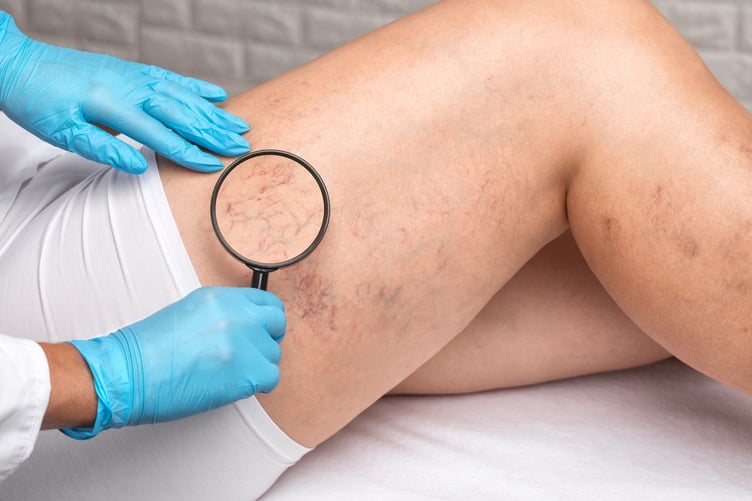
Why do veins suddenly become visible on the legs, and could it be varicose veins?
Many people notice at some point that the veins on their legs suddenly become more visible. Blue or green lines may appear more clearly under the skin and seem more pronounced than before. For some, this happens gradually over time, while others feel it appears quite suddenly.
But what does it actually mean when veins become more visible, and when could it be a sign of varicose veins?
Visible veins are often completely normal


.jpeg?width=209&height=140&crop=209:145,smart&quality=75)
In many cases, visible veins are not a sign of a medical problem. The body is constantly responding to temperature, activity and physical demand.
When the body becomes warmer, for example during exercise or in hot weather, blood vessels expand to help regulate temperature. This makes veins more visible through the skin.
People with:
- lighter skin
- lower levels of body fat
- higher levels of physical activity
will often naturally have more visible veins.
Age also plays a role. As the skin becomes thinner over time, veins tend to appear more clearly.
When it could be varicose veins
At the same time, more visible veins on the legs can in some cases be an early sign of varicose veins.
Varicose veins develop when the small valves inside the veins stop working effectively. These valves normally help move blood back towards the heart. When they weaken, blood can collect inside the vein.
This increases pressure within the vein, causing it to widen and become more visible.
The condition is known as chronic venous insufficiency and is very common. A large proportion of adults will develop some form of venous disease during their lifetime.
Common symptoms
For many people, it starts with visible veins, but other symptoms may also develop.
The most common include:
- heavy or tired legs
- swelling around the ankles
- a feeling of pressure in the legs
- itching or warmth in the skin
- discomfort after a long day
Symptoms are often more noticeable towards the end of the day.
Why do varicose veins develop?
There are several factors that increase the likelihood of developing varicose veins.
The most important include:
- family history
- pregnancy
- prolonged sitting or standing
- age
- hormonal changes
Many people therefore first notice symptoms in their thirties or forties, even though the process often begins earlier.
Assessment provides clear answers
If there is uncertainty about whether visible veins are linked to varicose veins, a medical assessment can provide clarity.
The most commonly used method is an ultrasound scan, which allows specialists to observe how blood flows through the veins. This helps determine whether the valves are functioning properly.
The examination is quick and painless.
If you would like to understand more about causes, symptoms and treatment options, you can read more about varicose veins here.
Treatment has changed significantly
In the past, varicose veins were often treated with surgery where the affected vein was removed.
Today, treatment is much less invasive.
Most procedures are minimally invasive and do not require traditional surgery. Techniques such as laser treatment and medical adhesive are used to close the vein causing the problem.
Once the vein is closed, the body naturally redirects blood through healthy veins.
Treatment is usually quick, and many people return to normal activities the same day.
For those who want to understand how it works in practice, there is a detailed explanation of varicose vein treatment here.
Experience and specialisation matter
Diagnosing and treating varicose veins requires experience and specialist knowledge.
In the UK, UK Vein Care is one of the clinics focused exclusively on the diagnosis and treatment of venous conditions. The medical team has performed more than 50,000 treatments and works with patients with varicose veins on a daily basis.
This level of specialisation supports accurate diagnosis and allows treatment to be tailored to the individual.
Clinics with high treatment volumes and specialised doctors are also often highlighted in international guidance, where experience plays an important role in achieving good outcomes.
Small changes are often the first sign
For many people, it begins subtly.
A vein becomes slightly more visible. Legs feel more tired at the end of the day. There may be mild swelling around the ankles.
These signs are easy to ignore, but they can be the body’s first indication that the veins are under increased strain.
When should you take action?
Visible veins on their own are usually harmless.
However, if they are combined with symptoms such as pain, heaviness or swelling, it may be worth having them assessed.
The earlier the condition is evaluated, the simpler treatment is often.
Comments
This article has no comments yet. Be the first to leave a comment.