
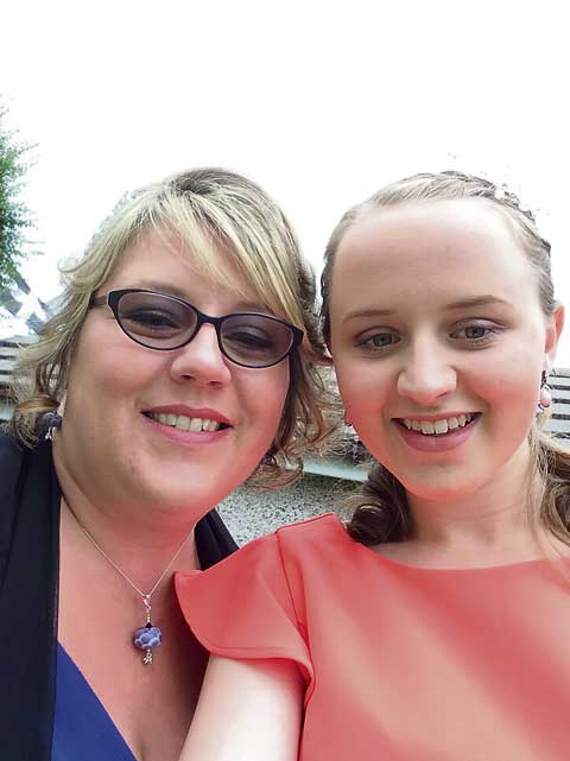
A YOUNG carer from Camelford is aiming to change the legislation regarding personal independence payment, with the help of Conservative MP for North Cornwall, Scott Mann.
Fourteen-year-old Olivia Ferguson, from Camelford, lives at home with her brother, 16-year-old Alex, and their mother, Kirsty, who has been living with multiple sclerosis (MS) since her diagnosis in 2010.
Multiple Sclerosis is a condition that affects the central nervous system, when the coating around the nerve fibres, called myelin, damages. A long-term disability, Kirsty will never get better from her limiting condition.
Since the age of eight, Olivia has cared for her mum for over 50 hours a week, trying to balance that with school, homework, friends, and time to herself, meaning she is dealing with responsibilities that most 14-year-old girls could not comprehend.



.jpeg?width=209&height=140&crop=209:145,smart&quality=75)
Despite her painful condition, Kirsty tries to stay a productive person. She was formerly a town councillor for Camelford, and is chair of the Camelford events working group.
Kirsty receives personal independence payment (PIP) as a result of her condition, providing support to cover the costs that her disability brings to her every-day life.
Those who receive PIP are required to undergo assessments, which determine the level of help they will receive. Between £21.80 and £139.75 a week is available to those with PIP, depending on their assessment results.
However, at the beginning of November, Kirsty received a letter, stating that she would need to undergo a re-assessment. Medical assessments will be conducted, and if she is not ‘deemed adequate’ for PIP at the re-assessment, the family will experience significant losses to their day-to-day living.
Kirsty could potentially lose £270 in benefits a month, as well as having their car taken away, a specialised mobility vehicle for Kirsty, and being put on social housing.
Olivia spoke to the Post about her family’s ordeal. She said: “It’s just ludicrous really. My mum lives with multiple sclerosis, which is not something that is going to get better. If we lose the case and if mum is not deemed adequate for PIP, then we will lose £270, plus our car.
“We will then be put on social housing, because we won’t be able to afford to live where we are. We’re struggling to afford it even now.”
Olivia explained that the emotional stress of this worsens her mum’s condition, meaning symptoms that come with multiple sclerosis ‘flare up’.
Olivia is Kirsty’s main carer, and her brother Alex helps when he can, although he is due to join the RAF in January, meaning things could get a lot more difficult for Olivia and Kirsty.
Olivia is the author of a blog, The Odd Pigeon, which updates readers on her mum’s condition, and gives an insight into their life. When the PIP letter was received, Olivia took to her blog, posting a ‘letter to the government’, and starting her campaign to change the laws on PIP.
In the blog post, she states ‘I’m not sure what else to say. I thought we were meant to be supported by the system for an illness we have no control over. I am truly and inexplicably disappointed in you and our so-called ‘rights’’.
Taking action, Olivia emailed Conservative MP for North Cornwall, Scott Mann. He arranged to meet Olivia, and on Saturday, November 26, paid a visit to her home.
Olivia said: “Scott came to my house, and the meeting went very well. We talked about mum’s physical needs, and what it will mean for us if it’s not in our favour. We also spoke about my life at home, and my school work.
“He explained what he was going to try and do for us. He said he is going to try and get the legislation on PIP changed, so that people with long-term illnesses or disabilities with young carers don’t get their PIP taken away from them until the young carer reaches the age of 18, so it will reduce stress on families.”
After he was contacted by Olivia, Mr Mann delivered their case to the House of Commons in London on Monday, November 28, directing it at the ministers of the Department for Work and Pensions, and the Disabilities Minister.
Following his time at the House of Commons, Mr Mann updated people on social media about his progress, adding that it is ‘crucial to highlight the amazing work young carers like Olivia do looking after loved ones, and at the same time trying to juggle education and childhood’.
Mr Mann told the Post: “I first became aware of Olivia and Kirsty’s case after Olivia contacted me a few weeks ago. She explained to me the predicament her and her mother are facing, as Kirsty’s PIP re-assessment approaches, and the anxiety and uncertainty this brings.
“Olivia is clearly devoted to helping her mum, and during my visit to their home, Kirsty explained to me the daily challenges she faces living with MS, which is an advancing condition.
“Just before our meeting, I decided to raise their case in the House of Commons. I asked the Disabilities Minister if re-assessments for people with long-term degenerative conditions could be stopped if they rely on young people to care for them, at least until such time that their young carer has finished their education.”
Mr Mann added: “My office and I will continue to be on hand to offer assistance to Olivia and Kirsty.”
The Department for Work and Pensions got in touch with the Post, claiming that when a PIP re-assessment is called, it does not necessarily mean that an individual will lose their money; there is a chance that the entitlement could be increased instead.
A spokesperson from the Department for Work and Pensions explained that 24% of people under PIP are being supported, in contrast to the 15% under the outdated DLA, of which PIP was introduced to replace.
A spokesperson said: “Assessments are an important part of Personal Independence Payments, to ensure we make the right decision about a person’s benefit entitlement.
“More people receive the highest rate of support under PIP than under DLA, and more people with MS, osteoarthritis and Parkinson’s are receiving the highest possible rate for daily living expenses.
“PIP assessments are carried out by qualified health professionals, who combine their clinical knowledge with an understanding of the fact that not everyone with the same disability is impacted in the same way.
“Decisions are made following consideration of all the information provided by the claimant, including supporting evidence from their GP or medical specialist.”
However, Olivia told the Post that thousands of people across the UK, including many MS sufferers, lose their battle with PIP, meaning families lose their vital benefits and more.
Olivia said: “This really has added a lot of pressure on me. There are days where I just want to lock myself away and escape from the world.”
She added: “If mum could work and support her family, she would more than happily oblige. She never asked for MS, and every day it burdens her life.”
Keeping positive and proactive, Olivia has started her own petition on Change.org, named PIP Legislation for Families with Young Carers, in the hopes it will reach Prime Minister, Theresa May.
Olivia also takes part in countless fundraising activities in aid of charities for MS, particularly for Multiple Sclerosis Society UK, where she has recently completed a fundraising walk with the likes of Oritse Williams, former member of JLS.
Olivia wants to get her story across, and hopes that the laws are soon changed, so that families like hers no longer have to experience the pressure, anxiety and uncertainty that comes with PIP re-assessments.
She added: “For the people who are similar to me and my family, and for those who live with MS, we’ve got to work together to get the message through, because we’re the people who really know about it.”
For those wishing to pledge their support to Olivia, sign her petition at www.change.org/p/theresa-may-mp-pip-legislation-for-families-with-young-carers.
Comments
This article has no comments yet. Be the first to leave a comment.