
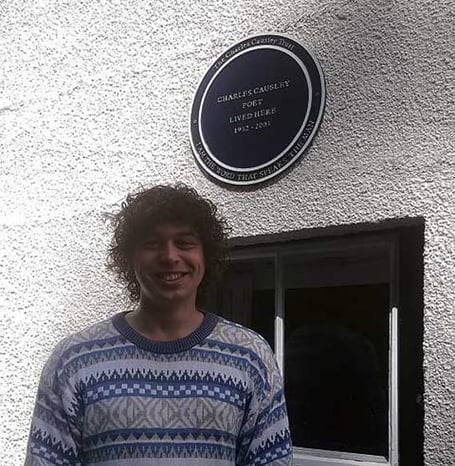
THE current writer-in-residence at the former home of late Launceston poet, Charles Causley, is helping to ‘breathe new life’ into the work being done to promote Causley’s work and legacy.
David Devanny is the first writer-in-residence for 2018 as part of the Charles Causley Trust’s ‘Fuelling the Flame’ project, which is funded by Arts Council England, Cornwall Council and Literature Works.
David has already spent around a month at Cyprus Well, which was Causley’s home. The residency, co-ordinated by the Charles Causley Trust and funded by Literature Works, runs until August.
He is an award-winning multi-media artist and poet, originally from Bradford, and lectures at Falmouth University where he is studying for a PhD in digital poetry and poetry publishing.


He moved to Cornwall four or five years ago, which is when he first came across Causley and his work.
David shared his opinion of Causley’s work: “There’s a lot more going on under the surface than it looks like initially in his poems. I think it’s a subtlety of his.
“[His poems] are actually profoundly complex and sad. He’s very much socially motivated — he writes about poverty a lot. There’s a dark side to it, which makes it quite vital really.”
David now lives in Penryn and is currently on summer break from the university, so the residency allows David to spend time writing.
He admitted he found the interview process for the residency a little intimidating, and said the ‘wonderful poet’ Penelope Shuttle was on the panel, with the interview held at Cyprus Well, but he added: “They are lovely people and they were genuinely interested as well in the work, and they are quite keen for me to have time to write. They are really generous with the space.”
He said of the residency: “It’s going very quickly. I have done a lot of work. It’s really peaceful — the birds are incredible! I’ve always lived in cities so at first I couldn’t sleep with the birds’ dawn chorus at 5am!
“It’s very peaceful here and not too many distractions. It’s such a luxury really to have time to write and sitting in Causley’s study. There’s a great atmosphere. A lot of his books are around so it’s pretty inspiring.
“I’m writing like mad and that’s such a pleasure,” — he’s currently putting together a manuscript.
He said of his home city, Bradford: “It’s very close in spirit [to Launceston] actually. A post-industrial region with beautiful scenery, and rich literary heritage.”
In Launceston so far he has been enjoying the chance to talk to local people about Causley, and learning more about his legacy. He was also able to be part of the Causley Festival, which ran from May 31 to June 3.
He read some of his work at a ‘Pimms and Poetry’ pop-up at Cyprus Well, and attended many of the other events going on in the town.
David classes himself as a digital poet, which he tried to describe: “It’s massive and can be a lot of things, from poems on screens to interactive poems, to mobile stuff. It’s the sort of thing a lot easier to see than describe!”
While at Cyprus Well, David is also working on a mobile application for the Charles Causley Trust, which would be a Causley poetry trail. However, he envisages it will be a longer-term project than his residency and could take a year or so.
He is also working on virtual reality poems that would be 3D poems ‘readers’ could walk through, which he described as ‘a lot of fun and quite engaging’. He is planning an exhibition of this work.
He added: “Poetry always evolves. It was first kind of just a spoken art and it’s evolved to be this page-based thing as well, and it’s changing again. In a way it’s a move back to the world of the acoustic.
“It’s not to say it’s making older forms obsolete — not at all. It’s just allowing greater access to it.”
David said he feels Causley tried ‘to break down the barriers’ between different types of poetry, and added he too feels different kinds of poetry — whether digital or traditional — can all co-exist.
“I suppose what motivates me is a lot of people can be quite nervous about poetry and I think it doesn’t need to be intimidating. I want people to get stuck in, that’s why I’m involved with literary education really. I think people can get frightened off from an early age.”
David said he was encouraged from an early age by his parents and school, and said by the time he went to university he was ‘pretty determined’ he was going to do poetry.
He added: “It’s just about possibility. I wouldn’t change it for the world, I love it. I think job satisfaction is so important.”
Comments
This article has no comments yet. Be the first to leave a comment.