
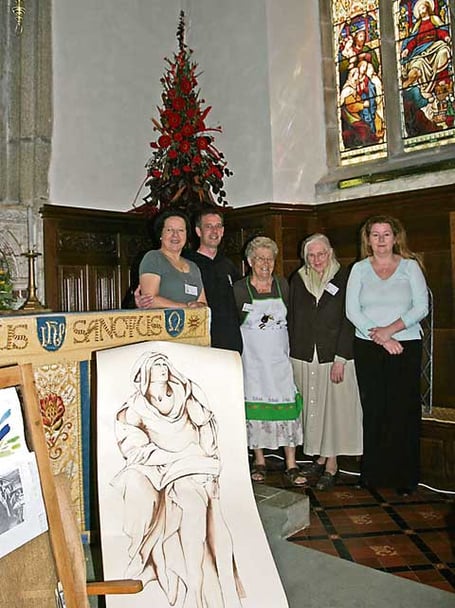
ENTERING St Andrew's Church, Stratton, was like stepping back in time to a thriving market town full of shops, businesses, public houses, a jail, police station, Court House and, of course, the cattle market.
This flower festival, unlike last year's which was based on heavenly realms, was all about the day-to-day living enjoyed in this town over the centuries. The floral displays, in the main, were unsophisticated and simple, helping to emphasise the uncomplicated living style enjoyed in Stratton years ago.
Once again imaginations had taken over and the results were ingenious, eye-catching and humorous. The former pannier market was represented by a display of dairy produce which included a milk churn pouring out white flowers turning into a compact display of yellow flowers! Former shops and businesses lined the aisle on both sides — individual displays for each trade ranging from the cobblers and the chemist to the haberdasher's and the butcher's — simulating a busy street in the town.
'The Town Beneath Your Feet' was an intriguing glimpse of very early Stratton from artefacts dug up literally a stone's throw from the church. This theme was also captured in the display from the Stratton School dig: memories of cold winter's nights and stone hot water bottles but now put to a more aesthetically pleasing use as containers for simple posies. How many of these children would recognise the 'Toys and Games of Childhood', displayed in profusion? And how many children still go fishing where the Clapper Bridge used to be? What a nostalgic display that was, with the jam jar and stick fishing rod!



The song 'Didn't we have lovely time, the day we went to Bangor' came to mind immediately with the delightful display entitled 'Sunday School Outing 1913'. The model horse-drawn trap with its beautifully attired occupants and the vicar standing by, all faithfully based on the photo alongside. The promise of the sea shore in the blues, whites and yellows of the accompanying floral displays.
The heavenly realms were reached by the display of ecclesiastical embroidery and communion plate with which Stratton is blessed, and also by the breathtaking display based on the William Morris window over the altar. The vibrant colours of the evangelist's robes in the window echoed in the magnificent display to the right of the window; the wings of their symbols echoed in the equally splendid display on the other side. How sad if this window were to deteriorate beyond repair.
The public houses featured on the window ledges: the lilies' blooms an inspired choice for the Ring of Bells: the Mothers' Union display showing how the society has grown since its inception: the reason behind the word 'Diddies' — so many displays to ponder over and from which to gain knowledge. Once again, congratulations to the parishioners and friends of St Andrew's for their expertise.
A number of visitors to the Flower Festival have shown considerable interest in 'Matthew', the cartoon artwork at the High Altar, by Ian Ridler and also the six Inn Signs of Stratton, painted in oils by Yvonne Bishop. Winners of the festival raffle were: Beryl Kendrick, Mr Holland and Emma Semple.
While visitors admiring the flower displays occupied the daytime, the evenings were equally full of activity. On Friday evening a talk was given by Miss Joan Heard, a much loved Strattonian, who entertained and informed a large audience with her tales and research on Stratton in times past.
It was fascinating to hear about the different shops and businesses in Stratton, firstly 100 years ago, and then during World War II, with Joan sharing her own memories of the once bustling and thriving town. Not only was Joan's subject matter interesting, much of the beauty of the talk was in her delivery. She is passionate about the subject and speaks in a refined and gentle way which drew in all the audience to rapt attention. It was a real treat and so utterly appropriate for the theme of the Festival.
On Saturday evening the church hosted a concert by local musicians. The range of instruments and musical periods was wide — from Bach and Mozart, played respectively on the organ and the clarinet, to American bluegrass and jazz saxophone. The audience participated by singing the Stratton Carol and Trelawny.
The evening was ably and humorously compered by Fr David Standen, and wine and refreshments were served afterwards. The musicians who gave generously of their time and talents were: Amanda Bluett, Calum and Chris Bradbury, Kath and her Bluegrass Boys, Idony and Ronan Perrett, and 260 not out.
The choir and congregation of St Andrew's were joined for Choral Evensong on Sunday night by members of St Michael's, Bude and Kilkhampton Church. The Magnificat and Nunc Dimittis were sung to a setting by Stanford, and the massed choirs sang the anthem O Thou the Central Orb, by Charles Wood.
Initial figures, though subject to adjustment, show that a staggering total of over £3,200 was raised over the four days of the festival. Congratulations go to all those people who worked so tirelessly for so long to achieve that result. And, of course, thanks go to all who went to support the festival: some 700 people over the course of the four days — an unprecedented number.
Comments
This article has no comments yet. Be the first to leave a comment.