
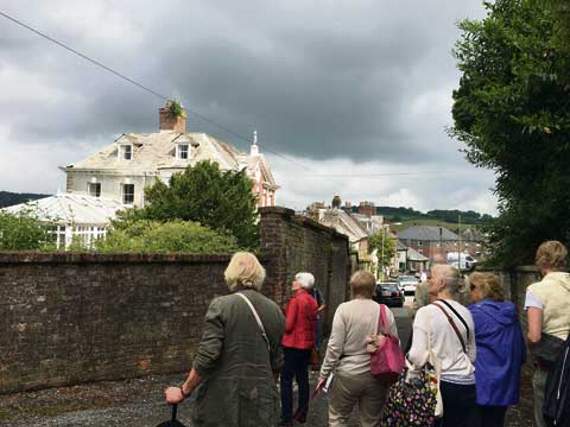
MEDIEVAL buildings, tales of the Dooms Dale prison and poems from Launceston’s renowned poet Charles Causley greeted visitors and locals to the town last Friday, as town crier Rob Tremain led a historical walk around the former Cornish capital.
Meeting at the castle entrance on Friday morning, Mr Tremain greeted several visitors to his historic walk around Launceston.
He began the tour at the entrance to Launceston Castle, opposite the famous town hall and guildhall, where the 17th century ‘quarter jacks’ above the clock rang out to signify the half-past-ten start.
In 1881, the Guildhall, tower and caretakers’ offices began construction, being completed in 1887 to celebrate Queen Victoria’s jubilee. The clock, located on the front of the building, below the quarter jacks, once belonged to the old buttermarket in the town square, until 1921 when the buttermarket was demolished to make way for the war memorial. The quarter jacks date back to 1642, and two were fixed onto the buttermarket in the square.

The party moved along through the castle grounds, where Mr Tremain detailed the history of the coat of arms of the Trelawny family, who hailed pre-Norman era from Altarnun.
The tour was able to gaze out to the wonderful views of the valley and St Stephens. “You can see the Priory, which was founded at Newport, and completed in 1140. It’s a very rich foundation. In 1415, the Priory lent money for the Battle of Agincourt,” he continued.
Views of the ‘Deer Park’ fields, where the sheep now gently graze, the 1960s-built St Joseph’s School and the old National School below, where Charles Causley attended as a child and taught for many years, captivated Mr Tremain’s audience.
The next site of attraction was the old jail — a typically dark, grotty, dungeon-like prison, which one could only assume would look as uninviting then as it does today — but perhaps much worse.
The castle jail was, too, the county jail, with criminals being tried all over Cornwall and transported to the jail. Before the jail, sits the ruins of the eastern gate to the castle, which would have once had another storey above for the gate and jail keeper. “It would have been a strong, defensive gate — and it’s all to do with the show of power,” Mr Tremain said. “Dooms Dale would have had rooms above, where the jailer lived. Beyond, down, was ‘Dooms Dale’ — George Fox was imprisoned here. The walls were running with water, the ground was flooded with mud, water and worse — because there were no suitable sewage facilities.
“George Fox wrote about how guards had once burnt straw to disguise the stench. Prisoners would have lived in terrible conditions.”
Beyond the jail and castle grounds, the tour was guided along Castle Street, where they were able to look upon the towering Eagle House Hotel.
“This was once a town house, built in 1764,” Mr Tremain said. “A young man fell in love — as one does a few times in his life, I suppose. He couldn’t afford to get married, but he bought a lottery ticket, handed it to his wife-to-be and won £10,000 — a considerable sum of money then. With the money, he built the Eagle House.
“The eagles are thought to represent the imperial eagles of Napoleon, and what is thought to be Brittania can be seen on the roof with her prong. The Marianne symbol of France can also be seen, and suggests perhaps the young man who built the house had a connection to the Napoleonic Wars.”
The party heard that as well as writing poignant poems for both children and adults, Charles Causley also had a knack for stories — one of which tells the tale of the eagles from the Georgian building disappearing to St Thomas’ riverside for a drink, and returning again.
Walking further along Castle Street, Mr Tremain noted how Castle Street would have been a wealthy area, telling by the cobbles lining the road. The Georgian street would have housed business families, and one of particular interest was Lawrence House — now home to Lawrence House Museum — built in 1753 by Humphrey Lawrence, an attorney and mayor of Launceston. A joined cottage also once stood, but was demolished in 1912 to make way for a porch and three-storey extension in 1913.
At the top of Castle Street, the group looked out across the valley once again, to spot Charles Causley’s second home at St Thomas’ Hill, which his poem Forbidden Games is based on. Mr Tremain read the poem, which highlighted Causley’s memories of the home he moved to, aged seven, with his mother, after they had caught sight of rats in their former home at Riverside.
As the group moved on to Northgate Street, Mr Tremain spoke about the church tower, built in 1380 by Edward the Black Prince (the Duke of Cornwall and son to King Edward III), as well as ‘the jewel in Lanson’s crown’, St Mary Magdalene Church. Construction began on the church in 1511 by Henry Trecarrell, and was completed in 1524. Edward the Black Prince’s church tower does not join to St Mary Magdalene’s Church, and Mr Tremain pointed out the ‘V’ shaped lines where the original church would have joined the tower.
The group also heard about Parr Cunningham-Hockin, mayor of Launceston several times during the 1800s, whose town council was responsible for the new water supply provided in the town. Under his lead, Mayor Cunningham-Hockin was also able to get the clock on the church tower repaired and repainted.
The group noticed how ‘richly-decorated’ the church building is, with Tudor roses, pomegranate flowers and Trecarrell coats of arms lining the stone. Heading towards the east end of the church, Mr Tremain pointed towards the mural of Mary Magdalene lying in the stone. He told of an old Launceston tradition, where people would stand with their backs to the statue, throw a pebble into the air, and if it landed on Mary’s back, the person would be greeted with a new set of clothes or a spell of good luck. Mr Tremain had a go at the old tradition, but was forced to laugh off the feeble try as the stone fell to the ground behind him.
The church was built in 1511 in honour of Henry Trecarrell’s baby son, who sadly drowned in his own bath water. Overcome with grief, Trecarrell built the church in memory of the child.
The group then moved on around the back of Market House Arcade, which was once home to the butchers and fish market. They came to an old Tudor archway, which Mr Tremain believes to be part of the medieval guildhall once located in the town square before the buttermarket, and relocated by former mayor Nicholas Baker in 1611.
Taking in part of the original town wall, the site where Mr Tremain’s parents met under an apple tree in a garden, the first photographic studio belonging to Heyman’s Photography situated above Flower Scene, and the ‘main gate in and out of the town’ — the Southgate Arch — the group finally came to the Bell Inn at Tower Street.
“In 1793, there were 18 inns recorded in Lanson,” Mr Tremain said as a gasp of surprise and flutter of laughter arose. “The Bell Inn is the oldest pub in Lanson, and while the church was being built, where would the stonemasons go? Well, they stayed here.”
The inn was enlarged further in its history, creating a stable with enough room for 50 horses and even a slaughterhouse.
Mr Tremain then led the group through the inn and into the back room, where a series of painted murals were fixed to the walls, illustrating the acts of cruelty and humiliation for criminals and wrongdoers in the town. Stocks were used for beggars and people with ‘wondering habits’. Stocks were last used in Launceston in 1860, with the man in question sat with his back to the church at St Mary’s porch. A pillory was used for people with worse crimes, such as pick-pocketing — they would be locked in with their head and hands through the pillory, and would have a tack through their ear to stop their head from moving. Another method of humiliation for people such as adulterers and bankrupts, or ‘a man who was wicked to his family’, would be a tradition called a ‘stag hunt’. A mural in the Bell Inn demonstrated this vividly, with people banging pots and pans outside a house, and others holding lit torches, tormenting someone from his window — perhaps a man who might have slept with another man’s wife, Mr Tremain suggested.
A quite humorous mural, now removed from the Bell Inn, told the story of an old Launceston tradition called the ‘mayor of the pig market’. “Locals and roughs would gather and pick a mock mayor, who would be plied with drink. Once the man was completely drunk, he would be carried to the star cross and proclaimed mayor of the pig market. The men would powder his hair and carry him on a chair through the town. The evening would usually end in uproar.”
To finish the tour, Mr Tremain read Causley’s poem The Staghunt, and donations were presented for the Charles Causley Festival.
Comments
This article has no comments yet. Be the first to leave a comment.