
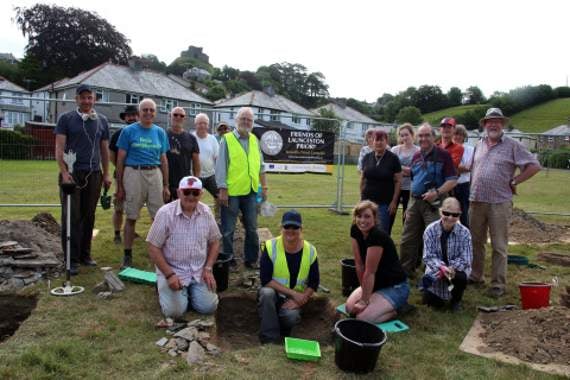
WHO says history is boring? Certainly not the 200 or more people who went to Priory Park, Launceston, over the three days of the archaeology dig arranged by the Friends of Launceston Priory.
By kind permission of the town council, the Friends had arranged three days of excavation to help determine if the Priory buildings had once extended under the land close to the main Priory site near St Thomas Church. The dig, under the supervision of expert archaeologists, attracted a wide range of people from the local community, some visitors to the town and lots of children.
Everyone had a chance to help with a series of trial pits which were sited at the lower end of the park. A geophysical survey had suggested there might be the remains of buried buildings and which could have been part of the Priory — once one of the most important places in Cornwall.
Over the three sunny filled days, unexpected finds included a metal stud, origin as yet unknown, a white metal sweetheart ring from the Second World War era and some, so far, unidentified dressed stones which may have come from the Priory. As expected, there was pottery and glass from times past and much evidence to show that over the years the area had been used as a dumping ground.



The Friends are planning to have an open day soon when everyone in the community will be invited to come along to help carefully clean the finds so that they can be dated.
Every day there was an air of excitement at the dig and the children especially enjoyed sifting through the soil and rubble in the trial holes and watching the careful work by the archaeology team assisted by other volunteers using metal detecting equipment.
By the end of the dig no substantial buildings had been discovered. It was concluded that the historical reports about the Priory site having had been used as a town dumping ground ever since its dissolution in 1539, were correct. Some of the area now covered by the park may have been orchards and gardens associated with the Priory and where its kennels and dovecote were also located.
It is known that the substantial remains of the Priory buildings are buried under the areas covered by the old railway sheds and beneath the site of the town gasometer. While it will not be possible to uncover these, the Friend of the Priory hope to build on the interest shown by this community dig and are already considering what other areas could be considered for future exploration.
The Friends of Launceston Priory would like to thank Launceston Town Council, R J Wervill Builders for the loan and delivering of wooden boards, and local resident Jackie for the cups of tea.
Comments
This article has no comments yet. Be the first to leave a comment.