
The talk, ‘Giant Steps — Effectiveness in Convservation’ (a deliberate misspelling), considered the numbers of sharks in British waters and the plight of elephants, lions and rhino in Africa. The audience was challenges to think beyond the ‘illusion’ that enough is being done to save threatened wildlife.
Welcomed and introduced by U3A committee member, Rosie Bowden, Richard spoke about his ‘seven days a week campaign’ to save endangered species. He explained that he does this primarily through writing books and giving most of the royalties to organisations involved in wildlife conservation.
Richard and his wife, Jacqui, for part of the year live in Cornwall and part of the year in Africa. Sharks have always fascinated him and in recent years, he had also turned his attention to Africa, where saving lions and elephants is a priority for him. Richard has written several bestselling books on wildlife conservation, as well as some with Cornish themes.
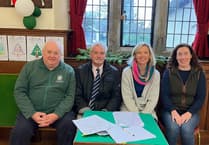


During the presentation, he urged his rapt audience to ‘close their eyes’ if they did not wish to see some of the more brutal and squeamish scenes in the short films he showed. They were told when it was safe to open them again!
The first film showed footage from an ITV broadcast about the large numbers of sharks in British waters — contrary to what most people believe and hence the lack of ‘no catch limits’ on blue sharks. Richard called the belief that there are not many sharks here a ‘dangerous illusion’, which results in the deaths of thousands of sharks every year. ‘If humans keep on taking, it can only end in extinction,’ he said.
His book, The Poachers Moon, deals with the plight of rhino and lions in Africa. Rhino horns are worth more than gold or platinum, although the poachers are paid a pittance for capturing them and cutting off their horns. As a result of the money others can make from the horns, the ancient rhino is now under threat.
His latest book, Cuddle Me, Kill Me, concerns the practice of lion farming in Africa. Richard estimated that about ten to 14,000 captive lions are bred each year, mostly to die before they reach the age of two and a half.
Lion cubs are taken away from their mothers, then bottle-fed and when older, taught, using a heavy stick, to walk with humans. Finally, they are used as easy targets for big game hunters. At each stage, the lion breeders make money in what Richard described as ‘this disgusting practice’.
The final part of the talk dealt with the ‘dire situation’ of African elephants. As a result of culling and poaching, elephant numbers are now much depleted. Even though culling has now stopped, Richard said that one elephant is killed for its tusks every 15 minutes. ‘Extinct is forever’, he told his shocked audience.
The film, Cry With Me, narrated by a young girl, Charlotte Peirce-Gregory, was shown to illustrate the ‘extraordinary’ intelligence and sensitivity of elephants and the brutal ill treatment handed out to them by humans. Richard reminded the audience: “We do not have dominion over animals, just guardianship. We need to help elephants live wild and free. In the last 40 years, we have lost 50% of the planet’s wildlife. Will our grandchildren only ever be able to see a picture of an elephant in a book?”
There is some good news since China has now put a complete ivory ban in place, but, concluded the speaker, ‘we must continue to spread the message that not enough is being done. Urgent, effective and ongoing conservation measures are desperately still needed’.
Rosie Bowden thanked Richard for his thought provoking presentation. She reminded U3A members that the next Friday coffee morning at the Weir Café is on July 7. The next open meeting is on July 20, and features a presentation by Karen White on ShelterBox, an international relief organisation based in Cornwall.
Comments
This article has no comments yet. Be the first to leave a comment.