
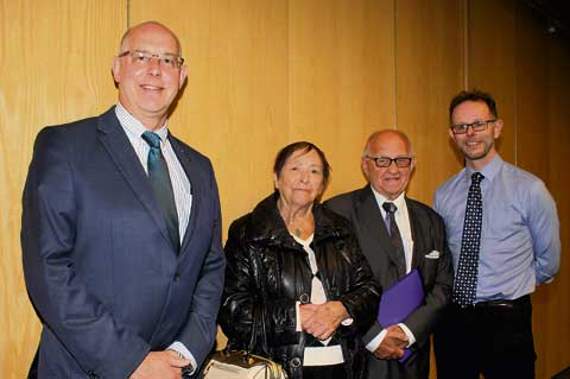
THE Holocaust is a horrific, almost surreal, historic event, something that most would never want to think about. But for 86-year-old survivor Zigi Shipper, the Holocaust was very real, and he decided some time ago to share his experiences with audiences across the country, including a talk at Holsworthy College.
Taking place on Wednesday, June 29, Zigi attended the school with his wife Jeanette, to inform audiences of his horrific experiences in Auschwitz, and how he lived to tell his tale today.
Kate Sampson and Jason Scott, history teachers at the school, organised the event, welcoming approximately 110 people into the hall for Zigi’s second talk at the school.
Kate said: “I’ve seen Zigi a few times. The first time I saw him was when he gave a talk whilst I was at university, at the University of Exeter. When I got the job here, I mentioned it a couple of times and Zigi’s been coming here ever since.

-and-Harry-(left).png?width=209&height=140&crop=209:145,smart&quality=75)


“The kids often find the Holocaust is something they can’t comprehend, but Zigi is fantastic — he’s funny and tells the story in a way that is accessible to them. It’s great to see returning students and members of staff here tonight.”
With a full hall of people sat and ready to listen, Zigi took to the stage, stating it was a pleasure to be able to talk to schools and universities about his experience, and that not enough is taught about the Second World War and the horrors people had to endure.
Zigi said: “People now need to know, especially the young people. Racists, bigots and hate – that is the reason I started talking about it. At first, we thought ‘who is going to believe us?’ Doctors were killing babies for no reason, women were being killed, families were broken apart.
“Young people are the most important people in the world; they are our future. There is little we can do about the past, but there is so much we can do about the future.”
Born in Poland, Zigi’s parents were divorced when he was very young, and his mother left. Early 1939 saw Zigi’s father run away to Russia, with the almost definite chance that there was going to be a war. After that, Zigi was brought up by his grandparents in their three-bedroom apartment in Poland, which was a great privilege prior to the Second World War.
The start of the Second World War saw the Germans invade Poland, meaning no Jewish child was allowed to go to school, Jewish teachers weren’t allowed to teach, Jews weren’t allowed to use certain transport, all solely to humiliate.
Zigi’s grandfather unfortunately passed away at this time, and following this, he and his grandmother lost their lovely home to be rehomed in a place with no working facilities. Jews were also told that they had to work, so at the age of ten, Zigi began working at a metal factory, where hunger was common.
He said: “The things we did because of hunger, I feel ashamed of even today.”
Later, workers in the metal factory were told they could be moved to Germany to work, and that they could bring their families with them, as Russia was vastly approaching Poland.
Zigi and his grandmother were allowed to bring one suitcase each, as they were told there would be more clothing and food at their next destination. They reported at the railway station, but there were no trains to be seen, only cattle trucks.
Zigi, his grandmother and other Jews that had been told the same lie were all thrown into the trucks, unable to even sit down due to the overcrowding. People gradually died of suffocation, thirst and hunger.
He said: “How can a 14-year-old hope that people should die so I could sit down? I had been completely dehumanised, I didn’t care about anything anymore – that is what they had made me.”
The cattle trucks arrived in Auschwitz, a camp designed for the imprisonment and death of approximately 1.1 million of Jews.
A vivid memory for Zigi was when the officers began dividing Jews apart — on the right, they sent the disabled and women with babies. They ordered the women with babies to put their baby down. Once met with objection, many babies were shot, and then they marched the people into the gas chamber, where they were dead within 20 minutes.
Zigi, in his group, was then sent to the showers, scrubbed with disinfectant and had his head shaved. He was given striped clothes, and a number, which he will never forget.
He said: “I had nobody and nothing. Now, I didn’t even have a name; I was a number. I wish I could get that number out of my mind. Even when I’m shopping and have to use my credit or debit card, I have to think of that number.”
With no way to escape, and with German doctors committing unthinkable crimes in hospitals, Zigi volunteered himself to be one of 20 people to leave and work in a labour camp in Germany.
Having fallen ill with typhus upon their leave for the labour camp, Zigi went for days without water or food, and had to walk for miles. British Prisoners of War explained that they should run away, and that they could find food and shelter until the end of the war, which was getting nearer.
In May, 1945, the British began bombing German ships, and the bloody and evil executions of the Jews came to its conclusion.
Zigi and his friends were given what seemed like endless amounts of food and luxuries, including chocolate bars, tobacco and even Nescafe powder. This is the worst thing that the British could have done, although they meant well. Their stomachs weren’t strong enough to take the amount of food they were eating, and people began overeating and dying.
After the war, Zigi recovered from typhus, a life-threatening disease, and had to learn to walk again.
Astonishingly, he received a letter from a woman in London, who had discovered his name in a hospital. She claimed that she had a son with the same name, and that he had once burnt his left wrist as a toddler. Zigi had a matching scar, and was encouraged by his friends to go to London to meet his mother, who he had thought was surely dead.
Zigi began to love England, and in 1954 was married to his wife Jeanette. Now, he says he is blessed with two daughters, six grandchildren and three great grandchildren.
He said: “I cannot tell you what a wonderful life I have had in this country, what a privileged life I have had.”
Among Zigi’s greatest achievements is meeting and giving talks to the Prime Minister, the England football team, Buckingham Palace and Westminster Abbey.
To finish his talk Zigi added: “Young people need to know. It is up to the young people of today, and I believe in the young people. I love the young people, and I will never stop for as long as I can, especially with what is going on today. We should never hate on someone’s race, whether they are white or black, muslim, or from any other background.
“As I said before, there is very little we can do about the past, but so much we can do about the future.”
Comments
This article has no comments yet. Be the first to leave a comment.