
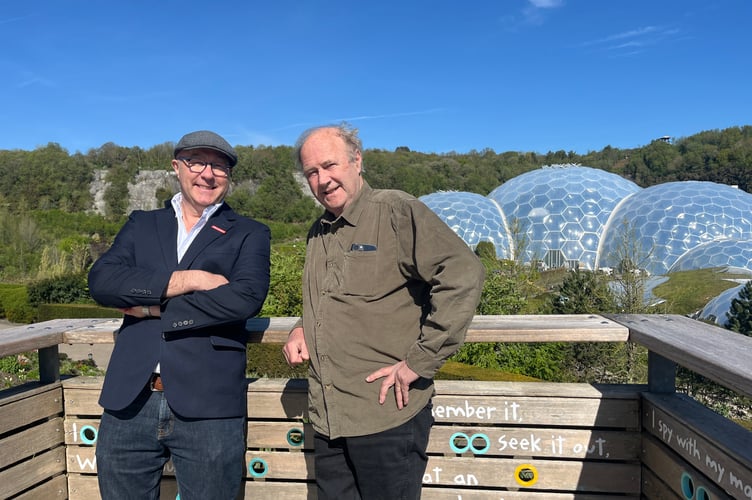
ON a sunny spring morning, I make my way to the Eden Project visitor centre to meet co-founder Sir Tim Smit and chief executive officer (CEO) Andy Jasper. My path converges with that of an excited Truro school group singing an endless refrain of: “We’re going to the Eden Project, doobie-doobie-doo!”
“We got them from central casting,” jokes Sir Tim. “It’s like this every day,” adds Andy, smiling so broadly I wonder if he arrives at work in exactly the same way.
Inside, the children sit cross-legged in front of the Plant Takeaway, an entrancing demonstration of how many things — food, equipment, oxygen — would disappear from our lives without our green friends. Having done a quarter-century’s heavy lifting, it recently enjoyed a much-needed refresh by Repair Shop experts Steve Fletcher and Dominic Chinea.
More than a million schoolchildren have passed through the Eden Project’s doors over the past 25 years for environmental education activities laced with a hefty dose of fun. It’s one of many impressive statistics revealed in an impact report published — and presented to Parliament by MP Noah Law — to celebrate the attraction’s big birthday.



Eden has welcomed 25-million visitors through the doors since it opened, with 80 per cent travelling from outside Cornwall. The total spend on these trips, at Eden and elsewhere, is estimated at £8.4-billion, 60 per cent of which would not have occurred without Eden.
“We’ve turned £210-million of investment into income that wouldn’t have been in Cornwall previously,” enthuses Andy. “Our supply chain policies have kept £632-million in Cornwall, and we’ve created 430 jobs, with many employees staying with us for over 20 years.”
In terms of carbon impact, the road to net zero has been accelerated by the heating of Eden’s offices and biomes using energy from the geothermal well drilled on site in 2021. “In the next four years, we should be producing enough to power half of St Austell as well,” adds Andy.
It’s been a whirlwind few weeks since the birthday cake was cut on March 17, to the sound of a “dawn chorus” (including adopted anthem Cornwall, My Home) performed by members of Cornish choirs. The following week, King Charles III and Queen Camilla visited Eden, and the Anthropy conference united CEOs, emerging leaders and even rock stars to discuss a brighter future for the UK: “The Edge from U2 was here,” says Sir Tim, sounding a little starry-eyed.
There’s more to come. In May, the Bring Me Sunshine garden will grace RHS Chelsea Flower Show ahead of its journey to Eden Project Morecambe, which in June will see spades in the ground on a former funfair site.
Today, Eden is on every Cornwall visitor’s checklist to visit alongside St Ives and Tintagel Castle, while a Local’s Pass is invaluable for a spring afternoon out or Christmas lights and ice skating in winter.
It’s a far cry from the almost-exhausted china clay pit that was transformed when Sir Tim joined forces with Bude architect Jonathan Ball to produce the vision we see before us. The plan: to create “the most incredible exhibition of plants useful to human beings”. It did that and so much more, in so many ways.
This summer will see the 24th year of the Eden Sessions, including the 150th concert and five sell-out shows, each pulling in a potential 6,000 per concert. The Big Lunch, devised to create safer, friendlier neighbourhoods over food, has grown from 700,000 participants in 2009 to 10.3-million last year. Meanwhile, Eden’s education arm stretches from Year R to university-backed degree courses and RHS certificates.
Tim remembers brickbats that first year from competitors who thought Eden was “an aberration, so trivial – but a year later, they saw our visitor numbers and were copying us, to my delight”.
The journey to 2026 was part design, part organic – with a sprinkling of fairy dust. “I’ve always been very heavily invested in fairy stories – I tend to think of them as a north star,” says Sir Tim. “Tinkerbell is a metaphor for the idea that if enough people believe in something, it can happen.”
“This idea makes people smile but it also really connects. Is there a 10-year-old anywhere in the country who doesn’t dream of building a castle in the mountains? I think our success to date has come from trusting the child inside us, and where we’ll go off the rails is when we listen to people with too many grown-up clothes on, who generally get it all wrong.”
Eden’s model has been replicated far and wide. In the UK, Eden Dock opened at London’s Canary Wharf in 2024, with floating gardens, boardwalks plus a safe wild swimming space open from sunrise to sunset, and Dundee is expected to open by 2030.
Further afield, Terra, the Sustainability Pavilion at the Expo 2020 Dubai, saw more than 24 million visitors over 182 days and is now a permanent attraction. Oriental Eden opened in Qingdao, China last year; and in Victoria, Australia, Eden Project Anglesea is currently in development on the site of a disused coal mine.
Meanwhile, 58 projects have taken place worldwide — in Costa Rica, South Korea, Japan and beyond. “These are all people who came here and liked what we were doing,” says Andy. “They were not used to environmental projects having that charisma. That’s the magic of Eden — it makes the impossible seem possible.”
Hailing from West Penwith, Andy is the bona fide Cornishman working alongside native Dutchman Sir Tim. He joined Eden at its inception as head of research and evaluation, then travelled the world working at the National Tropical Botanical Gardens in Hawaii before returning to the UK to work with the Royal Horticultural Society (RHS) and National Trust, finally taking the Eden CEO role in 2024.
“I couldn’t wait to get out of Cornwall — it was a depressing time after the tin mines closed,” he recalls. “But then I couldn’t wait to come back — the draw of Cornwall is very powerful. And when this job came up, I couldn’t bear the thought of anyone else having it.”
Ask Sir Tim what he’s proudest of, and he answers: “That when people think of Cornwall, and even the UK, Eden is seen as being built by people who believe in a future. When I moved here in 1987, Cornwall was a place people came to retire; now it’s a place where people come to start a career.” He pauses, and adds with a hard stare worthy of Paddington Bear: “I’m also proud of the righteous anger of science in the face of roaring ignorance of politics.”
He believes the future is in the hands of the young, and citizen science. “It’s a powerful thing. If I was a big company doing something not in the national interest these days, I’d be worried about my share price.”
We finish with the obligatory photo in the spot favoured by many visitors, overlooking the biomes and beautiful blue skies. A couple of ladies from Morecambe ask for a selfie with Sir Tim. It turns out The Edge isn’t the only rock star at the Eden Project.
Comments
This article has no comments yet. Be the first to leave a comment.