
PROMINENT politicians in the world of farming were probed for their thoughts on the referendum of the UK’s membership of the European Union at the weekend — voting takes place today (Thursday).
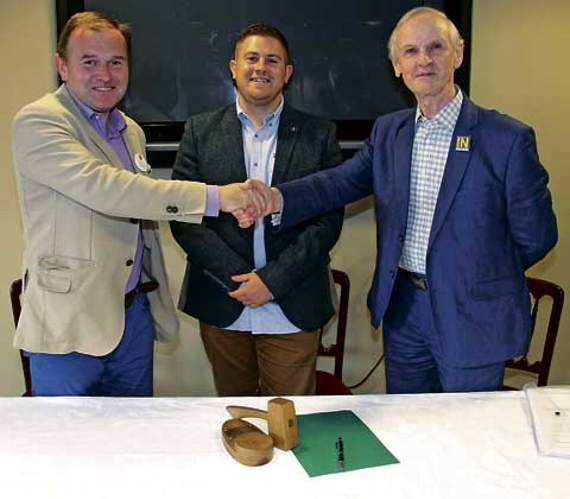
Organised by Launceston Young Farmers’ Club, the debate at the town’s rugby club on Saturday, June 18, allowed those gathered to listen to and ask questions of the speakers, Conservative MP and farming minister George Eustice, who supports the Vote Leave campaign, and former North Cornwall Liberal Democrat MP Paul Tyler, who wants Britain to remain in the EU.
The debate was chaired by Launceston YFC chairman Oliver Stephens, who started the meeting by asking everyone to stand for a minute’s silence to remember West Yorkshire Labour MP Jo Cox, who died two days prior to the debate.
Mr Stephens, opening the debate, said: “We are not sure where to go with the information we have been given. The aim is to go away better informed.”


Introducing Mr Eustice and Mr Tyler, Mr Stephens described them as ‘two people well known around our area, and who know everything there is to know about rural affairs’.
Each speaker was given an initial 45 seconds to speak. Mr Eustice went first. He said he was in farming for 10 years, adding: “One of the reasons I got involved in politics is because I was sick to death of all the regulation and paperwork.
“In two-and-a-half years as farming minister I have seen things that have shocked and surprised me with the way the country is run.
“I can’t continue to support membership [of the EU] knowing what I know, seeing what I’ve seen.”
Mr Tyler in his opening statement said people were ‘confused’ about the referendum, and added of the debate: “I hope we are going to avoid exaggerations that have been made on both sides. It’s nice we can avoid politicians’ discussion and have a serious discussion about the real issues.”
As well as farming, Mr Stephens pointed out another topic close to the politicians’ hearts is Cornwall. He said: “Cornwall has received over £1-billion in funding from the EU over the past 15 years. What does a future without the EU look like for Cornwall?”
Mr Tyler said: “A big change has taken place in Cornwall. There are more opportunities for young people because of so many businesses benefiting from some investment.”
Mr Tyler questioned how many businesses in Cornwall would survive the process of leaving the EU, if that process were to take five to 10 years.
Mr Eustice said ‘there is no such thing as European money per se’: “There is money we contribute to EU. We put in around £18-billion to £19-billion. We then get half of it back. The half we get back comes back with strings attached.”
Mr Eustice said ‘there is no reason whatsoever for the EU to be involved in regional policy’, adding: “When you take back control, responsibility comes back too.”
Mr Eustice said, in his view, if the UK left the EU: “We would replace our membership with a UK EU partnership based on cooperation and friendship.”
Quizzed on what it would mean for the Cornish language and minority status of Cornwall if the UK left the EU, Mr Eustice said: “These are conventions under something called the Council of Europe. It is something we would remain members of — it’s nothing to do with the EU at all.”
Mr Tyler said governments were ‘very urban minded’, but that the EU takes agriculture ‘very seriously‘, adding: “It is absurd to suggest if there’s any saving [if the UK leaves the EU] it would come into rural areas.
“This country hasn’t got a good reputation for looking after the countryside and people in the countryside.”
Another hot topic for the speakers was the European single market. Mr Tyler likened Britain possibly leaving the EU to ‘going through an acrimonious divorce’, and said: “If you have just kicked your partner in the teeth it’s not very easy to persuade him or her you should have your full marital rights again. He [Mr Eustice] thinks we can still negotiate our way back into the single market.
“I think it’s important for us to remain in the single market and the EU. There will be a much bigger risk if we take the shock tactics of getting out this week. Why would we want to opt out of the biggest single domestic market?”
Mr Eustice said: “We don’t want to be members of the single market. We want to be a self-governing country again but with a free trade agreement.
“We are in a very strong position to put in place a free trade agreement,” but one member of the public argued: “The EU has got far the stronger negotiating position. We are a small player.”
Another member of the public said to Mr Eustice ‘you’ve got the whole budget of the country to think about’, and asked Mr Eustice if the UK left the EU, whether ‘everything would be rosy’. Mr Eustice replied: “Yes. It will be great. In five years’ time the only question we will ask ourselves is ‘why did we put up with this nonsense?’
“[Prime Minister David Cameron] He thinks this is too big a decision to make. I don’t agree with that. The EU is an idea fit for the 70s but it’s an idea that’s run its course.
“This is a decision for the country. If the decision is to remain I will be gutted but I will reconcile to that decision and help the Prime Minister put the party back together. I just know in my heart it will be a desperately sad missed opportunity for this country.”
Mr Tyler quoted the writings of former mayor of London Boris Johnson, who wrote two years ago: “Together with Nato the European Community, now Union, has helped to deliver a period of peace and prosperity for its people.”
The topic of immigration was also raised. Richard Jenkin, of Werrington, asked: “I think people are concerned, rightly or wrongly, about the number of people wanting to come in and live in this country. How will that change if we come out of the EU?”
Mr Eustice, referring to conventions in place, said: “People already here and working here would be able to stay — sort of an earned right. We are not going to round people up and send them back.
“What you would have going forward is a slightly different system.” He added there could be an ‘Australian-style points system’ for people wanting to come to the UK for the long-term, and temporary work permits for others.
Mr Tyler said: “We still have very careful control of who’s coming into this country.”
The referendum question will be: Should the United Kingdom remain a member of the European Union or leave the European Union?
Polling stations will be open from 7am to 10pm today (Thursday).
Comments
This article has no comments yet. Be the first to leave a comment.