


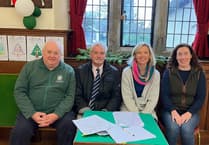
In front of an audience ready with their questions the chairman Roger Creagh-Osborne of Launceston introduced two of the candidates Danny Chambers (Liberal Democrat) and Joy Bassett (Labour).
Each candidate was given two minutes to introduce themselves. Mrs Bassett said she was a Bodmin Town Councillor and became involved in politics to make sure people were listened to. She joined the Labour Party in 2015 and had stood as a candidate in 2017. Mr Chambers said he was a vet. For him tackling poverty was very important but there was no bigger issue than climate change and there was a need for more scientists in politics. Then it was question time.
Steve Haynes asked how radical each would be to tackle the climate emergency and how they would vote on the expansion of Heathrow and the development of Newquay Airport as a spaceport.

Mr Chambers said he hadn’t flown for three years. Frequent fliers should be taxed to discourage them. He would support the spaceport as satellites were being sent to Italy to be launched so better to launch from Newquay and it would encourage high-tech jobs.
Mrs Bassett was also against a Heathrow expansion and the instinct was to vote against the spaceport since Cornwall Council had declared a climate emergency.
Philippa Purchase asked whether they would endorse the UK changing from a different model of growth from capitalism which ‘increased our inability to combat climate change’.
Mrs Bassett wanted to see less inequality through more local growth with shorter supply chains and community wealth building. Mr Chambers agreed. Growth was not sustainable if it was at the expense of people’s well-being. Products needed to be manufactured against obsolescence.
He would require companies to sign up to the Paris Climate Accord. By using as yet uninvented technology scientists could achieve the incredible.
Dan Haylock asked if the candidates supported the idea of community energy and what could be done to make community energy schemes in North Cornwall feasible again. Mr Chambers said that 80% of renewable energy would come from renewables by 2030. The National Grid should be upgraded and homes must be insulated by 2025. Mrs Bassett said that Labour would spend big on renewable energy and take the National Grid into public ownership.
Anna Denney raised the question of carbon neutral homes with sustainable materials and maximal insulation. How, for example, could all houses be converted from oil and gas to electric?
Mrs Bassett said there needed to be a transitional period with solar panels installed and other forms of renewable energy. Mr Chambers said ‘we need to be completely carbon neutral by 2025 or earlier’.
Several people raised the question of local transport. Richard Wolfenden-Brown asked would the candidates, if elected, act with urgency to reverse Beeching and reconnect Bude and Holsworthy to the National Railway Network.
Ruth Henderson wanted to know what they would do to improve rural transport and the question of a Camelford bypass was raised.
Mr Chambers said he supported the aims of Connect Bude and quoted the statistic that money spent on one mile of HS2 would be enough to reconnect Bude. There was a need for a charging network for electric cars. A bypass for Camelford would be more carbon friendly than the pollution from the current road through the town. With the population increasing and an alternative needed to the Dawlish line Mrs Bassett said ‘yes’ to trains. She thought a railway line for Camelford would be better than a bypass. A radical revolution was needed with people changing their lifestyle to reduce the environmental impact.
Lorraine Corrigan-Turner asked what plans the candidates had to eradicate the devastation plastics are causing to the natural world. They both agreed on a ban on single use plastic and that shops must eradicate plastic wrapping. Mr Chambers gave the astonishing statistic that if nothing was done there would be more plastic than fish in the sea by 2050 and that every toothbrush ever made still existed somewhere.
Steph Jones-Giles asked what steps they would take to address the effects of meat and dairy farming on climate change. Mr Chambers said the system where food was cheaper from South America than from a nearby farm was broken. Consumers should buy food certified by the farm assurance scheme. Research into cows’ diet could reduce methane. Mrs Bassett agreed people should eat local.
Liz Kotulski asked if they supported the view that curbing population growth by limiting family size was a step all governments needed to consider and adopt.
Mrs Bassett said the problem was that people were living longer. Mr Chambers said foreign aid must not be cut but used to bring people out of poverty.
Mr Creagh-Osborne then asked each of them where they would be living in 2030. Mr Chambers said there were 50,000 deaths from rabies and that if dogs were vaccinated that figure would fall to zero. So he hoped to see an end to rabies by 2030. Mrs Bassett hoped the climate emergency would be under control by then.
Having no doubt found the questions and discussion informative and stimulating the audience of some 120 people departed.
Also standing in the North Cornwall Constituency — Scott Mann (Conservative) and Elmars Liepins (The Liberal Party).
Comments
This article has no comments yet. Be the first to leave a comment.