
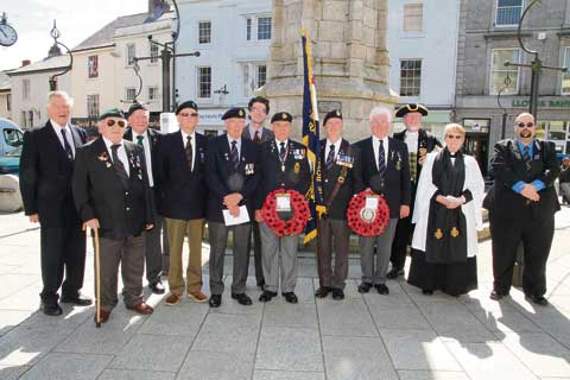
REMEMBERING those who perished in the Battle of Jutland, with many from the Post’s area giving their lives in the largest naval battle of the First World War.
May 31, 1916 served as one of the darkest days during the First World War for Launceston and its district, for on this day many of its men were taking part in the ‘Battle of Jutland’.
During the battle, the Royal Navy lost 14 ships; four of which were HMS Black Prince, HMS Indefatigable, HMS Queen Mary, and HMS Defence, and among the many casualties were six brave men from the area.
Aboard the ‘Black Prince’ was Alfred Leslie Quintrell. Alfred was born in 1893 to Alfred and Annie Quintrell at Kensington, London.



Both his parents were Cornish, with his father being employed as a wheelwright/coach builder.
The family returned to live at St Columb, with Alfred working as an electrician. It was this line of work that brought Alfred to Launceston, to work as the operator at the Launceston Picture Theatre in Northgate Street.
He joined the Royal Navy in early 1915 and served upon HMS Black Prince as a 2nd Class Wireman.
The ‘Black Prince’ was sunk with heavy loss of life. The circumstances under which she sank were mysterious for some years after. As the British had lost contact and did not see the ship destroyed, they were unsure as to whether a submarine or surface ship was responsible for sinking HMS Black Prince.
During the battle, the First Cruiser Squadron was deployed as part of a screening force several miles ahead of the main force of the Grand Fleet, but HMS Black Prince lost contact with the rest of the squadron as it came into contact with German forces, at about 5.42pm.
The HMS Indefatigable was hit several times in the first minutes of the ‘Run to the South’, the opening phase of the battle cruiser action.
Shells from the German battle cruiser Von der Tann caused an explosion ripping a hole in her hull, and a second explosion hurled large pieces of the ship 200-feet in the air. Only two of the crew of 1,019 survived. Three of the casualties were James Hill, Edwin Howe and Walter Lee.
James Hill was born in 1887, to William John and Eliza Jane Hill at Tiverton. The family moved to Launceston residing at 1 Tower Street. On leaving school James worked as a baker for Thomas Bailey at Tower Street, Launceston, before joining the Royal Navy. He was a cooks mate 2nd Class.
Edwin Howe was born in 1892, to Henry and Annie Howe at Royal Marine District Depot, Deal, Kent.
The family first moved to Germansweek and then into Launceston by 1911, residing at The Passmore Edwards Institute, St Thomas Hill where Henry was the assistant librarian and caretaker whilst also being a Naval Pensioner — he had been a Drum Major with the Royal Marines.
Edwin worked as a plumber. He joined the Navy and became a Plumbers Mate.
Walter Lee was born on December 13, 1894, at Abbotsham, Bideford to Samuel and Emily (nee Glover) Lee.
Walter’s father was an agricultural labourer and moved his family around to where he could find the work. By 1911 the family were residing at Watergate, St Mellion and Walter was working as a labourer in a fruit garden. The family moved again around 1914, having been living at the Sportsmans Arms at Treburley, to Lower Larrick, Lezant.
Walter joined the Royal Navy as a Stoker 1st Class on November 13, 1912, for a 12-year service period. After his initial training he joined the crew of HMS Indefatigable on June 17, 1913.
On board HMS Queen Mary was John Stanley Orchard. John was born on December 11, 1886, at The Week Inn, Week St Mary, to Thomas and Mary Orchard.
John’s mother died in 1900 whilst in childbirth. His father, having remarried to Jane Walkey in 1904, moved the family to run the Launceston Arms Hotel, Exeter Street.
John was a Wireman 2nd Class and was killed in action on May 31, 1916, when his ship the battle cruiser HMS Queen Mary was hit twice by the German battle cruiser Derfflinger during the early part of the battle and her magazines exploded shortly afterwards, sinking the ship. Her wreck was discovered in 1991.
Finally, Claude Tucker who was born on September 17, 1893, to George and Edith Tucker at St Austell.
His father, a Lezant man, worked for Pearl Assurance, his brother Leslie also perished in the war.
Serving as Leading Telegraphist aboard HMS Defense, Claude perished when the ship was sunk when two salvoes from German Ships detonated her rear magazine. The fire from the explosion spread to the ship’s secondary magazines, which exploded in turn — there were no survivors.
Comments
This article has no comments yet. Be the first to leave a comment.