
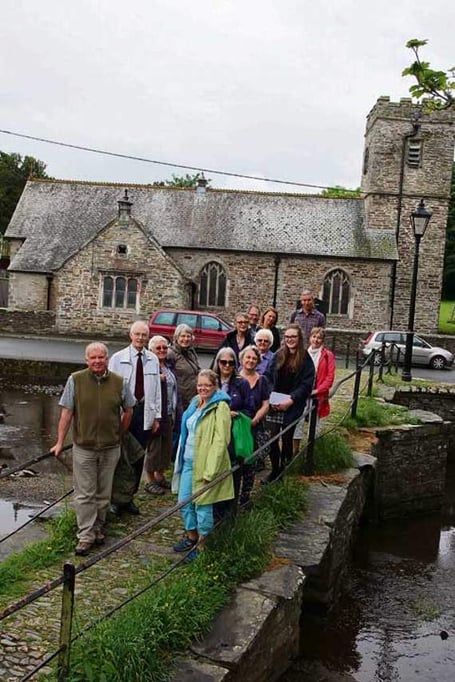
POET, Charles Causley, was given a commemoration to remember last Friday, as people were given the chance to take a glimpse into the inspiration behind Causley’s renowned poetry — all within the walls of his beloved Launceston, writes Rosie Cripps.
On Friday, June 2, as part of the annual Charles Causley Festival celebrations, local historian, Arthur Wills — also a dear friend of Causley’s since a young age — hosted his Causley walk, starting at St Thomas Church, where the poet’s story begins.
Born in August 1917 to Charles and Laura Causley, the centenary year of the renowned poet’s birth marks a special occasion in the calendar. Arthur introduced his story in a personal way, and said: “Charles was my friend, and I spent many hours with him — we had a wonderful time.
“I got to know Charles the man, not Charles the poet.”


The walk began at Trekensey House, St Thomas — also known as the ‘White House’ — where Charles was born nearly 100 years ago, and where, in Arthur’s words, he ‘took his first steps’.
By kind permission of the current owners of the property, Arthur led his walk over the wooden bridge across a stream, which is linked to Harper’s Lake across the valley, and to the back of the property, where there is now a modern patio area.
Here, Charles would have played, his mother would have gone about her business, and the stench of the gas works, tannery and abattoir across the way would have dominated the air. Arthur even said that in Charles’ day, a baby or toddler’s cough could be cured by lifting them above the wall to breathe in the fumes of the gas works.
He said: “This was the sort of life Charles grew up in, and all of this was a common sight. This was the life Charles was brought into.”
Charles’ father served during the First World War (1914 to 1918), but due to experiencing a gas attack in the conflict, developed a lung condition and died soon after the war ended, leaving a lasting impression on his son, and leaving his wife, Laura, to become both mother and father to young Charles.
The pair lived at Trekensey House in Charles’ early days. Then, the outdoor courtyard area would have been flat — not raised with a modern patio area as it is today. His poem, A Baptism, tells the story of when Charles took his very first steps in sight of his mother and aunty, after falling in a sink of water and having to pull himself up. His mother told him, “You’re a walking little man now!”
Arthur told the group: “People can read his life all the way through — it’s all there in the poems.”
He said that Charles’ mother, Laura, was a ‘super, light soul’, who was strong with dealing with her husband’s death. Arthur told the story of when Charles was sat listening to some music, with the sound of wailing women in the background.
When Laura came in with a coffee for him, she asked him what on earth the noise was, and when her son explained that they were women who had lost their husbands in the war, she said: “They should do what I done — get up and go to work.”
With that, she dropped the coffee on the table beside him and left the room.
Arthur said: “1917 was a different age altogether. The river would flood during the wet seasons, and Charles’ house would often become flooded. Of course, Charles and his mother eventually moved away from here. But what made the move essential was when his mother was sat doing some knitting one day, and she looked up and there was a big, dirty rat sat looking at her on the beam somewhere over there. After that, she had to move them away.
“But this is where Charles started his life — a very interesting life. It is very rewarding for me to know him. He shared a lot of things with me, and I shared a lot of things with him. We had a lot of memories — wonderful memories.
“He was such a wonderful poet; he could see people’s nature. He saw the sadness, and he saw the happy things too.”
The group then moved on to the round house at the bottom of St Thomas Road. Built by the Duke of Northumberland in the early 1800s to preserve the stone stump of the market cross, Arthur explained that Launceston once had four MPs, who were elected from here.
He said: “But for us (local children), it was our place where we used to play. We spent many hours here, and had a lot of fun.”
Now surrounded by busy traffic leading to and from St Stephens Hill, Dutson Road and St Thomas Road, the round house sits empty — from a different era altogether.
Leading from here, the group walked across St Thomas’ packhorse bridge, past the church and up Riverside at St Thomas, where they came across the old flourmill, which is now residential apartments.
Arthur told the group that once the building was a ‘big, open place’ — he would be able to see the belts going round, making the flour, and it would smell ‘lovely’.
He said: “It’s sad looking at it now; it’s all disappeared. I remember seeing the workers with their aprons on, making the flour — memories; wonderful memories.”
After stopping at the bridge, which runs across the old Launceston railway line, the group moved on to Tredydan Road — Charles’ second home, living just three doors down from a young Arthur and his family, who resided at number 18.
Arthur said: “One of my first memories of Charles — I would have been about eight or nine — was music; I would always hear piano music playing.
“There was a white wall across the front of Charles’ house, and I would stand up and listen — but I would get told off by my mother; she would tell me it was very rude to stand and listen outside Mrs Causley’s house. I would say, ‘But I’m listening to Charles play the piano,’ and she would say, ‘It doesn’t matter; you’re not to listen’.”
Whilst the group stopped here, Arthur pointed over to the old blacksmiths, owned by Mr Bate, at number 1 Tredydan Road. Here, farm machinery would also be made, and Mr Bate owned a patch of land at Priory Mere, just across from there.
The group moved over to Priory Mere, by the kind permission of the current owners, where Arthur led everyone to the pond with two islands situated in the middle. Carp fish were kept here, and it is also where Charles, Arthur and other children and young people in the area would play and spend time.
Arthur told the group: “Back then, the winters were very severe — the water would be all frozen, and we’d end up with an ice rink! The history of this place goes back a long way, but the fun we had at this place was wonderful.”
He explained that the water in the pond was from Harper’s Lake, which would come from the moors, and a natural stream would flow through the valley. Lilac trees also once stood on one of the islands, with a strong smell from the trees surrounding both Charles and Arthur as they spent time on the islands, and the children would look for birds nests to watch the chicks hatch from the eggs.
Arthur said: “When Mr Bate came round, you’d scarper! I think he did that to stamp his authority, but we’d still come back — we had some wonderful times. It’s all gone now.”
The building along St Thomas Road, home to the former National School, was the next stop for the group. This is where Charles was both a pupil and teacher during his time in Launceston.
After his time in the Navy during the Second World War, Charles returned to Launceston and embarked on a teacher-training course, studying for a Cert. Ed. in teaching at primary and secondary level, specialising in History and English. He then went on to study further at Peterborough Teacher Training College in 1947.
Standing in the former boys’ playground, with the old girls’ playground now merged with it, Arthur explained that, during his time as a pupil at the National School, he enjoyed his classes and liked many of his teachers, including Miss Truscott, Miss Batten and Miss Trethoy. However, he didn’t like Mr Curnow. Mr Curnow wore ‘big spectacles’, and would be able to catch what a pupil was doing behind him, in the reflection of the blackboard.
The National School was responsible for the temporary education of many evacuees during the Second World War, who came on the train along with James Bond actor, Roger Moore — who passed away just a couple of weeks ago.
Making their way to the front of the National School building, the group was enticed with an original poem by Charles, dated March 30, 1963, which was written for his pupils as a thank you, when he spent some time away from the school when he was ill.
Arthur said: “This is the type of man Charles was — he was very much aware of children. It just shows he was a man who was very thoughtful.”
The next stop was at the top of Wooda Road, looking down the steep hill of St Thomas Hill, where Charles lived during a time. This is where he wrote the poem Forbidden Games, telling his thoughts of when his mother and aunt told him that his father was ‘with the angels now’, whilst playing a game of snakes and ladders.
Arthur said: “He is (was) very happy to share things with people. I think this poem would have helped someone who had lost a dad or mum — it was showing those people that he understands how they feel. At the time, he couldn’t have shared this with his mum, I suppose, because she is (was) grieving.”
Arthur also mentioned another poem, Eden Rock, depicting the image of his mother and father sat having a picnic by a river along the valley. The poem suggests that the river is the cross-over, telling him to cross to the other side.
Arthur said: “He had this ability — his poems — the more I read them, the more there is. It’s a wonderful privilege to have known him.”
The group then moved on to the ‘zig zag’ walk, which used to be the old slate quarry. Charles wrote a poem, based at the zig zag, called Richard Bartlett. Richard was Charles’ grandfather, who worked at the slate quarry. He was killed by a shaft of slate that hit his head and split his skull open, leaving his wife and young family behind, including a three-month-old baby. Arthur said that the death of his grandfather affected Charles greatly.
Walking down the steep zig zag walk, which was once one of the main means of getting to and from town from Newport, Arthur led the group to a wall, overlooking part of the old Southern Railway Station at Newport. This is where Charles joined the Navy in 1940 with a friend, Eric, who lived at the other side of the valley.
The poem, Song of a Dying Gunman, was written about Eric’s death, as Charles never returned with this close friend to Launceston. Arthur said that Charles had once told him, ‘Oh Arthur, I find it very hard to go to town to meet Eric’s mother’.
The final stop for the group was Charles’ grave, at St Thomas churchyard, where he was laid to rest shortly after his death in 2003. Here, Arthur spoke about Charles’ time in the Navy, when taking the call from HMS Hood to say it was going down.
Before taking donations for the festival, Arthur looked down at the headstone, and said: “Charles, you’ve given us so many memories. Thank you so much. I miss you.”
Comments
This article has no comments yet. Be the first to leave a comment.