
THE Government's decision to abandon proposals to prevent GPs from dispensing medicines if they are within a mile of a pharmacy has been welcomed by local MPs and protestors.
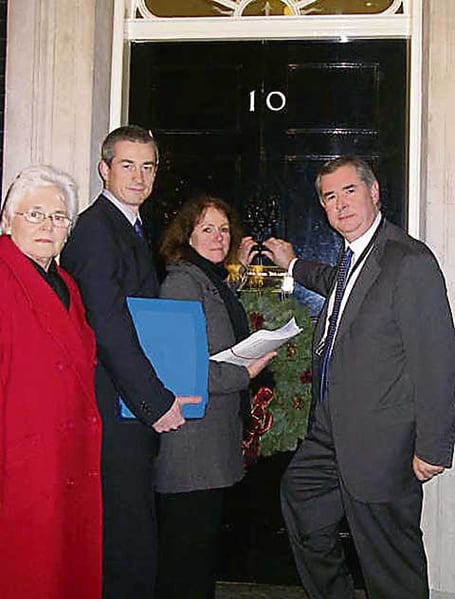
The U-turn came only a day after Geoffrey Cox, MP for Torridge and West Devon, led a group of Okehampton and Tavistock patients and dispensary staff to present petitions signed by thousands of concerned local people to 10 Downing St.
The MP, who received hundreds of letters from worried constituents faced with having to travel large distances to pick up their prescriptions, or losing the door to door service for the housebound run by the GPs' surgeries, has repeatedly spoken out in speeches and questions in the House of Commons on the damaging effect of the move on Torridge and West Devon's communities.
He also made his own submission to the Department for Health's consultation, warning of the "cruel blow" that the proposals would deal local people were they to be adopted.


The presentation of petitions from the Okehampton Medical Centre and the Abbey Surgery in Tavistock was the latest step in this campaign, and was intended to convey to the Prime Minister the complete rejection of the proposals by the people most affected by the changes.
Geoffrey Cox, who arranged for the group presenting the petitions to gain access to Downing Street with him, said: "I am delighted that the Government has finally seen sense, and has abandoned these ill-considered and disastrous plans.
"It is a great pity however that these proposals were even considered in the first place. The Government has provoked a great wave of fear and worry amongst elderly and vulnerable patients across the countryside for no reason.
"While doubtless well-intentioned, it would have drastically reduced patient choice and removed another vital service for rural people, for whom the GP's dispensary is often a lifeline. Elderly and less mobile patients are terrified about the prospect of losing yet another rural service after the recent Post Office closures and reductions in social care and other provision.
"This was a plan designed for the cities, with no regard for the interests of rural people, and I am very happy indeed that the Government has realised how damaging it would have been."
Sian Flynn, the Conservative prospective Parliamentary candidate for North Cornwall also "whole-heartedly welcomed" the news.
Sian, who ran a high-profile campaign against the controversial plans, said they would have had "disastrous consequences" for patients in rural communities had they gone ahead.
However, she reiterated her shock that the moves, which she insists would have "undermined this important service", were raised at all.
More than 10,000 local people signed a petition, and wrote letters, supporting the vital service provided by GPs across Cornwall.
Sian said: "I was contacted by people all over North Cornwall when it emerged that rural dispensing was under threat.
"A fantastic campaign has been mounted here, and literally thousands of patients have made their voices heard by writing to the Department of Health, signing petitions and supporting their local surgeries.
"For months, the Government refused to acknowledge calls from patients and GPs to allow doctors to retain the ability to be able to dispense medicines.
"Had they gone ahead, there could have been disastrous consequences for patients in rural communities."
Sian added: "I am delighted that the Government has finally listened to the concerns of people in rural areas — but it would have been so much better if it had avoided worrying so many patients in the first place.
"Dispensing surgeries are enormously valued — as the response to their possible loss proved — and it is extraordinary that the Government ever thought of undermining this important service, particularly in rural areas."
Eric Parkin, the Chair of Cornwall's Health and Adult Social Care Committee, was "delighted" the Government had decided not to change the rules under which GP surgeries dispense medicines to their patients.
Mr Parkin wrote to the Department of Health in November expressing the committee's concerns that changes could impact on service provision in rural areas.
He said: "We were very concerned that this would create real hardship in a rural area like Cornwall where many people do not have access to transport. Cornwall has one of the lowest population densities in the country, with people scattered in small towns and villages. Rural dispensing by doctors provides a vital service to these patients.
"I am delighted that the Government has recognised the importance of maintaining this safe, local, efficient and convenient service which enables patients to receive their NHS prescribed medicines without having to travel long distances.
"This is a wonderful Christmas present for rural GPs and their patients who will be extremely relieved by this news."
Comments
This article has no comments yet. Be the first to leave a comment.