
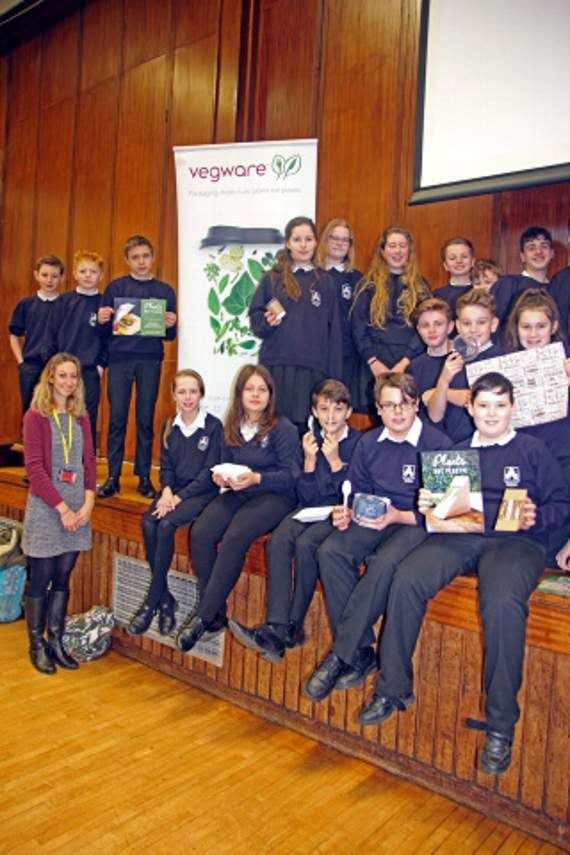
Launceston College is proud to be leading the way in the local area, with its commitment to eliminate single-use packaging, after they converted to using environmentally friendly, compostable products.
The college has been working with Edinburgh-based Vegware and Youings Wholesalers to achieve this.
The use of Vegware within the college’s catering department has eliminated single-use packaging completely, and items that were formerly made from single-use plastics are now fully compostable — being made from sugar cane and corn starch.
Products include wrap boxes, sandwich wedges, coffee cups, salad pots, pasta pots and even cutlery.




With help from their sponsors, the school has also adopted an efficient plastic recycling mechanism to help dispose of waste, such as bottles and cans. This support has meant the college now has purpose built recycling units positioned all over the site.
According to the college’s catering manager, Josie Jones, this initiative has been wholeheartedly supported by students and staff alike.
She said: “As part of a homework project we asked the children and parents if they’d support the Vegware scheme. The results were outstanding and they were all for it!”
The project had taken almost a year to put in to practice and January 15 saw the new initiative launch.
To kick start their eco-friendly campaign, Harriet Banks, a representative from Vegware, visited the college to talk to Year 7 and 8 pupils about the benefits of using the plant-based packaging.
Harriet told the assembly: “Compost is a wonderful nutrient rich fertislisier.Compostable means that once the item has broken down, in less than 12 weeks you will have compost.”
Using plant-based products will eliminate the need of sending waste to landfill sites, as they can be burnt without releasing many harmful chemicals into the atmosphere.
Harriet explained: “Plastics which are filled with oils are not good for the environment when they’re burnt and are catastrophic for our coastlines when sent to landfill.”
Although some Co2 is released from burning the plant-based products, the impact is significantly less.
Following the assembly, various representatives from the school met with Harriet to discuss further plans.
Harriet explained the process of turning waste into compost would only take 14 days, if the college had its own incinerator. This compost could then be used across the site to treat the grass areas.
The college is currently looking to invest in an on-site incinerator, which will enable them to be almost entirely self-sufficient, when it comes to recycling.
Harriet advised the school that an incinerator would cost around £35,000, due to their size and weekly waste amount.
Josie said she had been in talks with Chris Simms to organise some crowd funding for the project.
Despite the initial cost, Harriet was keen to point out the long term financial gain. She said: “Some places that have installed their own incinerator have paid the costs off within four years, from their reduced cost in waste disposal.”
Alex Bailey, from Youings Wholesalers, spoke after the meeting about his input on the project.
He said: “I have been working with Josie for some time now and we both sat down, I think it was this time last year to come up with a plan.
“We wanted to work on removing single-use plastics from the kitchen in the school. Josie introduced the plastic free idea to the children and they loved it. We thought everyone recycles at home so we could emulate that within the school.”
This is why Alex helped the college to get plenty of recycling bins, and then brought Harriet down to help educate the children.
Alex continued: “The real aim is to advertise and to influence the younger students, hence the assembly for Years 7 and 8. Children at this age absorb the information and want to do the right things.”
Alex, who is local to Launceston, explained the reason Youings committed to this ‘green scheme’.
He said: “As a local company we live and work in the area like everyone else and we want to have a good impact.
“We want to make the community a better place, which is great for the people and personally it’s fantastic to help the place I live.”
Following this project, Alex has had two schools in Devon approach him, to help adopt similar projects.
The catalyst for Launceston’s plastic free initiative came from Josie, whose fascination began after watching David Attenborough’s Blue Planet,
She said: “I was concerned we were committing to a potentially huge problem. In all honesty it is a real worry and I don’t think there’s enough being done about it.
“As a place of learning, it all stems from us. At the moment we are just at the start of getting the ball rolling.
“Special thanks must be given to Alex from Youings Wholesalers for his support in working together with me to bring this idea to life.
“Thanks also to Harriet from Vegware, for making a special trip to the college to talk to our Year 7 and 8 students about the importance of these initiatives within our community.”
Launceston College isn’t stopping there and according to both Alex and Josie, they have more plans to put into action within the next few months.
Comments
This article has no comments yet. Be the first to leave a comment.