
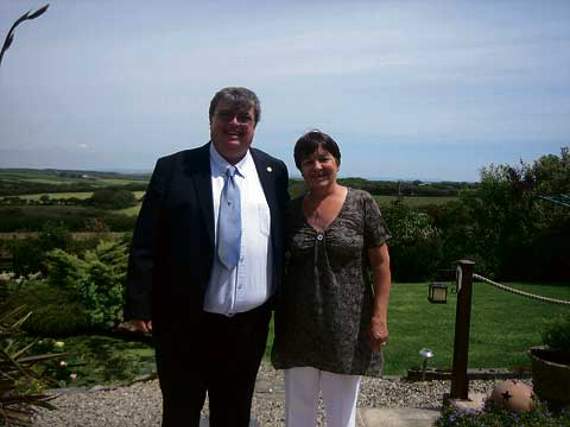
A PRESENTATION of the work of the Purple Angel Dementia Awareness Campaign brought Launceston’s mayor and fellow town councillors to tears last week.
The council had invited Jane Moore to its meeting on April 17, where she gave a moving talk about her role as a co-founder of the global movement.
She explained how she cared for her mother, Elsie, who was diagnosed with Alzheimer’s and vascular dementia.
She said: “I cared for her for five years, then reached burnout. She spent the following five years in a care home in Camelford. To say it destroys you is putting it mildly.”


.jpeg?width=209&height=140&crop=209:145,smart&quality=75)

She said both her friends and those of her mother ‘disappeared’, adding: “We felt captive by the disease.
“I wanted to learn what I was doing wrong — learn about dementia, learn about Alzheimer’s.”
On Facebook, she came across Norman McNamara, who lives in Torbay.
Norman was diagnosed with dementia at only 50 years of age. While out shopping one day, he was rudely spoken to by a shopkeeper and decided to change the way people see dementia and treat others.
Norman began by asking his local shop staff to read two pieces of information so that they could better support people with dementia and their carers.
He wrote the ‘Guide to Understanding Dementia’ and put that together with ‘What is Dementia’ written by the Alzheimer’s Society. Two weeks later he returned and, if staff had read the information, awarded a Purple Angel logo for their window.
This is where Jane joins the story. When she found Norman through Facebook, he was looking for someone to design the logo.
Jane said Norman ‘always called his wife an angel’ — which is where the inspiration for the Purple Angel logo came from.
The logo is becoming known as a global emblem, which can be used by anyone who is voluntarily raising awareness of dementia.
The Purple Angel was born on January 12 2012.
It was formed as a steering group to try and make Torbay the first Dementia Friendly resort in the country. Norman suggested Jane visit shops round Camelford, and it has grown from there.
She visited all her local shops, asking them to read Norman’s ‘Guide to Understanding Dementia’, selling plants in the centre of Camelford to raise funds for printing stickers and posters, aided by groups including Tintagel Garden Club and Neetside Community Centre. Recently, she has been supported by Launceston Rotary Club to produce the Living With Dementia magazine, and DC Property has printed some of the Guide to Understanding Dementia posters.
Now more than 700 shops and businesses in Jane’s local towns of Camelford, Launceston, Bude and St Austell have committed to support people with dementia, and Jane revisits them every year with updates.
Purple Angel upholds the principle that people with dementia have an absolute right to enjoy a good quality of life and continued involvement in their local community so far as they are able and willing to do so.
The purpose of the Purple Angel Dementia Campaign is to raise awareness, give hope to and empower people with dementia by giving out information on how shops, businesses and other services can support people who have these progressive diseases — both elderly and younger onset.
The Purple Angel friends and ambassadors are at work in many UK towns and overseas, creating dementia friendly communities, and all are invited to join in.
She explained dementia is an umbrella term for many types of diseases that are incurable at the moment, such as frontotemporal dementia, vascular dementia. If Alzheimer’s is diagnosed early, she said there are some treatments that can help.
She added: “Every three seconds someone is diagnosed with dementia. In the UK there are 850,000 people with dementia. We need to up the diagnoses.
“Who would not want to get diagnosed when their memory starts to fade? It’s so important.”
But she stressed ‘it’s not all about memory’, and said loss of life skills is a major part of the disease. Difficulties with movement, hearing, vision, stuttering and repetition can all be signs, and sufferers can even experience such things as hallucinations and night terrors.
She added people with dementia can have ‘difficulty processing information, so will fill the gap with whatever comes to mind — sometimes it’s appropriate, sometimes it’s not’.
Jane praised the work of local memory cafés, including those at Launceston and Camelford, who she works closely with, and said they have even proved inspirational to people wanting to set up similar groups Stateside.
She said a Professor McFadden visited the memory cafés from the USA, fact-finding ideas for memory cafés in America. Jane added: “I think Launceston can pat themselves on the back for leading the way out there.”
The Purple Angel campaign is approaching 1,000 ambassadors across the world in 58 countries, all voluntary.
There is also a ‘World Rocks Against Dementia’ worldwide event, that has just been held for the third year, with 85 events in 20 countries.
Jane finished her presentation by presenting a certificate to mayor, Cllr Margaret Young, recognising the town council as a dementia friendly organisation.
Cllr Young, in thanking Jane for her talk, said: “I think you are remarkable and what you are doing is absolutely amazing. I haven’t sat here feeling quite as emotional for a very long time. It’s a very frightening disease and could be any of us that get affected.”
Camelford’s Top Town Memory Café is held from 2pm to 4pm the second and fourth Wednesday of each month at the hall, Clease Road. For more information, contact Jane Sleeman on 01840 211337 or Jane Moore on 01840 212780.
Launceston Memory Café meets every other Saturday from 2pm to 4pm at the Methodist church, next meeting on April 28. For more information, call 01566 774425 or 07970 045310.
For more information on the Purple Angel Dementia Awareness Campaign, visit www.purpleangel-global.com/
Comments
This article has no comments yet. Be the first to leave a comment.