
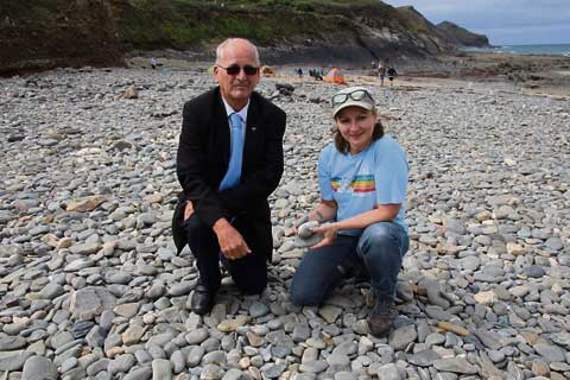
AN ONGOING debate about signage on a beach near Bude has sparked media attention — but is missing the main point, according to a local resident and councillor.
Concerns were raised via social media in regards to signage that appeared to come across as aggressive or threatening to visitors, in an attempt to prevent stone theft from Crackington Haven beach. Although the local parish council agrees that this is one of the most effective ways forward to stop the problem, which occurs regularly according to residents, other residents believe that the signs spoil the picturesque beach, and worry about the reputation of the community.
The signs have been put in place due to stone theft. The stones situated on the beach in Crackington Haven are there to act as a natural sea defence, preventing cliff erosion and protecting the environment there.
Jennifer Dixon, who partakes in regular beach cleans in the area, brought up the issue via Facebook. She was disappointed to see the red, yellow and ‘strongly-worded’ signs situated within a short distance of each other across the beach, feeling they gave the wrong impression from the close-knit community and were too aggressive.




Meanwhile Conservative Cornwall Councillor for the Tintagel ward, and parish clerk, Barry Jordan, has backed the signage, stating that it is one of the most effective ways in which to prevent stone theft and, ultimately, damage to the cliffs and beach.
However, further concerns have been raised after the debate hit national media last week, with Jennifer and Cllr Jordan both appearing on television news programmes, radio programmes and in national newspapers. Jennifer and Cllr Jordan both feel the story has been misrepresented, with many of the stories instead focusing on a visitor having collected a bag full of stones from Crackington Haven now fearing prosecution.
Jennifer wanted to clear this up, and told the Post: “Despite the media focusing on a holidaymaker returning their bags of stones for fear of prosecution, for me it’s always been about the signs’ implementation.
“I first encountered the new signs on one of our regular beach cleans and was struck by how large and aggressive they are. They’re about A2 in size, yellow and red text, and conclude with ‘thieves will be prosecuted’. While I completely agree that we need to preserve our area of natural beauty (AONB) and our special geology, I thought the number and tone of the signs was just too much.”
Jennifer made a post on the local Facebook page and other residents appeared to share her thoughts. “One in particular had overheard visitors commenting on the signs being aggressive and spoiling the beach,” she said. “This was my concern — Crackington Haven is a small village and beach community, which has a healthy tourism period in the summer. If we install numerous signs threatening our visitors of prosecution if they take a stone, how does that reflect on the community?”
Jennifer continued: “Something needs to be done about people taking large quantities of stones, of course, but the parish council solution with three signs on one slip and fixing a new one on the same concrete structure as an older sign saying the same on the opposite slip, seemed aggressive and uncomfortable. Thankfully, two have been removed, leaving just one new sign on each slip.
“The council is in a tough position — they are trying to prevent the loss of our beach, but they also risk coming across as unwelcoming. I think there’s a balance to be struck.”
Jennifer believes one way of preventing stone theft is simply educating others on the problem: “I have approached several people over the years, some filling rucksacks or prams with stones, and asked them to leave them behind. Education works, and I think can do a lot to change minds and hearts about our unique beach. As a regular beach cleaner, I am just as keen to protect and preserve our beach as our parish council.
“Saying that, beach-combing is a hobby for many, and I think we all probably have a few seashells, coral and bits of driftwood on our windowsills around here, but I think given the right information, most people will leave their handfuls of stones at the beach. Obviously, stones are a lovely reminder of a holiday, but when visiting a beautiful place, try to leave it just as you arrived, or perhaps do a quick beach clean to leave it better.”
Cllr Jordan believes it would have been better for Jennifer to approach the St Gennys parish council directly on the matter, but agrees that the majority of press on the issue has gone ‘overboard’. He said: “They have missed the most important issue and that is the protection of the community, safeguarding the Haven for future generations.
“The council is a responsible council and has a duty to protect the whole of St Gennys — they do it out of a sense of duty, they are volunteers and try to do the right thing. Unfortunately in this instance one person, who doesn’t live in Crackington Haven, although spends time here, decided she didn’t like the notices.
“The council put up the signs to try and deter thefts, and it is theft — anyone caught taking stones from the beach can be prosecuted by the police for theft and end up with a criminal record. I am sure the police have better things to do.”
Cllr Jordan explained that the signs contribute massively to the beach’s safety and heritage, continuing: “If I were to walk into someone’s garden and take something, I would be reported to the police. This is exactly the same principle — you might ask why? Fill two bottles with water, drop one onto a concrete floor and one on a nice, soft cushion. One would smash, the other would remain whole.
“The stones act as a cushion — they take the sting out of large, damaging waves. The south side of the beach is being eroded very quickly, and the post holding the ‘kissing gate’ is hanging over the beach. This has happened in the last three or four years and it will not be long before a bridge will have to be installed to keep the coastal footpath open.”
Cllr Jordan said that part of Crackington Haven is covered by a Site of Special Scientific Interest, with additional historic sites within a short distance. “The council have a duty to protect this are — we don’t want people in 30 or 40 years to say if that council had taken this seriously we would still have people visiting us, and that is the worst case scenario. To lose all the protection that the stones provide will leave the Haven open to total destruction and that is what the council is trying to avoid.”
- What are your thoughts on the signs at Crackington Haven? Email [email protected]
Comments
This article has no comments yet. Be the first to leave a comment.