
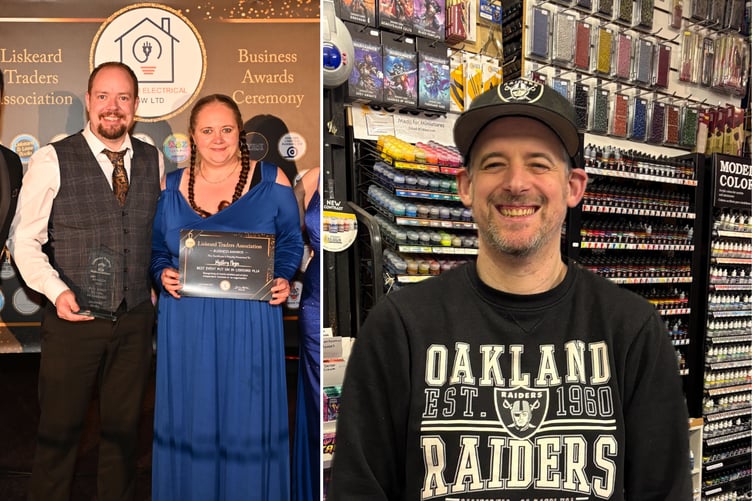
ACCORDING to figures, one in 20 adults in Cornwall and the Isles of Scilly "often or always" feel lonely — however an unlikely community is stepping in to combat this.
For many in Cornwall, rural isolation is the reality. According to the Cornwall Community Foundation, the population of Cornwall is 572,000, however, on average the population per square mile is only 416.
With a loneliness issue growing across the region, a rising cost of living, and local amenities such as pubs, cafes, and libraries closing their doors, residents are turning to a new place to socialise; local game stores.
Local Game Stores, or LGSs as they’re known within the community, are a growing trend across the county and country. A space in which patrons can play boardgames, or more commonly, trading card games such as Pokémon, Lorcana, and Magic the Gathering.



According to Dr Jessica Finlay of the Institute for Social Research, ‘third places’ or ‘third spaces’ “are, specifically, physical locations outside of the home (first place) or workplace (second place) that facilitate social interaction, community building, and social support.”
Traditionally these spaces were primarily made up of churches, pubs, and libraries among other locations. Simply, they serve as a space for communities to socialise, support each other and provide a sense of belonging.
However, if these spaces close or become inaccessible or unaffordable, Cornwall’s residents are left looking elsewhere to fulfil their need to socialise. In recent years, LGSs have become the spaces which fill this gap.
Del Ryan and his wife Lacey are among those who noticed a desire for these sorts of community spaces.
“We moved to Liskeard in 2015 and whilst bringing up our two daughters here we became very aware of the lack of things for them to do or opportunities to socialise,” said Del, who runs Mystery Ninja, an LGS based in Liskeard and Looe.
“We had an idea with the concept of one day creating a community hub where people could connect, socialise, play games and generally enjoy themselves. We wanted this to be either free or as affordable as possible, but we knew it had to be a self-sustaining business.
“Since then, using the store as a foundation we have created and funded countless events and game nights for our community including trading card game (TCG) and board games nights, anime movie nights, the annual Liskeard Anime and Gaming Mini-Con and brought global events to our small town like RPG Day and Pokémon Day.”
Del believes that spaces like this are becoming more popular, and he’s not the only one. Vini Gardner first opened his LGS, Mad for Miniatures, in St Austell’s Aylmer Square more than 20 years ago. After a year, he moved into his first official shop in the St Austell Market House.
Eventually, Mad for Miniatures and its community outgrew the space, resulting in them moving to a larger unit.
“The main reason I wanted to open my store was that I’d recently rekindled my hobby of Warhammer after moving to Cornwall and had met a few friends at college who shared the same interest,” explained Vini. “Around the same time, the local shop, Kit Bits, had just closed down, and the nearest place to play was in Truro. I felt there was a real need for a local space where people could meet, play, and enjoy the hobby together.
“We’ve always seen a lot of interest in LGSs, but traditionally the community was seen as more niche and geared towards geeky hobbies.
“More recently though, with shows like Stranger Things, social media influencers, and even movie stars being more open about their hobby interests, public interest has really exploded over the last few years.
“Trading card games like Pokémon, Magic the Gathering, One Piece, and more recently Lorcana have seen huge growth, and that’s generally had a really positive impact on local gaming communities as well.
“I think people are looking for that sense of community again; somewhere they can meet like-minded people, make friends, and enjoy a shared hobby in person. We’ve seen a real mix of ages coming into the shop too, from younger players discovering the hobby for the first time to older players returning after years away.”
For many, these spaces are not simply a way for them to enjoy their hobbies, they also serve as safe spaces to connect with others. Lyn Goold from Liskeard has been playing Magic the Gathering for nearly a decade and says that these spaces fill a gap left by the cost of living and often provide a nurturing environment to combat other exclusionary spaces.
“I visit my LGS weekly, either for some shopping of the latest released set or to sit and play with friends,” she said. “Magic the Gathering is really meaningful to me. To some it appears as a complicated card game but it allows me to use my creative skills in deck building, teaches strategy like you would use in chess and encourages communication.
“Being able to access designated spaces is so important - we just don’t have the space to host games at home! A kitchen table just isn’t quite big enough, especially for friends who live at home with their parents or can’t dedicate the space to play. It also allows a diverse group of people get together in a protected space as well as provide a platform for events.”
Lyn, who also runs a social media account dedicated to the card game, says that more and more of these locations are popping up across Cornwall.
“These spaces are absolutely growing in popularity. I have been running a series on social media visiting all of the LGSs in Cornwall and I keep having to add more to the list!”
However, these spaces are about more than just playing games.
“The community is so diverse,” she continued. “There are people who have been playing for years along with new players and people of all ages. There tends to be more men than women playing, and I think there are some longstanding negative stereotypes surrounding the hobby, but we are working hard to disprove them.
“LGSs provides space for people who have been stereotypically judged for having ‘nerdy’ hobbies. They are also usually more inclusive to other marginalised groups such as the neurodiverse and LGBTQ+ communities, it’s just a judgement free zone. Without them, a lot of people wouldn’t have a space to socialise in person within the community.”
With a growing need to combat loneliness and provide spaces which allow communities to thrive, LGSs are not only catering to what have previously been seen as niche or ‘nerdy’ hobbies, they are tackling this growing issue, especially for the neurodivergent population.
Dr Rebecca Magil, consultant clinical psychologist for general practice, at Launceston Medical Centre said that these spaces are key to battling isolation and anxiety.
“From a clinical psychology perspective, opportunities in our local community to form social groups around shared passions are so important,” she said. “Our neurodivergent population are more likely to enjoy connecting with others around shared interests or hobbies so I can see that these sorts of enterprises are really valuable for battling isolation and the anxiety that grows via avoidance of social settings, or depression that can grow from inactivity.”
Mrs Jess Careswell, social prescribing lead and Health Hub manager at Launceston Medical Centre added: “I think any space which brings people together to increase social interaction, connection, reduce loneliness and provides a sense of community is such an asset. As social prescribers we regularly connect people with social opportunities in line with their hobbies and interests, such as card and board games. We are fortunate to have such a wealth of groups and clubs in Launceston and the surrounding area and know the value and benefit to peoples overall wellbeing when they access these.”
These connections have been seen by the region’s LGS owners.
“We are incredibly lucky that our customers and visitors to game nights are so friendly and inviting towards one another and anyone new who arrives,” explained Del, owner of Mystery Ninja.
“Quite often we will have someone who has never played a particular game come in and before we’ve had a chance to interact, they have already been invited over by other players to start showing the ropes. We have also seen a number of people who previously would tell us they didn’t have any friends locally, now regularly up at game night and going to each other's house not just for a game, but to simply socialise. Even I have benefited from this as having from 250 miles, we barely knew anyone, now I’m meeting up most Saturday nights for a game.”
“I think community spaces like LGSs are really important because they give people a place to connect in person through shared interests,” added Vini.
“For a lot of people, they can be a great way to build confidence, make friends, and feel part of something welcoming and inclusive.
“Whether it’s trading card games, board games, or miniature hobbies, these spaces bring people together face-to-face and create real social interaction and friendships.
“For many people, it’s more than just gaming; it’s a genuine community.
“There have been many memorable moments over the years, but the ones that stand out most are usually the small, everyday moments rather than anything big or dramatic. Seeing friendships form across the tables, watching newer players get their first win, or helping someone discover a new hobby they really connect with has always been really rewarding.
“We’ve also had the privilege of supporting players on their journey to much higher levels of competition, including helping people prepare for and go on to win national-level events. Seeing someone start out locally and then achieve that kind of success is incredibly rewarding.
“One of the best parts is seeing people grow up through the store, customers who first came in as kids now coming back as adults, sometimes even bringing their own children in. That kind of long-term connection really shows what these spaces are about.”
These connections, alongside a growing interest in trading card games among other ‘geeky’ hobbies, is what it leading LGSs to step in to fill the gaps that are being left by more traditional ‘third places’.
“As someone who doesn’t drink it’s really nice to have a designated space to relax and hang out with friends,” Lyn continued. “I think more people are choosing to enjoy their ‘nerdy’ hobbies without fear of judgement. I don’t know if they are ‘replacing them’ but they absolutely provide an opportunity for those who may not have had somewhere they felt they belonged to.”
And Del agrees, saying there is a growing desire for people to find community, whether that be through sports, arts, or even card games.
“I think there is space and a need for all types of community focused places, whether it be a pub, church, sewing shop, or sports club. But there are many challenges to overcome,” he explained.
“Social anxiety for a person to turn up at one of these places can be a huge deterrent for some people, but quite often once they have walked through that door and find a warm a welcoming environment all those worries are left and they will quite often have a great experience.
“For places or people building these community places, sustainability is incredibly difficult due to rising costs and often in our case, giant online retailers taking a huge portion on the sales that would ordinarily help sustain places like ours.”
However, despite these pressures felt throughout the nation, Cornwall’s trading card and gaming spaces are thriving, bringing together communities which would otherwise feel isolated.
I, the journalist behind this story, have benefitted from the social spaces which LGSs are providing across Cornwall. I believe these spaces are providing a vital service by providing a safe outlet. So, if you are even slightly interested in meeting new people or trying a new hobby, visit your local game store and start playing.
Comments
We've recently changed our login process. If you have an account for commenting, you will need to re-register on the login window.
This article has no comments yet. Be the first to leave a comment.