
BUDE’S Steph Jones-Giles has applauded an announcement by the Dr Hadwen Trust, who have awarded a grant of £311,000 to support the University of Dundee’s pioneering work to teach doctors life-saving surgical interventions and to test new medical devices.
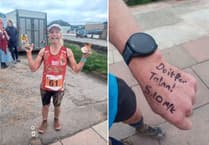
Steph is currently undertaking a sponsored slim, raising money for the Dr Hadwen Trust in memory of her father, who she lost last year to heart disease. Having already smashed her three stone goal, Steph is now working steadily towards losing five stone by December. She hopes to raise as much money as she can, specifically for heart disease research, through the charity.
The grant takes the Dr Hadwen Trust’s funding to almost half a million pounds, enabling staff from the University’s School of Medicine and Centre for Anatomy and Human Identification (CAHID) to develop a programme for training senior medics.
Heart, stoke, kidney and liver patients are among those who will benefit from the training clinicians and the devices that are tested using Thiel embalmed bodies.

This initiative will help replace animals used in the course of medical training and device testing procedures, and it is hoped the programme will be developed in future to allow junior staff to be trained using Thiel cadavers.
CAHID built the first morgue in the country to use the Thiel method of embalming, bringing significant boosts to medical research and training in the UK.
The Dr Hadwen Trust is the UK’s leading medical research charity that exclusively funds and promotes the development of techniques to replace the use of animals in research.
The charity’s science director, Dr Brett Cochrane, said: “It is imperative that any new procedure, drug or medical device is as safe as possible when applied to humans for the first time, and the key to replacing animals in biomedical research is evidence-based, human-focused science.
“Through the application and development of the Thiel embalmed cadaver model, Professor Houston and his team at the University of Dundee may well have one of those most elusive keys – human research and application that leads to direct clinical translatability to benefit people, not in ten years time, but with immediate effect.”
One of the interventions that the new project will help train doctors in is advanced abdominal aortic stent graft repair for aortic aneurysms, using a Thiel training technique developed by the university’s Professor Graeme Houston.
He said: “We are very excited by the potential of this new programme which is, first and foremost, made possible by the incredible generosity of those who bequeath their bodies to the university for medical research and training.
“This helps us move away from using animals to train doctors in advanced interventional techniques and allows us to carry out training in interventions where there is no animal model capable of replicating the human organ, such as aortic stent grafts, which are used to treat aneurysms.
“New medical devices are continually being developed and require rigorous testing before they can be used to treat patients. We are very grateful for the ongoing support of the Dr Hadwen Trust, which is important for the continuation of the programme of research and application.”
Comments
This article has no comments yet. Be the first to leave a comment.