
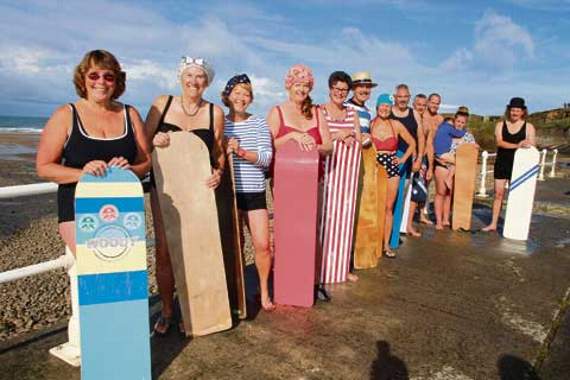
‘BUDE at War’, which drew vast numbers of visitors to the town last weekend, was a unique event that recreated the critical days of 1943 and 1944, when American troops came to Bude to train for the D-Day landings, writes Christine Williams.
Among those who attended on the weekend of September 16 and 17 were some, now in their 80s, who could remember those days — the dances at the Headland Pavilion, the PX (Naafi) at Killerton Road, donuts sold in newspaper and the day a bomb dropped on Hollabury Road.
Many of these memories were captured by students from Budehaven School in an art exhibition at the Crooklets Inn. They drew their inspiration from the recorded memories of local people.
When a Liberty boat sank offshore, people rushed to the beach to pick up items such as chocolate, peanut butter, tinned food and cigarettes, that is, until the customs men arrived.


At night from Lynstone Road, people could see the sky lit up by the blazing fires in Plymouth during the Blitz.
Above all, friendships developed between the Americans and Bude people, who welcomed them into their homes and were saddened when news reached them that many of them were killed in Normandy.
A focal point above the car park was the encampment of military vehicles, guns, jeeps, motorcycles and tents, where there were numerous displays of memorabilia, a record player playing 78 rpm records of songs from those days, while at the ENSA tent, accompanied by Andy on the piano, Samantha ended her medley of wartime songs with We’ll Meet Again.
Much in evidence were military men and women in smart uniforms and civilians dressed in the fashions of the war years.
Elsewhere, there were opportunities to learn Morse code and send a message, or attempt a cryptic crossword, which appeared in the Daily Telegraph on January 13, 1942, and played a crucial role in helping the allies win the Second World War.
Meanwhile, upstairs in the Surf Life Saving Club, an actual enigma machine from Bletchley Park was on display.
A warden’s post and an air raid shelter, its wall covered in wartime posters, vividly conveyed what it was like to experience the Blitz. Beach cafes and stalls offered a taste of wartime food, if not at wartime prices.
Saturday evening brought another chance to step back in time with a lively GI dance at the Parkhouse Centre to the music of Steve Tucker All Stars Jazz Band and the Liberty Sisters.
On Sunday morning, there was a moving commemorative service on Summerleaze Down where wreaths were laid at the Rangers’ memorial.
Later from the surf club balcony, Churchill look-alike, Geoffrey Burns-Sweeney, delivered Churchill’s ‘We shall fight them on the beaches’ speech, followed by a reading of Montgomery’s and Eisenhower’s calls to arms on the eve of D-Day.
As a prelude to the main action, Richard Bass, a military historian, author and battlefield guide specialising in Normandy, then gave a detailed account with great clarity of what happened on Omaha Beach on June 6, 1944.
Around noon, there must have been thousands of spectators with all eyes on Crooklets beach, where the pivotal event, a re-enactment by living history group, First Wave ’44, of a training assault in readiness for a landing on Omaha Beach and an ascent of the cliff at Pointe du Hoc by the American Second Ranger Battalion, was to take place.
First troops poured onto the beach from a flat bottom landing craft and then, to the deafening sound of gunfire and explosions, the engineers cleared the way for the infantry to attack and scale the cliff and take out a pill box.
After a pause for lunch, there was a demonstration of original reel and line surf life saving techniques from pre and post war Australia, followed by a concert of wartime music, inevitably including Glen Miller, by Bude Metric Brass.
The fantastic weekend came to an end with everyone joining in the singing of the Star Spangled Banner, God Save the Queen and a rousing rendition of Trelawney.
The ambitious idea of recreating ‘the day the Americans came’ and organising a re-enactment weekend was the brainchild of Clair Roberts, who has had a lifelong fascination for the 1940s.
The educational value of bringing the Second World War to life for those for whom it is past history, the reminder of the debt we owe to those who sacrificed their lives, the enjoyment the event brought to the crowds of visitors and locals who flocked to Crooklets, even the well-nigh perfect weather meant that the whole weekend was an enormous success, and surely exceeded Clair’s wildest dreams.
After she had publicly thanked the many people who had supported her in organising the event, she deservedly received three cheers from the crowd.
Comments
This article has no comments yet. Be the first to leave a comment.