
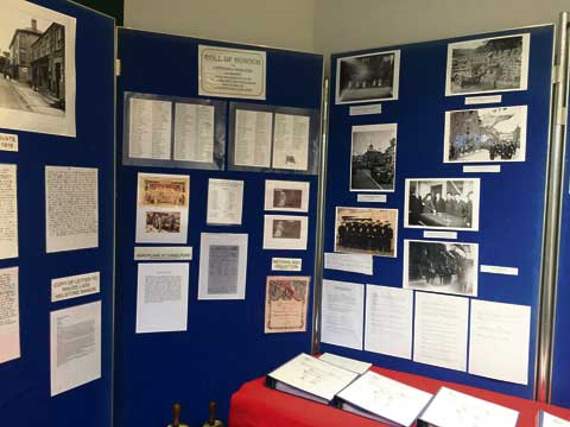
A REMEMBRANCE exhibition in Camelford is hoping to mark the bravery and sacrifice veterans and civilians have given during the First and Second World Wars.
The Camelford History and Archive Trust, a historical organisation based in Camelford and chaired by town councillor Philip Lessels, recently gained residency in the former Lloyds bank building in the town, transforming the derelict building into a tourist information centre and museum, along with an exhibition room.
The trust, since opening the museum on October 17, has held various exhibitions, using different artefacts donated to them by the old North Cornwall Museum curator Sally Holden and other members of the community.
To mark Remembrance Sunday the trust set up a new exhibition filled with artefacts from the First and Second World Wars, a haunting and moving way of remembering times past, as well as those who fought, died and were affected by the two wars that were set to change the world.

.jpeg?width=209&height=140&crop=209:145,smart&quality=75)
The Post attended the Camelford Remembrance exhibition on Wednesday, November 9, and was warmly welcomed by Cllr Lessels.
On display were a variety of photographs, entries in old log books from Camelford Primary School, letters, gas masks, warden helmets and even a shield from HMS Birch from 1942, which was given to Camelford by the admiralty for the funds raised during Camelford Warship Week.
Speaking of the exhibition, Cllr Lessels said: “Initially, we had got in touch with the Royal British Legion in 2014 to mark the 100th year commemoration of the First World War. However, we gained our own premises this year so we’re trying to do this as an annual event to remind younger generations of the part that Camelford played in the world wars.”
Since opening two weeks ago, there has been a lot of interest from local people, some who, of course, lived to experience the hardships of the Second World War and are still alive to tell their stories today.
Cllr Lessels added: “It really is moving listening to the memories people have from the Second World War.”
He showed the Post an old photograph of a table of people, perhaps during a street party in Camelford, at the celebration of VE-Day in 1945. He explained that a few of the people from the photograph had come along to the exhibition, had recognised the photograph and the setting and rejoiced over old memories.
Another photograph, showing the St John Ambulance brigade marching through the streets of Camelford in 1945, features a young nurse, Gladys Pearn, who was in the Camelford Nursing Cadet Division, another fond memory for those who explored the exhibition.
Cllr Lessels continued: “It’s very important that the younger generations realise the price that people paid for the democracy we have now. The world could have been a very different place.”
Cllr Lessels said that, during wartime, families would have to ‘make do and mend’, a well used saying during the Second World War.
“People’s grandparents today would be able to make do and mend; they wouldn’t just throw things away, and ration books were in every household during the war.
“Rationing came to an end in 1952, and I even remember rations. My brother, who is a year older than me, and I never used to have sweets, except for liquorice sticks — we still love them today!”
Cllr Lessels’ parents were married on September 2, 1939, a day before the Second World War broke out. Mr Lessels was too old to be called up for active service so spent the war years as an air raid warden.
Although a rural town, there was once an air raid warning in Camelford on September 25, 1940. However, the all clear was given at 1.30pm.
Another memorable incident was when a British aeroplane landed at Trenuth Farm, Camelford, during the First World War in 1916, after running out of fuel. The local school children found out about this, and left school without permission to go and explore.
The next day, petrol was delivered to the pilots and their plane, but the headmaster had just a handful of children in class. Therefore, he closed the school early to let the children watch the plane take off.
An article from a 1916 edition of the Post said: ‘On Friday morning, a large crowd witnessed the aeroplane’s departure. It rose gracefully, sped out of sight in the Launceston direction, returned and went toward Bodmin and without stopping ran along the field in which it had been located and made for the north coast.
‘The exhibition of flying was witnessed with great interest. During their sojourn in the town the aviators were entertained by Mr and Mrs W D French of Camelford House.’
Full of excitement, Cllr Lessels proclaimed: “With Louis Bleriot having only just crossed the channel in 1909, can you imagine the excitement? It would have been the first time that the children of Camelford had ever seen something like that.
“Seth Whittaker, the headteacher at the time, tried to enlist for the war, but was deemed medically unfit, but he would have known about aeroplanes. For the children, they would have only just got used to seeing trains, but an aeroplane — wow!”
During the Second World War, evacuees arrived from Plymouth, which was badly bombed due to being home to a naval port. With over 90 children, as well as their teachers, arriving in Camelford, pressure was put on local people to accommodate the arrivals, who relied on the good will of Camelfordians.
On November 11, marking 98 years since the armistice in 1918, and November 13, Remembrance Sunday, Camelford History and Archive Trust lay wreaths at the memorial in Camelford, as well as the memorial in Lanteglos.
The remembrance exhibition will continue throughout the month from 10am until 2pm, up until November 26, when the museum will close for the winter.
The exhibition is not only a holder of fascinating artefacts and photographs from times past, but is an excellent reminder of why people today should never forget those who have given their lives, left their families and lost loved ones due to war.
Comments
This article has no comments yet. Be the first to leave a comment.