
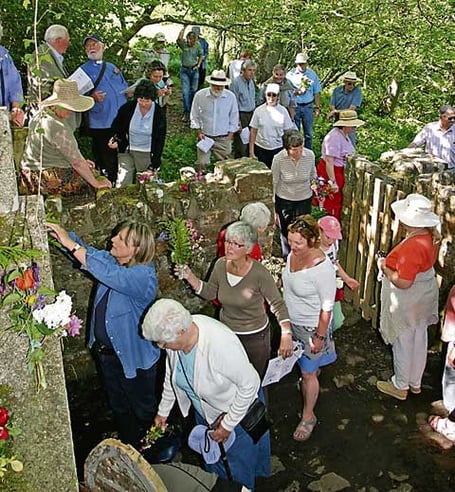
On Sunday, May 24 about forty locals and visitors walked out to St Neot's Holy Well for a short Celtic service and to decorate the well with flower posies, before returning back along the lane to the Gildhouse for tea to round off an enjoyable weekend.
Cornwall is fortunate in the number of ancient wells to be found, some functional, some with saintly connections. Poundstock has a hidden treasure from the second type with St Neot's Well.
In his book 'Secret Shrines', Paul Broadhurst describes the well as being "in cloistered seclusion." This is indeed how it is, for the well is on the edge of the wooded border of the little stream that runs down to Wanson Mouth, about a half mile from the church.
Access to it is down the lane that turns off just above the church. The lane itself is a joy with many wild flowers and magnificent views across towards Penhalt and the cliffs. Then it's across the field, often accompanied by sheep or cattle to the hidden path leading to the well.




This path is cobbled, giving a dray access. At its end, a small oak gate gives access to the little courtyard in which the well may be found. The well is a fine stone built structure with sloping stone roof over a well recess tipped by a granite arch. Each side of the well structure are recessed stone seats. Another seat is to be found outside the courtyard.
Behind a lattice work oak door, the little pool of cool, clear, water is fed through the back wall. On each side are little recesses, one of which holds a small cup to allow visitors to taste the water.
The granite arch has carvings on, written in a kind of Cornish Latin! 'Fenton Synt Neot Dreyhevys Dydh Luer Me Mis XVIII:MDCCCXIV' can be translated as (This) well of St Neot (raised) day ? May month 18th, 1914. (The writer of this is not sure of the translation of Luer).
On each side pillar is a carving, one of which is a fish. This is, of course, the symbol for Christ, the fisher of men. But here there is an added symbolism, although maybe not intended. St Neot was told by an angel that as long as he took only one fish at a time from his well, there would be another for the next time. However, his servant ignored the lesson in ecology. Luckily, St Neot was able to restore the balance by magic, so the story goes.
As can be seen from the date on the structure, that isn't old. There seems to be no record of an earlier structure. But, there surely must have been, or why would a Miss Astley of Millook pay for this fine structure in such a remote spot?
It was built by Samuel Ferrett in 1912. He lived at Swelle Farm, where his father farmed. Reg Ferrett could recall being taken with his mother to see the well before work started. Sam Ferrett took a wagon and two horses to St Breward to fetch the granite trough that used to stand to the well. He cannot recall where the granite used in the structure came from; was it re-used granite, or did it too come from St Breward?
Comments
This article has no comments yet. Be the first to leave a comment.