
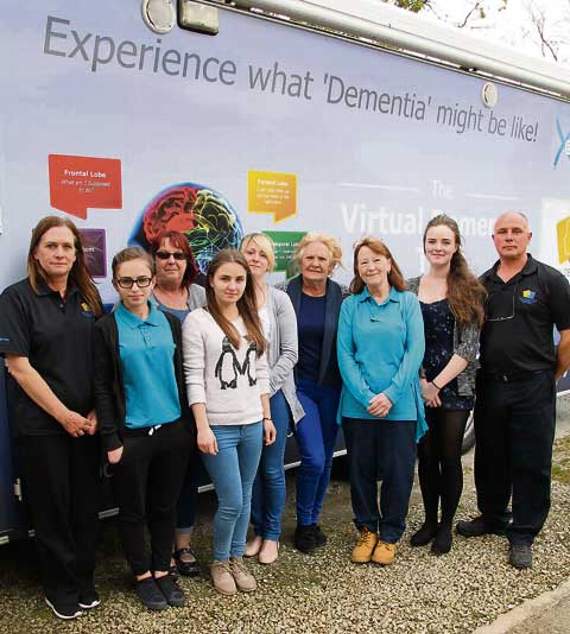
STAFF from Penbownder House, Trebursye, have recently taken part in a Virtual Dementia Tour, to enhance their knowledge and understanding about what patients with dementia have to experience on a day-to-day basis.
With recent studies suggesting that one in five people could develop the disease in the future, and that dementia is due to overtake cancer as a top disease within the next eight to ten years, Christine Oakes and Beverly Dobbin, managers at Penbownder House, were keen to give their staff a stronger understanding of the disease through a Virtual Dementia Tour.
The Virtual Dementia Tour was created by P K Bevell, an American dementia specialist, who couldn’t understand why people got so frustrated with people with dementia and wanted to improve people’s knowledge and understanding about the disease.
The tour took around 18 years to develop, and has now been to 17 countries, with over two million people taking part.



Christine told the Post: “Dementia is an epidemic problem now, because people are living longer. It is likely that it will take over cancer within the next few years, that’s how serious it is getting.
“The problem is that the government haven’t looked into the problem; they haven’t produced any specialised homes for dementia patients – they just haven’t helped the situation at all. Now they’re reducing fees for something that requires 24-hour care.”
Beverly added: “There just hasn’t been any provisions at all for dementia, and the government know it’s getting worse. Our staff have had lots of training and experience, and the Virtual Dementia Tour has been like the cement to get them to fully understand why they do the things they do.
“Now they have understood and experienced it for themselves, both our staff and clients will benefit from it.”
The staff at Penbownder House have been working vigorously hard to empower dementia patients to retain their skills and encourage them to do as much for themselves as possible.
Although Christine and Beverly believe that the growing problem is due to a lack of funding from the government, as well as a lack of physical training and experience in some care homes, it is hoped that the Virtual Dementia Tour will enhance Penbownder’s staff’s immaculate quality of care and dementia-friendly assets.
The Virtual Dementia Tour was expensive, but worthwhile, according to Beverley. Another important factor to the managers was networking and supporting other organisations.
Through their participation in the tour, it is hoped that other care homes in the area will be inspired to also get involved, making care homes in Cornwall more dementia-friendly.
Beverly said: “I thought this would benefit our clients and our staff. It is hard work, but if they didn’t enjoy it and didn’t care, then they wouldn’t be here. It’s all about getting to know your clients too.”
Each group of eight staff – along with Post reporter, Rosie Cripps, in one group – were taken to a van in pairs.
Sunglasses, gloves, spiky soles to place in the shoes and headphones were provided for each individual to wear. Following this, the headphones were switched on, revealing a chaotic concoction of voices, bangs, thuds, as well as sirens, and the individual was led into the dark room by the Virtual Dementia Tour trainers, Wendy and Tony.
The room was set up to be a realistic living area, with a bed, kitchen area, television, sofa with cushions, and clothing. Colourful lights beamed all over the room, and that, along with the chaos of the noises in the headphones, created an irrational, frightening environment.
Once being given tasks by Wendy and Tony, such as ‘find something useful to do’ and ‘match all of the socks on the bed’, individuals found that items were being snatched away from them, or hidden from them, having to start their activities all over again.
Along with the blurry vision from the sunglasses, and the constant tingling feeling in the feet, the members of staff found themselves getting frustrated and worried, beginning to grunt, sigh and say things aloud without realising.
Following the tour, Wendy and Tony gave a debriefing session, explaining to each member of staff what they did during the experience.
Staff explained that they felt ‘aprehensive’, ‘stressed’ and ‘nervous’ when entering the tour, and each person behaved in a different way.
Some snatched back items when they were being taken away from them, whilst others surrendered their items to the trainers; some started trying to read different signs around the room and searched vigorously for things to do, and others stood around, not quite sure what to do with themselves.
The tour’s purpose is to reflect what a patient with dementia has to deal with on a daily basis, from dealing with short-term memory loss and agnosia, to difficulties with understanding communication from carers.
The staff at Penbownder House drew positive experiences away from the event, and are confident that it has enabled them to understand fully what they are working towards – helping to understand and support people with dementia.
Comments
This article has no comments yet. Be the first to leave a comment.