

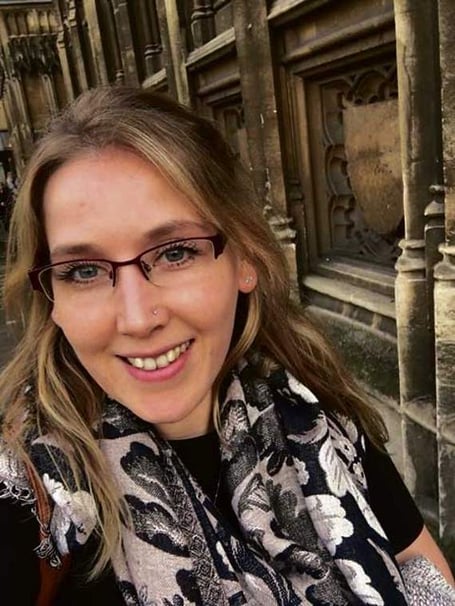
TRUSTEE of suicide bereavement charity Pete’s Dragons Kayleigh Hodge, of Launceston (pictured), was invited to represent the charity in the House of Commons recently.
Kayleigh has been a trustee of Pete’s Dragons for three years and a fundraiser for the charity since 2014.
Pete’s Dragons was formed as a fundraising group in 2010 after the suicide of Pete Wicks, of Launceston, the brother of the group’s chief executive and founder Alison Jordan.
Kayleigh said the charity is close to her heart as she is also from Launceston.




Pete’s Dragons has made great progress over the last 12 months supporting families across Devon that have lost someone to suicide — securing publicity on national TV through Countryfile and Red Nose Day, and receiving £80,000 in government funding to train blue light personnel on suicide prevention.
One more achievement to add to the list was being invited to the House of Commons to contribute to a new government strategy focussed on online suicide prevention.
Kayleigh was invited to the House of Commons on ‘Blue Monday’, January 15, for the launch of a new report ‘Online Suicide Prevention: A Pro-active Strategy for Government and the Internet Industry’ initiated by Conservative MP Grant Shapps. The report was the output of a year’s worth of research, which started with a suicide prevention summit in early 2016, also held at the House of Commons.
Pete’s Dragons, along with other suicide and mental health charities, came together with technology giants such as Google, BT and Twitter to submit evidence based on their front line work, to help answer the question; ‘what is actually being done to keep people suicide safe online?’
In the report it states: ‘In a sample of over 1,500 patients arriving at hospital following a suicide attempt, it found: 8% of people had used the internet in connection with their suicide attempt. Of those aged 16 to 24, 12% used the internet in connection with their suicide attempt. 24% of those who had self-harmed and were identified as having a high suicidal intent had used the internet in connection with their suicide attempt. In a survey of 21 year olds, of the 248 participants who had made suicide attempts, three quarters reported some form of suicide related internet use, while one in five had accessed sites giving information on specific methods of suicide (although most of these people had also accessed help-sites).’
Kayleigh said: “These are shocking statistics. Pete’s Dragons knows as a charity that supports families directly affected by suicide, that 68% of people experiencing suicide loss are likely to consider it themselves. In rural places like Cornwall and Devon, there isn’t the support networks that you would find in more populated parts of the country.
“It is more likely that people will go online to learn or seek support. It is therefore crucial that the government and internet industry take a proactive approach to exploring the links between suicide and the online world.”
She said the report does not make for easy reading: “While some of the technology giants in the room, such as Google, have been proactively working with organisations like the Samaritans to ensure the safety of its users by signposting to help sites, there still needs to be better attempts to curb the auto-complete functions of other search engine providers away from predicting or encouraging direction to harmful content.
“Guidelines are not enforced on the availability of suicide-related content online. One shocking part of the report (which was blurred out for readers) shows the extreme content that exists online — content that demonstrates methods of suicide.
“These findings were presented to this particular site provider who would not take the pages down due to their freedom of speech policy. There were many in the room that agreed that sites like these should be treated the same way as extremism websites and shut down immediately.”
Kayleigh said she feels technology that is meant to help keep people ‘suicide safe’, is having the opposite effect. When using website filters to filter out pro-suicide sites Kayleigh explained this can also block support sites — meaning if vulnerable people are seeking help in the form of counselling, or helplines, they may not get the help they need if internet settings are blocking certain themes.
There has been substantial research completed in the last 12 months but Kayleigh said more needs to be done: “It’s unrealistic to suggest that taking up a few policies based on research areas will eradicate suicide attempts or deaths, there are areas now that inadvertently or otherwise help ‘encourage’ suicide.
“The internet plays a pivotal role in preventing suicide. It also expands networks through support from government, local authorities, internet providers, search engines and social media — who are all vital in ensuring those who are vulnerable can access the help they need.”
The outcome of the event at the House of Commons and the report is a series of specific recommendations for both government and the internet industry to make to ensure the internet is a positive and safe environment for those who may be vulnerable.
The topic is being escalated in government, which Kayleigh said ‘is great to see’ and she is pleased many positive steps are being made by suicide prevention and support charities and in the internet industry to address these issues. She added: “There is so much more that can be done but it is encouraging to see that this typically taboo topic is now getting the exposure it needs.”
Comments
This article has no comments yet. Be the first to leave a comment.