
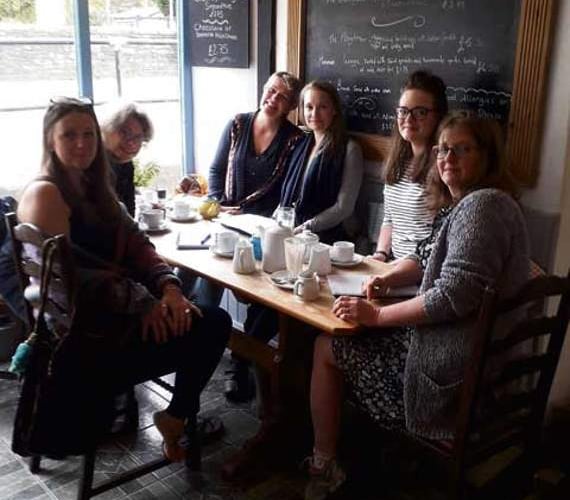
CAMELFORD is well on the way to gaining plastic free status, writes Rosie Cripps.
The group of Camelford ladies, consisting of Sarah Tweedie, Clare Monson, Claire Hewlett, Jacquie O’Neill and Debbie Gregory, have been working on shared aims to reduce single-use plastics in their town, and encourage the local community to make small changes to contribute positively to the issue.
Cllr Hewlett, who is now deputy mayor of Camelford, is also Green Party spokesperson for North Cornwall, and is representing the town council within the Plastic Free Camelford group.
All it took was for Sarah to notice a hard-hitting article on how plastics are affecting the marine environment, and through sharing this on the community Facebook page Love Camelford, others started presenting their thoughts on the issue, with suggestions of creating a group with those who would be interested in driving Camelford towards plastic free status.

.jpeg?width=209&height=140&crop=209:145,smart&quality=75)


Sarah, Clare and Cllr Hewlett then agreed to meet to discuss the next steps for their group, Plastic Free Camelford.
On Wednesday, May 9, the Post met the group in the Four Seasons café in Camelford to catch up on their plans for the coming weeks and months — with two more members added to the table, Jacquie O’Neill and local business owner Debbie Gregory.
Clare had brought along the charity Surfers Against Sewage’s Plastic Free Coastlines information sheets, with information, advice and criteria on how to gain plastic free status — and discussions got underway.
Sarah said: “I think lots of people think being plastic free means getting rid of everything. We need to make it clear that we mean just single-use plastics.”
Plastic Free Camelford are making plans for their debut appearance to the town’s upcoming event to kickstart Camelford Fun Week, the spring fayre, with a display of every day items used in a household with their alternatives, including straws, cotton buds, teabags and — the most recent item to be under the government’s radar, with a possible ban to be put in place — wet wipes.
Mum of two, Clare, joked: “I’ve always thought I was the only person who used washable wipes — now I don’t feel like such a weirdo!”
Sarah said: “It has been found that 98% of sewage blockages are baby wipes — and fat. But the thing is, lots of people don’t have the time for washable wipes.”
Clare said: “People can literally throw things in the washing machine — it really is easy, and people need to understand that. The bottom line is, people want convenience. It’s just about providing them with the right thing.
“I use biodegradable nappy wash, add some Ecover, whack it on 40 degrees and you’re good to go!”
“Over time, we’ve finally encouraged mums to go to work, so now mums and dads are both at work all day. Lots of people will feel they just don’t have the time, and that’s when convenience was brought in and it needs to change,” said Sarah.
Even in the garden, plastic is used. Sarah continued: “As a keen gardener, I know Monty Don (gardening TV presenter) is going plastic free. Instead of throwing his plastic pots away, he says to reuse them. So instead of getting rid of them, you continue to use them.”
For the spring fayre, on May 26, it was suggested that an interactive workshop could be held for people to create their own plant pots, using newspaper and old items such as washed out jam jars.
There will also be a Morsbag making workshop at Needle and Thread in Camelford that week, run by Camelford Carriers creator Kimberley Ross, whose work the Post has previously reported on.
Sarah said: “It’s important for people to understand that we’re not anti-plastic; we’re anti-throw-away. We have to get people to be responsible for their plastic use.”
“People are understanding a bit more, and slowly people are getting the hang of what it is, because it’s in the news now,” Clare added.
“It’s about information and informing, and the little changes that can be made,” Sarah said.
Debbie told the group that one problem people sometimes face is the cost of the change to a plastic free lifestyle. The ladies then discussed their purchase of recycled toilet paper. “What puts people off is that you buy this in bulks,” Debbie told the group.
Clare added: “The thing is, if you buy recycled already, like I do, you’ll find that it’s probably the same price to buy a bulk of this. I usually buy from Suma.”
Eco-friendly companies selling items such as recycled toilet paper, which can be bought by the bulk, also use their profits to help provide toilets for deprived areas and other community projects.
Clare continued: “There are lots of people who can’t do this, they can’t afford to do it and they don’t have the time. But then there are people like us who can! Even if those people who feel they can’t make little changes, it’s something. I think there are probably tonnes of people out there who do have the money and do have the time, but they don’t do it.”
The group then referred back to their objectives listed on the Plastic Free Coastlines paperwork, which included getting the local council to lead by example, support provided by the council, gaining a representative of the council, showing objectives to the public, getting the press involved and raising awareness in the community.
At one of the recent meetings of Camelford Town Council, councillors agreed to support the objectives of Plastic Free Camelford and reduce their use of single-use plastics in town council businesses and venues.
Another aspect of gaining plastic free status is having ‘plastic free allies’, by finding at least three local businesses to comply with reducing single-use plastics, which is something the group will be focusing on.
To get business owners involved, the ladies hope to come across them at the spring fayre and ask if they can commit to providing plastic-free alternatives in their establishments in return of promoting their business on their social media pages for free.
The meeting also heard that plastic free communities require 50% of community spaces, 30% of schools and at least one community organisation to follow plastic free guidelines.
Bringing the discussions to a close, Cllr Hewlett said: “Although this paperwork is aimed at coastlines, our area is still very relevant. We need to make it clear that rubbish and litter ends up in rivers and that’s where it eventually ends up (beaches and the ocean). We need to keep litter out of our river, because eventually it will get into the estuary.”
The group agreed to host monthly litter cleans around Camelford, with their first pick having taken place on May 5. Cllr Hewlett said: “I was absolutely gobsmacked at the amount of litter we picked up.”
Sarah added: “That’s why we need to educate people — it’s against the law to drop litter!”
For further information about the group and any future litter picks being held in the town, like their Facebook page, Plastic Free Camelford.
Comments
This article has no comments yet. Be the first to leave a comment.