
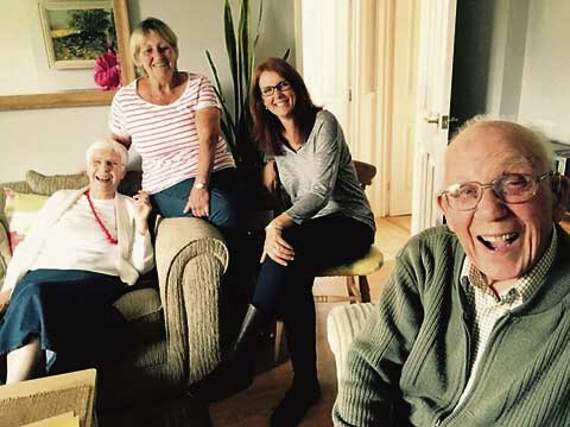
HELPING those with early to moderate dementia in Holsworthy to get out and about, ‘The Filo Project’ offers clients days out to reduce isolation and improve social interaction.
The Filo Project is a not-for-profit organisation and offers small-group day care services to people in a number of areas across Devon and West Dorset, including Holsworthy, who have early to moderate dementia.
It is a local service that helps people with dementia in a different way to traditional day centres and is a community interest company — all its clients live in their own homes, either by themselves or with family.
Now entering their third year, The Filo Project is still a comparatively small organisation and want to ‘spread the word’ about what services they provide in order to help as many people living with the early to moderate stages of dementia who feel isolated — especially in rural areas such as Holsworthy and its surrounding parishes.



The project is a relatively new organisation, having been set up in August 2014 by Liz Dennis and Libby Price. When they met, Liz was studying for her PhD with a focus on the role music plays in the every day lives of people with dementia.
At the time Libby was working for Age UK in Exeter in a dementia day care capacity. Libby’s experience of working extensively with complex client groups meant she was the ideal individual for Liz to collaborate with during her PhD fieldwork. Liz began working closely with Libby attending a number of her day care sessions.
Co-director of The Filo Project, Liz, said: “It all really started when I was studying for my PhD at Exeter University. I met Libby, who is from mid Devon, and she was doing similar work for Age UK at the time. Unfortunately, Age UK wanted to close down the service they were running, but we saw how brilliant it was and how valued the services was by local communities so we decided to set up our own.”
Explaining the aim of the project, Liz said: “The motivation [of the project] is that a large number of people with early to moderate dementia, who still live in their own homes, feel isolated — most socially — and we provide an opportunity for them to get out and about and meet others.”
One of The Filo Project’s many aims is to provide those with dementia the chance to socialise and get out of their often rurally isolated homes. Their formula is simple; groups are kept small with generally no more that four per group in a safe and intimate setting — usually at the home of a ‘host’, a person who organises and holds the day care sessions.
The hosts try to make the service like spending a day with friends, where everyone can hear and engage with the others and no one gets left out to encourage quality social interaction.
Transport is included in the service, to help those in rural areas get out of their often lonely and isolated surroundings and into their local community. The hosts also provide hot lunches for their clients, which many have said are a ‘welcome and important part of the day’.
The Filo Project’s hosts help facilitate the small-group day care service and lunches offered by the organisation.
Liz said: “We offer a bespoque service. Our host’s job is to facilitate a day out for a small group of people.
“Because our hosts only take out small groups at a time, with maybe three or four people at most, no one will feel excluded and everyone has the chance to contribute and have their voice and opinion heard.”
In 2014, when The Filo Project was still quite new, Devon County Council helped Liz and Libby develop their business model ‘to provide support for people with dementia in family home environments across Devon, where, rather than people with dementia attending traditional day centres, they’re invited to spend time in a host’s own home’.
The Filo Project is now on their list of day services for older people and people with disabilities that have been quality assured by Devon County Council.
Day services on the council’s assured list need to have demonstrated certain quality standards. They must also have been assessed by professionals, including people who use those services and their carers.
This means when a person, who has been assessed as needing social day-care, approaches the council for help or advice they can be signposted to a service that the council know have demonstrated good quality care standards — like The Filo Project.
Depending on an assessment of their finances, some people may pay for the services provided by The Filo Project or the council will put money towards the cost of the service for people who are eligible for funded support.
A spokesman for Devon County Council said: “It’s sometimes difficult for people with dementia to leave their own homes in order to attend services elsewhere. It can make some people anxious, and that can be upsetting for the individual and their families or carers.
“We also know that people with dementia find comfort from familiar routines, and through this project and others similar, people are invited into host’s family homes, which feel familiar and where they can spend time enjoying a social routine.
“While it provides a stimulating and safe environment for the person with dementia, it also provides a vital break for the partners or carers of those individuals.”
The Filo Project recently celebrated its second anniversary. In that time the organisation has helped support a number of clients and have gone from strength to strength.
In their first four weeks as an operational organisation they supported 51 client spaces with one host, they now support around 650 client spaces with 25 hosts.
It is not only their clients that benefit from the support. It can also be of vital help to family members, who are often in considerable need of some respite.
Among the many positive responses the organisation has had to its services, one of The Filo Project’s client’s carer said: “I just wanted to reiterate how important the Filo group is for John. On a Tuesday and Thursday evening, following his Filo sessions, he is at his best. He is in a good mood, he is not worrying about things or falsely accusing people of things.
“On Mondays and Wednesdays when he is struggling with his Alzheimer’s I can usually help bring him out of his confusion, paranoia and depression by talking about where he is going the next day.”
The Filo Project currently has a presence in North Devon with hosts catering for clients living in and around Holsworthy, Northam, Bideford, Barnstaple, Chivenor, Umberleigh, Braunton, Torrington, Chumleigh and South Molton.
However, they are interested in extending their service more to those in Holsworthy and increasing the support they are able to give there.
For more information about The Filo Project call 0333 939 8225 or email [email protected] or visit www.thefiloproject.co.uk
Comments
This article has no comments yet. Be the first to leave a comment.