

By Georgia Lambert, SWNS
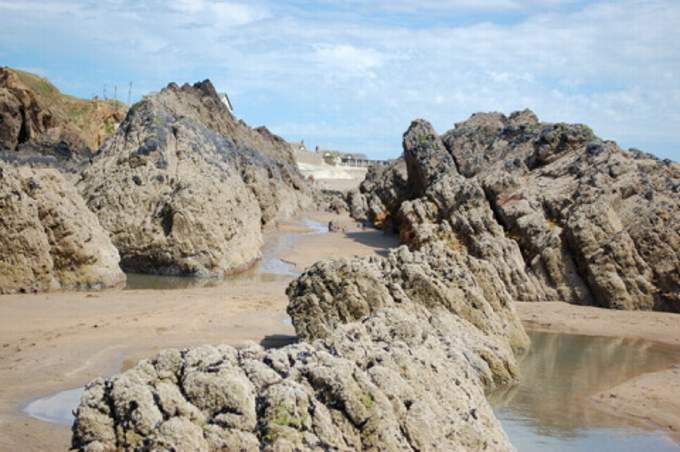
AN increase in rock surface temperature in Bude has led to changes in the species living on the shores, reveals new research.
A temperature increase of around 1.5 degrees Celsius, just under the maximum target agreed at the COP23 Paris meeting in 2017, has sparked a "significant" change in coastal habitats, say scientists.
University of Plymouth ecologists examined how the increase in rock surface temperature was affecting the quantity and behaviour of species, commonly found on the shorelines of Devon and Cornwall.




The team focused on two sites on the region’s north coast, at Bude and Croyde, and two others — Bantham and South Milton Sands — all of which have deep gullies with both north-facing and south-facing surfaces.
After analysing the sites’ environments, their findings showed the average annual temperature on the south-facing surfaces at low tide was 1.6 degrees Celsius higher than those facing north, and that temperature extremes were six times higher on south-facing beaches.
Across the four coastal sites, the team found that these temperature differences had a significant effect on 45 species found on north-facing sites during the summer of 2018, compared to 30 on south-facing ones.
In winter, the team found that species including the red seaweed (Plumaria plumosa) and sea cauliflower (Leathesia marina), were restricted to only existing on north-facing surfaces.
The different temperatures also had an impact on the species’ breeding patterns, with five times more dog whelk (Nucella lapillus) eggs found on north-facing surfaces than south-facing ones.
Because of the increased temperature changes, the researchers found that limpet reproduction generally occurred earlier on south-facing surfaces but the key grazers had exhibited greater levels of stress.
This research, published in the journal Marine Environmental Research, is the first to explore the link between temperature and site geography on species abundance, physiology, and reproductive behaviour in coastal areas.
The studies’ authors explained that their research provides key evidence of how temperature variation at local scales can affect certain species while offering an insight as to how future changes in global temperatures might have a negative impact over the coming decades.
Dr Axelle Amstutz led the research as part of her PhD and worked closely with experts in marine ecology and zoology to carry out the study.
Dr Mick Hanley, the studies’ senior author, said: “We have all heard for some time about the importance of limiting average global temperature increases to 1.5°C, and it will undoubtedly be one of the key topics discussed at the forthcoming COP26 conference.
“This study shows the impact even that kind of increase could have on important species that contribute to the health and biodiversity of our planet.
“As such, it does add to overwhelming evidence of the threats posed by human-induced climate change.”
Dr Hanley, who is also an associate professor in plant-animal interactions at the university, continued to explain why the study was so important.
He added: “However, more than that, it shows how the pressure on different species can change even within individual locations.
“For example, we recorded a temperature of 42.5°C on a south-facing surface at Croyde at the same time as 22.5°C was measured on the opposite north-facing side.
“We believe this shows such sites can be used as a ‘natural laboratory’ to inform and predict how species and habitats might respond to climate change over the coming decades.”
Comments
This article has no comments yet. Be the first to leave a comment.