
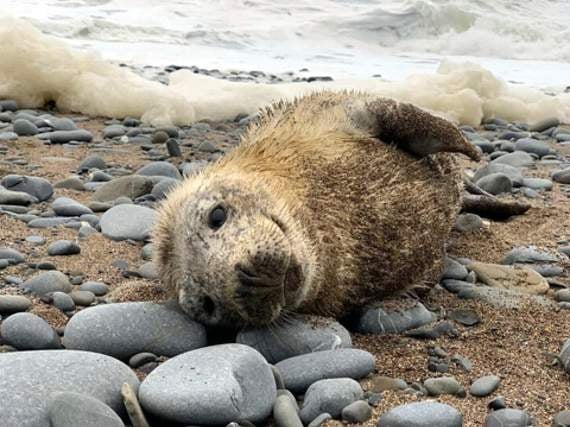
PEOPLE in the Bude area pulled together recently to rescue a seal pup stranded on Welcombe beach.
On Tuesday, October 1, Sue Clancy Gear of ‘Born to be Wild’, who takes in injured or abandoned wild animals and nurses them back to health ready for release, if possible, alerted Ado Shorland and Paul Willshire from British Divers Marine Life Rescue (BDMLR) to the beautiful, creamy-coloured seal pup washed up on the pebbles at Welcombe. Sue was contacted by a member of the public, who came across the pup.
Ado described the pup as ‘weak’, having been struggling in the ‘massive shore break’.
He reported: “On our arrival with the tide about to get dangerously close to the cliff, fellow BDMLR medic Paul Willshire and I decided on an immediate uplift. There was no fight left in her and uplift was simple.”


The pup was identified as a 19kg female with wounds to her front and rear flippers and bridge of the nose. Following her rescue, the pup — fittingly named ‘Milky Bar Kid’ to match her milk-coloured fur — was taken to Penbode Vets for a tube feed by Michelle Robinson Clement and BDMLR medic Paul, where further checks revealed a swollen front flipper and multiple marks on the rear flippers which were treated.
Ado added: “Great BDMLR teamwork once again. A massive thank you to everyone on the beach, you did great!”
BDMLR has issued some advice on their website on what people should do if they come across a live seal.
They advise to watch the animal from a distance and do not approach it. Seals regularly haul out on the coast, to catch up on some well-earned rest and allow their food to digest, and a seal spotted on the coast could well be a healthy, but sleepy, seal! This can often happen following stormy weather.
However, in some instances, a seal could well be in some trouble and will need assistance to ensure its survival. BDMLR has provided some tell-tale signs of what could be spotted in a potentially poorly or distressed seal.
• Abandoned — If you see a seal with a white, long-haired coat in the autumn and winter, or you see a small seal (less than three feet in length), alone between June and August, then it is probably still suckling from its mother. Check the sea regularly for any sign of an adult seal.
• Thin — Signs of malnutrition include visible ribs, hips and neck, as well as baggy, wrinkled skin.
• Sick — Signs of ill health include coughing, sneezing or noisy, rapid breathing and possibly thick mucus coming from the nose, wounds or swellings — particularly on the flippers and possibly one flipper when moving — cloudy eyes, thick mucus around them or possibly one eye kept closed most of the time.
Anyone who spots a seal and thinks they may be in distress or sick, should call BDMLR’s rescue hotline on 01825 765 546 from Monday to Friday, 9am to 5pm, or 07787 433 412 for out of office hours and bank holidays. Alternatively, call the RSPCA hotline on 0300 1234 999 (England and Wales) or SSPCA hotline on 03000 999 999. These numbers can also be contacted if you find a live whale, dolphin or porpoise.
Comments
This article has no comments yet. Be the first to leave a comment.