
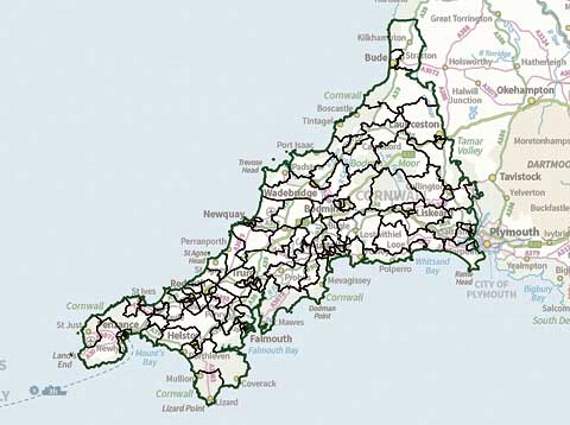
ONLY a handful of people attended Cornwall Council’s event at Launceston Town Hall last week, held to find out residents’ thoughts, which will help produce a new pattern of divisions when the number of councillors is cut from 123 to 87.
There, moving Stoke Climsland out of the Launceston Community Network Area and into Callington’s was suggested.
From May 2021, the Local Government Boundary Commission for England (LGBCE) is minded to recommend the number of Cornwall Councillors will reduce by 36. This means that the current electoral divisions across Cornwall have to be redrawn to reflect that reduced number.
The LGBCE is the ultimate decision-maker, and consultation on division boundaries is underway now until February 19. Cornwall Council said this stage is ‘possible the most important opportunity to influence the outcome’ and said ‘as many people as possible need to respond to the consultation’, available at consultation.lgbce.org.uk



.png?width=209&height=140&crop=209:145,smart&quality=75)
Cornwall Council established the electoral review panel to lead the council’s work on the LGBCE review.
The panel has held a series of events across the county, with its latest at Launceston on December 7, where maps showing the possible electoral divisions for the Launceston, Bude and Camelford Community Network Areas were handed out.
Interactive maps and printable maps of the possible division boundaries are published on www.cornwall.gov.uk/council-and-democracy/elections/electoral-review-of-cornwall-council-2016-18/division-maps/
The meeting heard the statutory criteria the LGBCE is required to balance are:
l To deliver electoral equality where each councillor represents roughly the same number of electors as others across the council;
l That the pattern of divisions should, as far as possible, reflect the interests and identities of local communities;
l That the electoral arrangements should provide for effective and convenient local government.
In relation to electoral equality, the average electorate the council has to aim for in each division is 5,163, based on the 2023 electorate forecasts. The commission allows a tolerance of ±10% from this average, which means the electorate range is 4,647 to 5,679.
In exceptional circumstances where there is a sound justification the commission will allow this range to be exceeded. However, the council warns that the further away from the average it is the greater the risk of electorate inequality occurring sooner and triggering another electoral review.
The council’s lead officer Matt Stokes said while they would likely still be looking at a council size of 87 once they have worked out the divisions, the LGBCE could change that number by plus or minus one.
Consultants had drawn up possible electoral divisions, but this is not to say that these would form the council’s submission. There will be another meeting on January 8 in Truro covering the whole of Cornwall, when Mr Stokes said the council ‘might be in a position to launch an indicative set of divisions that we might submit to the commission’.
“There is a lot of work to be done to come up with better divisions that [the consultants] have come up with,” he said. “We are keen to understand the views of everyone with an interest in the review.”
Launceston town councillor Paul O’Brien, who explained to the panel he is part of a small town council working party looking at this review, said their ‘first draft’ would ‘move Stoke Climsland out of their Community Network Area into the area covered by Callington.
“We think geographically that would work. Historically it looks south rather than looking north to us. We would have thought it wouldn’t create too many problems to the residents of that area.”
Cornwall Councillor Dick Cole, panel vice chairman, asked Cllr O’Brien ‘how much thought had been given to the knock on impact of moving’ Stoke Climsland.
“By passing it down to Caradon, you’re making exactly the same problem in the Caradon area,” he said. Cllr O’Brien said their work was still ‘in progress’, but added: “Something’s got to be removed. If Stoke Climsland’s not removed it’s mathematically impossible.”
Cornwall Councillor Malcolm Brown, chairman of the electoral review panel, said: “The point about Stoke Climsland has been brought up by other people. This is about how much importance you attach to the future of community networks.”
Philip Stephenson, clerk for Tresmeer Parish Council, said: “I don’t think network boundaries are at all important to the electorate and I don’t think they should get in the way of doing this job at any point really.”
Anyone wishing to respond to the LGBCE should do so direct but the council wants to understand the views being expressed to inform its own submission. The council’s dedicated email for the review is [email protected]
Comments
This article has no comments yet. Be the first to leave a comment.