
A Star of Bethlehem plant grows in the St Hugh’s churchyard and to see it in bloom with its six white petals you must visit during bright sunlight.
This must be one of nature’s shyest flowers as it curls up its star-like petals after midday, giving it the name ‘Betty-go-to-bed-at-noon’.
In fact, the one in Quethiock never fully opens until mid-morning.
The hedges and grassy banks have been decorated with loads of Cow parsley.




It’s a sight to see and even Monty Don, the presenter of Gardeners World on television, said that he was pleased to see it growing in his garden at Longmeadow.
An old common name for these clusters of white flowers is ‘Queen Anne’s lace’ because of its light, frothy appearance, and the plant is one of the earliest members of the Umbelliferae family to come into flower.
Bluebells, that’s the English hedgerow variety and not that horrible Spanish or garden bluebell that pops up everywhere in the village, are dying out now but their place is being taken by beautiful Foxgloves.
Odd really, but all parts of the Foxglove are poisonous but their leaves have been used for many years to produce a drug to treat problems of the heart.
Another red-flowered plant is Common vetch which, despite its name, is not the most abundant of our vetches that we will see in our area.
The plant was introduced from the continent and was grown in large quantities as cattle feed.
Their flowers are very similar to those of the garden pea.
I think the plants are related because I remember walking with a local Ramblers Group in Liskeard many years ago and one of them ate some tiny peas from one of the vetch plants that we came across.
Herb Bennet, a plant that’s also known as Wood avens, is in bloom on the hedgerows now with yellow, five-petalled flowers.
The plant seems to have been named for St Benedict, founder of the Benedictine Order of monks, and it had magical powers as it was said that if a man carried the root of the plant with him at all times, no venomous creature can harm him.
Herb Robert flowers are also blooming, in fact, they start flowering early in the year and stay in bloom until autumn.
A member of the Geranium family, they will grow anywhere, be it on grassy banks, hedges and on stone walls.
My wife has several growing among various flowers in her greenhouse.
I think the herb’s seeds were blowing in the wind and settled on the flower pots when they were put outside ‘for a drink’.
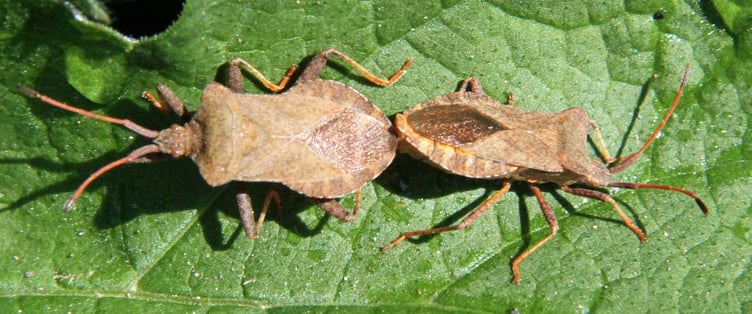
On a walk over past East Quethiock Farm, I spotted a load of Squash bugs on the hedge.
There were 14 that I quickly counted and a few couples were mating.
These brown bugs are one of the largest bugs in the country and have particularly long antennae which, unfortunately, are easily broken when the insect is young, but I think they survive with only one.
I spotted a large wasp-like insect resting on a leaf on the hedge and although it was hornet- sized, the face was unfamiliar.
I think it may have been an Asian hornet but I’m not sure, maybe a reader can help with identification.
There are several Southern marsh orchids growing around the parish.
These wild orchids are usually the second species I see after the Early purples bloom, and I remember when I used to walk a great deal further than I do now, there used to be hundreds of them growing on the roadside verge near Trerulefoot.
If you can help Ray with identification, email [email protected] and we will pass your messages on to Ray.
Comments
This article has no comments yet. Be the first to leave a comment.