
RECENT discoveries have suggested that Tintagel could be the most important historical site in Britain.
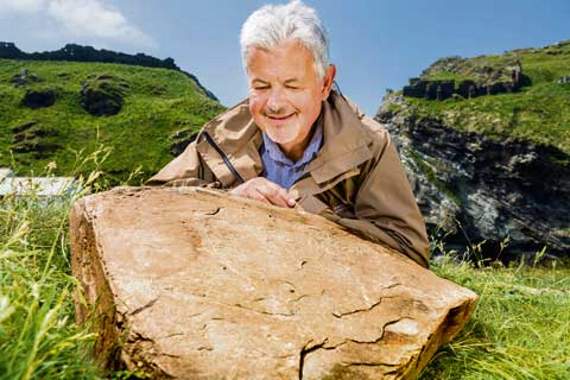
The Cornwall Archaeological Unit has discovered a stone with ancient inscriptions at Tintagel Castle, allowing historians and archaeologists to take a step further towards learning more about the people who would have once lived at this site.
The findings suggest both backgrounds of Mediterranean people, and ancient Cornish saints.
A five-year archaeological project, commissioned by English Heritage, has been taking place at Tintagel Castle and last year, during a five-week excavation, the stone was unearthed, with ancient symbols and writing inscribed into it.

-Rebecca-Marks-and-Ross-Hancock-showcase-the-Cornish-Pirates-departure-lounge-takeover.jpeg?width=209&height=140&crop=209:145,smart&quality=75)


English Heritage curator, Win Scutt, has been working alongside a dedicated team, including paleographer Michelle Brown and linguist Oliver Padel, to find out more about the people who would have once lived at the historical site.
Mr Scutt told the Post: “This was a big find, last August, as part of a five-year project. We’re gathering our evaluations from the five-week excavation when the stone was discovered. The information is still being processed, but by March 2021, it will be ready for publication, so this is an interim report on this particular find.”
The stone went on display at Tintagel Castle last Saturday, where people will be able to view the ancient inscriptions in the flesh.
Mr Scutt added: “We’ve now got the first results (from the excavation), and the characters on the stone, most are Latin, with one Greek letter. They are unusual characters — a mixture of capitals and lowercase, but then there is even a ‘U’ as we would write today, so it’s very mixed.
“However, from this, Michelle has been able to find that the writings would have been from between the years 600 to 700 (AD).
“We excavated three buildings, and this stone came out of the wall of one of the buildings — it could have been a window ledge. But the inscription, at the bottom of the stone, is the Roman name ‘Titus’, written as ‘Tito’. Then there are the words ‘fili duo’ — ‘fili’, which means ‘man’ or ‘men’, and ‘duo’, which of course means ‘two’.
“So then we’ve got the words ‘two men’. There is also a curious ‘A’ symbol, which is like a monogram — it is a curious thing, but it has been suggested that it refers to God.
“The Latin word ‘fili’, which could also be ‘filius’, means ‘son’, and if it was plural, this could suggest the words ‘sons of God’.”
Mr Scutt also said that there are two Celtic names written upon the stone — ‘Budic’ and ‘Tud’.
“It is very interesting from a Cornish point of view,” Mr Scutt continued. “The two names sound similar to Cornish and Welsh names, which could suggest they are ancient Celtic names. We do know there was an ancient saint that came from Brittany (France) to Cornwall, who was called Budic. The name Tud could also relate to the saint from Cornwall, which was St Tudy. We don’t know this for certain, it could have been anybody, but it is a possibility.”
The writings, although informal, were evidently inscribed by a professional or professionals. Amongst this significant find, there have been excavations of around 3,000 pieces of pottery from Tintagel Castle, all of which are thought to have originated from the Mediterranean, Greece and Turkey, which could suggest a royal background.
“This was a very important trading centre,” Mr Scutt said. “But the inscriptions are the sort of thing you would find on beautiful, illuminated books. I think whoever wrote them was using a slab to practice their writing, so it was definitely a bit more than a note. It’s really rare and really exciting.”
These findings have opened up a lot of doors for the archaeological teams working on the site, and confirms that Tintagel is much more significant than once thought.
“Tintagel is not just an important site to Cornwall. From the artifacts we have excavated from that period, from around 400 to 800 (AD), this tells us that Tintagel is the most important site in Britain. We have found nothing to this extent anywhere else before.”
Using the latest archaeological technology, artifacts include Mediterranean olive oil and wine vessels, and more pottery has been found at Tintagel Castle than anywhere in the UK.
The artifacts are still being analysed, but the discoveries have proved what a major settlement the site is.
“It is the most extraordinary site,” Mr Scutt continued. “It’s very intriguing — we don’t know who exactly lived there. For the first time, we discovered a bone, but it wasn’t a human bone, it was an animal bone.
“So we know what these people would have eaten. Unfortunately we have no human remains; if we did have them, we could analyse them and find more about them.
“Are these people from the Eastern Mediterranean area, who would have settled here? Or are they local? The names on the stone suggest that they were locals living here.”
He added: “There are three languages that have come from this — Latin, Roman and Celtic. It’s a very multi-cultural centre here. Whether these people are from outside the British Isles, we cannot be certain. At the moment, we assume they are Cornish.”
Comments
This article has no comments yet. Be the first to leave a comment.