
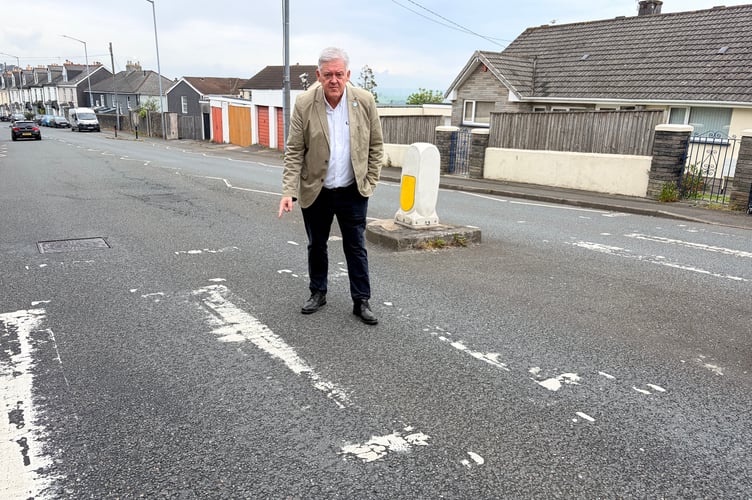
A DEBATE over faded road markings and road safety in Cornwall ended with councillors rejecting a motion calling for faster repairs and greater oversight – but not before a proposal to tax the super-rich entered the discussion.
Councillor Keith Johnson, who represents Saltash Tamar, brought the motion before Cornwall Council’s full meeting, arguing deteriorating yellow lines, junction markings and crossings were creating increasing dangers for motorists and pedestrians across the county.
The motion called for a comprehensive review of Cornwall’s inspection, maintenance and renewal programme for road markings, alongside prioritised repairs at locations where faded markings posed clear safety risks.
Cllr Johnson said residents continued to report “repeated near misses” at locations where markings had worn away or disappeared entirely.

“If the current programme was working, we would not be seeing zebra crossings fading, junction markings disappearing and residents reporting repeated near misses,” he said.
“We are told the yellow line budget will be £225,000 a year, yet officers estimate a backlog of around £2-million. At that rate, we are not catching up – we are managing decline.”
Seconding the motion, fellow Reform UK councillor Sean Smith described it as a “practical, proportionate and evidence-based proposal”, saying visible road markings were essential for both safety and parking enforcement.
However, several councillors argued the work was already being addressed through existing investment programmes and risk-based highway policies.
Liberal Democrat cabinet member for transport Dan Rogerson said the administration had already increased annual spending on yellow line renewals from around £40,000 to £225,000.
“This administration takes this very seriously, which is why we’ve invested more money,” he said. “We’re going to be spending five times what was being spent before.”
Councillor Rowland O’Connor, leader of the Cornish Independent Non-Aligned Group, said while concerns about faded markings were valid, the motion failed to explain where additional funding would come from.
“Cornwall’s highways budget is not unlimited,” he said. “If we accelerate delivery further without new funding, that money has to come from somewhere.”
Mebyon Kernow councillor Loveday Jenkin agreed saying: “We know there’s a backlog, but what I don’t see in this motion is how that backlog can be filled.”
Conservative councillor Martyn Alvey added: “I have been frustrated, as all members have, with white lines not being repainted, but ultimately I must trust the system that the money is allocated as best as possible for safety.”
The debate then took an unexpected turn when Green Party group leader Drew Creek proposed an amendment, seconded by Labour group leader Kate Ewert, calling on the UK government to introduce a progressive wealth tax on assets over £10-million to fund local highway safety improvements.
He said the proposal would ensure road maintenance was “funded through the broadest shoulders in society rather than ordinary working families in Cornwall”.
Independent councillor Julian German drew laughter in the chamber when he asked whether councillors affected by the proposed wealth tax should declare an interest before voting.
The amendment was rejected, followed by the original motion, which was defeated by 46 votes to 24.
Comments
We've recently changed our login process. If you have an account for commenting, you will need to re-register on the login window.
This article has no comments yet. Be the first to leave a comment.