
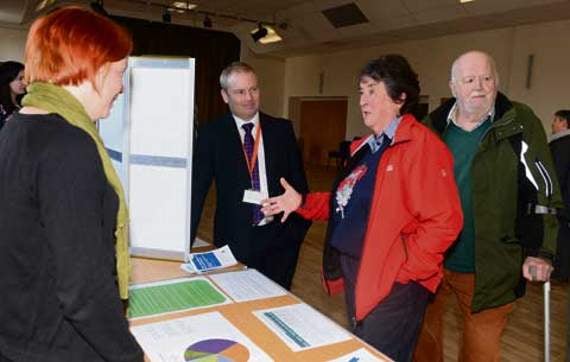
THE public were invited to discuss the draft action plan for Camelford to tackle its air quality issues, writes Rosie Cripps.
On Tuesday, March 6, people were given the opportunity to approach Cornwall Council representatives from the environment department at Clease Hall, and discuss the latest draft of the action plan for the town’s air quality.
Since Camelford was declared an air quality management area (AQMA) at the beginning of last year, Cornwall Council has been developing its action plan to take the town forward in improving its air quality.
Air quality has been monitored in Camelford since 2010, and was found to have alarmingly high levels of nitrogen dioxide in various spots in the town, leading to the town finally being declared an AQMA.

.png?width=209&height=140&crop=209:145,smart&quality=75)

It is thought that cars stopping and starting at the traffic lights in the centre of town, as well as the copious numbers of heavy goods vehicles (HGVs) travelling through Camelford are high contributors to this pollution.
Cornwall Council recently released its draft action plan for Camelford, with 14 main points stating possible solutions that could be taken forward to help the town’s problem.
Town councillor, Claire Hewlett, who is also chair of the Camelford Clean Air Group and Green Party spokesperson for North Cornwall, said: “My thoughts on the plan are that it’s wide and varied — it’s got everything from a bypass to idling solutions. But the real issue is the private cars driving through Camelford, and the HGVs, which pump out a lot of nitrogen dioxide.
“If Cornwall Council were to focus their efforts on improving public transport services, we would obviously stand a better chance of getting the traffic off the roads, but it’s not going to get rid of the pollution.
“Modern trucks, apparently, don’t contribute to the air quality problem, but they’re still rattling along and making the windows of houses shake. So they can tell me that they’re not causing any pollution, but they’re certainly causing noise pollution.”
She added: “So there are two sides to all of this. But then you’ve got the very basic problem of money and funding — this is all pointless if there’s no money available.”
Cllr Hewlett said a grant has been put to Defra, but stressed that Cornwall Council ‘needs to commit’.
“Speaking to the MP’s office, Cornwall Council has to put forward five to ten per cent of the project cost. So Cornwall Council needs to commit to that five to ten per cent. If we can’t get that, then we’re not going to be able to move forward.”
She added: “I want this event to increase public awareness and get people to recognise that if they want anything to come out of this, they have got to get more vocal. The ultimate solution, in my opinion, is to get the HGVs out.”
Cllr Hewlett leads the Camelford Clean Air Group, put together towards the end of 2016 in an aim to recognise the main issues surrounding Camelford’s air quality and traffic problem, encourage Conservative MP for North Cornwall, Scott Mann, to get on board with their campaign, and lobby representatives at Cornwall Council to bring their case forward.
Camelford is one of nine areas in Cornwall that has been declared an AQMA, including Launceston.
A member of the Camelford Clean Air Group, John Green, thought that a thorough investigation into the town’s traffic light system would be more beneficial.
He said: “People like me query, why do we not have an inspection of the traffic light system, with the traffic going south?”
He said that a 150-page report had been released previously by Cornwall Council, but that the representatives from the authority had not brought it along to the consultation. “I’m going to find it and read it,” he continued. “I just can’t believe that there’s no way we can control the traffic better. It does get blocked, not all the time of course, but certainly during the holiday periods.
“If we had a simpler control system, it would assist motorists in not determining whether to do the right or wrong thing themselves, because it would be laid out for them already.”
He said: “I also don’t agree with the idea that, in regards to a bypass, it would cost £1-million just for a survey, because the plans from 2002 are there and everything was covered. It just puts people off — it’s rubbish! I’m very frustrated.
“Money is being spent here, but not delivering anything. You could argue that the 14 possible solutions in this latest report makes sense, but it’s not going to turn around the pollution — and the traffic lights aren’t even an option on here.”
Cornwall Council’s action plan report, aims to recognise actions to improve the air quality while work to determine the viability of a bypass is undertaken, stating: “Due to the nature and layout of the town, it will be necessary to reduce vehicle trips within the town and reduce emissions from vehicles travelling through and within the town.”
While an investigation into a possible bypass or alternative HGV route is carried out, with a business case and funding needed for these options, this form of action would not be implemented quickly enough to improve Camelford’s air quality, so further actions have to be considered, which are highlighted in the report.
As well as working with partners to investigate the bypass and alternative HGV route, options also include working with hauliers to reduce HGV traffic, exploring alternative options for deliveries, routes and new technologies; launching ECO Stars scheme providing recognition and advice to operators of larger vehicles such as HGVs and buses; promoting car share and modal shift; promoting the use of low emission vehicles and electric vehicle charging points; sustainable school travel; upgrading efficiency of the current bus fleet; enforcing yellow lines on the A39; use advisory signage to ask drivers to change their speed and divert to different routes; targeting air quality information and improve awareness; anti-idling campaigns; and advisory or mandatory engine switch-off and anti-idling zones.
Before implementing a bypass, the original designs from 2004, when Camelford first received planning permission for this scheme, would have to be reviewed and an approximate cost of £1-million would have to pay for an outline business case, being delivered within a timeframe between 18 months and two years from commissioning.
CORMAC also considered the traffic light system in a recent report, and came to the conclusion that altering the layout of the system would still not remove the air quality problem completely from Camelford.
Cornwall Council’s report also highlights that a bypass would cost in the region of £34-million, and a HGV route £1-million, both with timescales depending on funding.
A spokesman for Cornwall Council said: “Fifty five residents attended the Camelford event to hear more about the Council’s proposals to improve air quality. The public consultation closes on April 2. After that the council will take into account the comments received, amend the plan if necessary and publish it. The Camelford plan will form an appendix to the Clean Air for Cornwall Strategy and will be implemented alongside the county-wide measures in the strategy.
“The actions in the plan would be mainly implemented over the next few years, however some are longer term actions. Without pre-empting the results of the consultation, it is likely that numerous actions will have to be implemented to improve air quality, and for the plan to be a success we all need to ‘do our bit’ and think about how we can contribute to improving air quality, e.g. walking to school, switching off engines when waiting at the traffic lights.
“There was support for a number of the actions at the drop in event, and residents gave some good suggestions for other options which the council will explore further.”
Comments
This article has no comments yet. Be the first to leave a comment.