
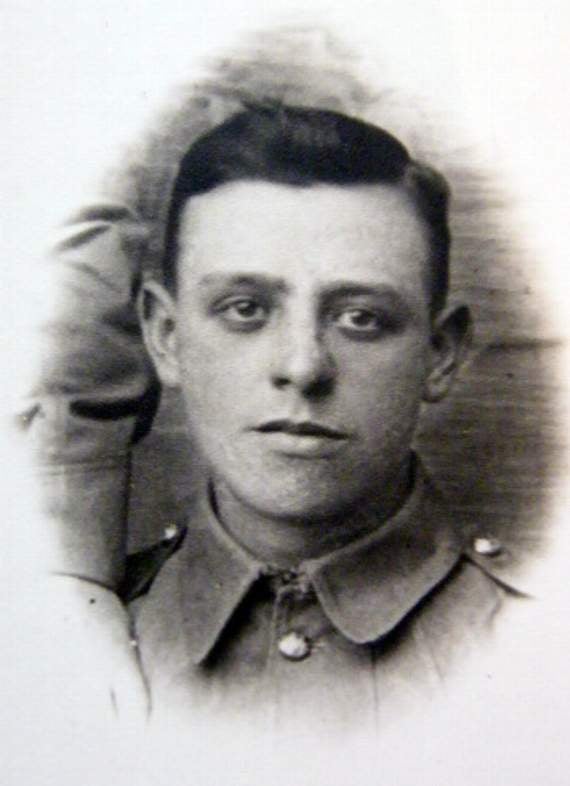
AS PART of Holsworthy’s centenary commemorations, Shawn Dymond, historian and museum volunteer, has been researching the area’s fallen.
He has found information on the 39 war dead from Holsworthy and the surrounding area. Among those was Private William John Cann, whose service was hindered by illness.
Born at 10 Rill Cottages, in the Devon village of Withycombe Raleigh, near Exmouth, William John Cann was the second child, and eldest son, of Prudential Assurance assistant superintendant George Cann and his wife Florence (née Mullens).
The family were to have six children, one of whom was to die in infancy, by 1911 had moved to Crediton, and by the outbreak of war in 1914, were living at 4 Viaduct View, Holsworthy.

Aged 18½ and working as a grocers assistant, William enlisted at Barnstaple into 1/6th (Territorial) Battalion Devonshire Regiment on August 31, 1914. Embarking on the transport ship Galeka on October 9, 1914, the battalion had a long and protracted trip before arriving at Karachi on November 11 from where they proceeded by rail to Lahore.
From here, for the next year, the battalion carried out policing and internal security duties as well as continuing their training continually buoyed up by the prospect of being posted on active service (which did not come until December 1916 when the battalion was posted to Mesopotamia).
In September 1915 William began to experience a pain and swelling in his left knee, and on October 4, was admitted to the Station Hospital at Lahore Cantonment where the swelling was identified as a probable tumour.
On November 6 he was sent to the military hospital at Ambala where a biopsy was performed and the removed tissue sent to Kasauli where it was identified as a ‘Periosteal sarcoma of the femur’, with a recommendation that the leg be amputated as soon as possible.
Refusing the operation whilst in India, a medical board, held on November 12, declared William unfit for further service and invalided him back to the England on November 23, in the hope that a speedy amputation there might prevent the disease from spreading — the medical officer commenting on the report that ‘if this is not carried out he will almost certainly be dead within a year’.
On March 8, 1916 William was admitted to the Royal Victoria Hospital at Netley and, on March 21, an operation to amputate his left leg (at the hip joint) was performed, following on from which he was medically discharged on April 7, 1916.
William was fitted with an artificial limb in June of that year and that same month his father requested an increase in his son’s pension of 20/-, the conclusion of the Medical Board however was that his condition could be regarded as ‘only aggravated by service since the declaration of war’ and consequently no increase was sanctioned.
By the closing months of 1916 it had became apparent that the disease had unfortunately disseminated to his lungs and liver and William was to endure a long and painful illness before death came on Wednesday, June 6, 1917, at his home in Viaduct View.
After a largely attended service at the United Methodist Chapel, William’s body was interred in the parish churchyard on Tuesday, June 12.
Comments
This article has no comments yet. Be the first to leave a comment.