
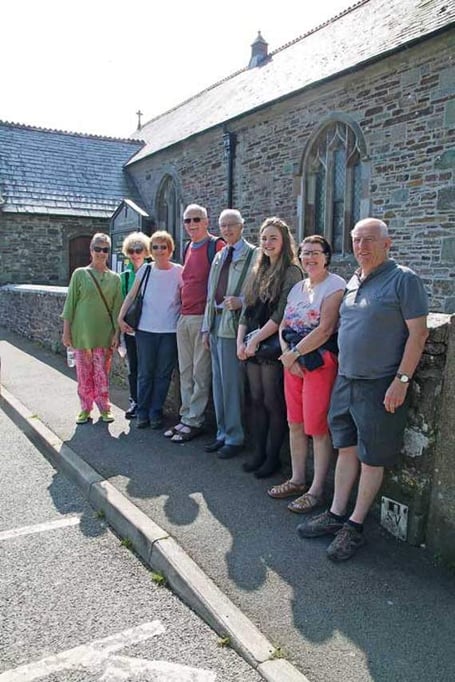
THE glorious summer sunshine complimented the nostalgic tales of Charles Causley’s life and childhood in Launceston, making the recent Charles Causley Walk a treat to be a part of.
On Friday, June 3, a small group of Charles Causley enthusiasts and interested locals met at St Thomas Church, Launceston, with their host, Arthur Wills, a close friend of Charles Causley and a noted local historian, to set off on a walk around the town, exploring the places that inspired Causley’s iconic poetry.
The first location the group visited was the cottage where Causley was born, and where he took his first few steps as a child.
Born in 1917, Causley never lost touch with where he came from, and his childhood, similarly to Arthur’s, was filled with the images of the Launceston railway, the gas works, local tannery and abattoir. After his father had died shortly after the First World War, he was brought up by his mother alone, and it was when Causley’s mother saw a rat staring at her from a beam whilst she was knitting one day that she decided she and her son should move to another home in Launceston.

Arthur first met Causley at the age of eight. Their mothers were very good friends and they lived a few houses away from each other. Arthur explained to the group that his friend was happy to share personal things with the people he knew, saying: “We had very long, personal talks at times, which I miss. It’s lovely to have these memories to share with people.”
The next stop was Causley’s second home on Tredydan Road, where he spent many years of his life, and where he set off for the Navy. Here, he also played the piano, and Arthur recalled crouching down by the wall to listen to the songs Causley would play, often being told off by his mother for ‘hanging around’ Mrs Causley’s house.
Following this was a trip to the large pond near this house, where Arthur and Charles would often play on the two islands in the middle of it, building bridges with sticks in the summer, and being able to slide across the ice in the winter during harsh frosts.
Next was a visit to the Old National School, where Causley went to school during the 1920s. Later, Causley became a teacher here. Arthur said: “Charles had a wonderful ability to connect with children; he made them feel like they all mattered. He never lost his human touch, and I would often visit him in his last home at Cyprus Well.
“We’d sit in the sitting room or the office where he used to write, and then he’d say ‘I think it’s time for a cup of tea’, and we’d sit and chat. He never made anyone feel unwanted, and he never pushed anyone out of the door. I still miss him and the talks we used to have.”
Following this was a walk to one of the last homes Causley lived in, as well as to the zig zag in the town, where his grandfather was killed following a fatal accident with a block of slate that fell and split his head open. It is evident that Causley’s life stories and the tales of his family and closest friends are portrayed in his poetry.
Arthur said: “The last time I spoke to him was when he was in bed at Kernow House, where he spent the remainder of his life once he got ill. On one of my visits when I went to leave for the day, I stroked his head, as I usually did, and told him I’d see him tomorrow, and he didn’t reply.
“Instead, he grabbed my hand and looked up at me, and that, I think, was when he said goodbye.”
Charles Causley died in 2003, and his poetry is still widely read to this day. Arthur added: “It hit us all very hard when Charles died, because someone who is very special in your life is just suddenly taken from you. If you read his poems, it’s like you are still having a conversation with him – he’s telling a story.
“To know the man was a great privilege in my point of view. It is something I treasure, and I still miss him.”
A visit to St Thomas Church finished the walk, to see the font where Causley was christened, and then a stop at his grave, where he was laid to rest next to his mother, Laura, in St Thomas Church cemetery.
Comments
This article has no comments yet. Be the first to leave a comment.