
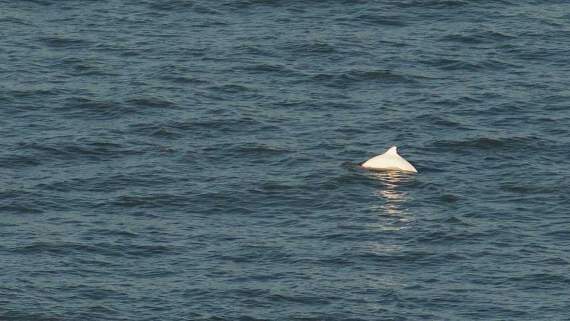
A RARE sighting of a porpoise has recently been recorded off Morwenstow, according to the Sea Watch Foundation.
Sea Watch Foundation are no strangers to reports of ‘weird and wonderful’ sightings around the coasts of the UK. In fact, it is part of their mission to encourage people to report what they see.
Logging onto her emails recently, sightings officer, Kathy James, was surprised to see a picture of what seemed to be only the sixth documented harbour porpoise, with all white colouration, ever seen in the UK waters, discovered off Morwenstow, by Henry Kirkwood.
Harbour porpoises are usually a uniform brown to grey colour with lighter underparts, and many people all over the UK will have been lucky enough to glimpse them as they make a brief appearance at the surface to breathe.


.png?width=209&height=140&crop=209:145,smart&quality=75)

Kathy said: “Henry’s photograph shows the typical view that an observer usually has of a harbour porpoise, with a broad-based, triangular dorsal fin showing in the centre of its back. However, the big difference is that they are not usually white.”
Henry was in awe of his sighting and his father, Rupert, who got in touch with Sea Watch Foundation to report the incident, said his eyes were on stalks when he saw the photograph.
People are urged to keep an eye out for this distinctive character and to inform Sea Watch Foundation if they spot anything at www.seawatchfoundation.org.uk/sightingsform.
Henry said: “On Monday, November 28, I spent a very enjoyable day photographing the wildlife around Morwenstow, North Cornwall, focusing primarily on the resident peregrine falcons. I also had an uninterrupted view of the sea, stretching from Travoise Head, 30 miles away to the south, to Lundy Island, 15 miles to the north.
“Weather conditions were perfect for spotting cetaceans with a light offshore wine and small swell. In the first four hours from my viewpoint, sat on top of the towering 200 feet cliffs, I had seen several seals and a couple of conventionally coloured harbour porpoises.
“Whilst scanning out to sea, my attention was drawn to a small white glint. Initially, I thought that this might be the fin of a very pale Risso’s dolphin, but on closer inspection through binoculars, I was amazed to see what looked like a completely white porpoise!
“The selection of photos show that the porpoise was completely white, apart maybe from some darker pigment around the blow hole. I had no idea quite how unusual this observation was, until I arrived home and trawled through the internet to learn that there has been only a handful of sightings reported, and hardly any photographs.
“I went back the next day to try and get some better images, knowing that porpoises tend to be quite sedentary, but with no luck.”
Henry and his father take part in the research charity’s national sightings scheme by reporting their sightings of whales, dolphins and, of course, porpoises. The organisation uses this information to build a picture of the marine life around the UK, and have been doing so for more than 40 years.
Using information from members of the public in this way, Sea Watch Foundation are able to report on their status and distribution and to advise on governmental policies for the protection of the species.
To get involved with the sightings scheme, visit www.seawatchfoundation.org.uk/become-a-sea-watch-observer.
Many people might be tempted to refer to the animal as an albino. Albinism is caused by a genetic mutation, resulting in the animal being unable to produce melanin, the pigment which gives rise to colour. However, it is thought that the animal’s appearance is because of a phenomenon called leucism, whereby only some of the cells lose the ability to produce melanin.
Whatever the process, it certainly results in a distinctive looking animal and is only the sixth documented case around the UK. Find out more about whales, dolphins and porpoises around the UK at www.seawatchfoundation.org.uk
Comments
This article has no comments yet. Be the first to leave a comment.