
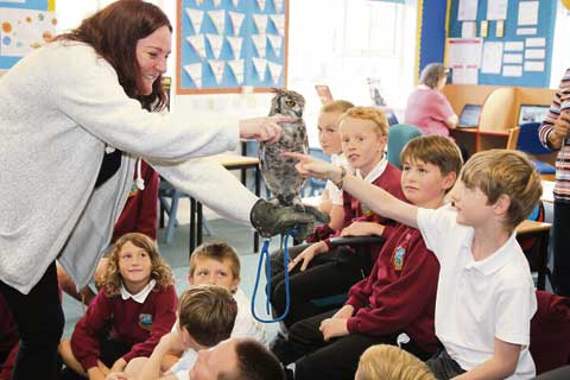
THE pupils at Stratton Primary School were delighted to have a hands-on experience recently, when a number of feathered friends paid them a visit.
The children were delighted when falconer Sharon Bindon, from ‘Ancient Art Falconry’ based near Holsworthy, brought along a selection of birds for them to see.
Her visits were part of the Ancient Art Falconry’s education programme. ‘Falconry for Schools’ is a project run by the Countryside Alliance Foundation that takes birds of prey into primary and senior schools as part of lessons that encompass history, science and technology, English and mathematics, whilst encouraging knowledge and understanding of the natural world.

Sharon ably taught the children the key features of the British birds of prey and their habitats and preferred habitats. During the visit Sharon also helped the pupils profile their favourite birds and draw pictures of them as well as dissecting a pellet to find out what they eat.
The children were filled with awe and wonder as the birds were brought out. A number of pupils were able to handle ‘Click’, a little owl, and ‘Charli’ an African Spotted Eagle Owl.
They were then given the opportunity to ask questions about feeding and handling and about where the birds fit in the food chain.
Some of the pupils were particularly impressed by the Red Kite named ‘Zeus’, whilst others preferred ‘Rocky’ the ‘dancing’ Barn Owl and ‘Star’ the American Kestrel.
Ray Newbury, class teacher, said: “We were able to take so much from this wonderful experience. The children were captivated by the close contact with these fabulous creatures, and they absorbed so much from Sharon’s vast knowledge. It was great to see how active and involved the children were, and how motivated they were to see how they could be involved in conservation matters.”
Comments
This article has no comments yet. Be the first to leave a comment.