
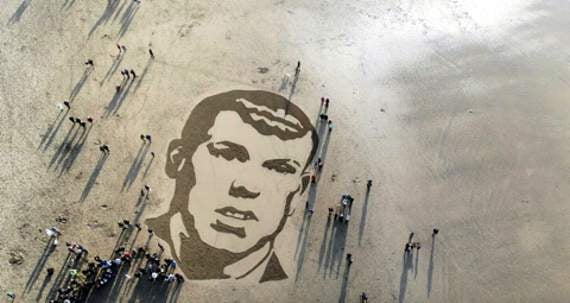
A BUDE man was commemorated at Perranporth beach on Sunday, November 11 as part of a national project to ‘say goodbye and thank you’ to those who left England’s shores over 100 years ago, and never returned.
Four beaches in Cornwall and one in Devon were among 32 across the nation where crowds came to see giant sand portraits of fallen soldiers created as part of Pages of the Sea, Danny Boyle’s Armistice Day commission marking the 100th anniversary of the ending of the war.
The portraits were designed by sand artists Sand in Your Eye and drawn below the high tide line, allowing them to be washed away as the sea came back in, offering a moment for everyone to say a collective goodbye.


.jpeg?width=209&height=140&crop=209:145,smart&quality=75)
The Eden Project, with support from the Lost Gardens of Heligan, led the events at Porthmeor beach in St Ives, East Looe beach, Perranporth beach and Saunton Sands in Devon. There was also an event at Porthcurno beach near Land’s End where the National Trust took the lead.
During the First World War, from 1914 to 1918, millions of men and women left the UK and Ireland to fight, or contribute to the war efforts abroad. This included 28-year-old Archibald (Archie) Jewell from Bude, who, amazingly, survived the Titanic disaster in 1912, but would sadly go on to die on a hospital ship in 1917.
Archie, who was born in Bude on December 4, 1888, survived the sinking of the Titanic in 1912, but went on to lost his life on a hospital ship in April 1917.
Born at 34 King Street, Bude, Archie was the son of sailor John and his wife Elizabeth Jewell, and was the brother of Clara, John Henry, Ernest W, Albert Richard, Elizabeth and Orlando.
Archie was aged 15 when he first went to sea, and married Bude’s Bessie Heard. They lived together in Southampton, and that’s where he signed on with the White Star Line’s Titanic before her maiden voyage in April 1912. Archie was a lookout and was in his berth when the ship struck an iceberg — he was one of the first people to evacuate the ship in the few lifeboats available.
However, Archie would go on to leave the White Star Line to work as an able seaman on the passenger steamship SS Donegal, a hospital ship during the war. The ship survived an encounter with a German U-boat on March 1, 1917, but just a month later, in April 17, it was torpedoed in the English Channel. Archie died, along with ten other crew and 29 wounded servicemen.
Archie was commemorated at Perranporth beach, where Hall for Cornwall performed alongside an interactive installation created by Cornish artists.
There was spontaneous applause after the two-minute silence at 11am. Children also joined in by creating silhouettes of people in the sand, remembering those who took part in the conflict.
To explore the online gallery of portraits of some of the men and women who served in the First World War, visit www.pagesofthesea.org.uk.
Comments
This article has no comments yet. Be the first to leave a comment.