
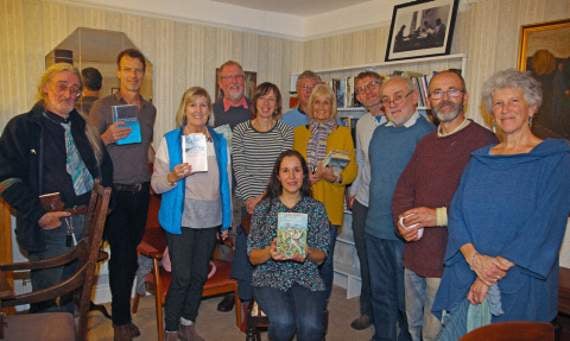
AN evening to remember the great Cornish poet Charles Causley was held at his Launceston home, Cyprus Well, on Monday, November 4.
Hosted by Causley writer-in-residence, Lou Sarabadzic, the evening welcomed members of the public into Cyprus Well to read and listen to some poetry by both Charles and other notable poets.
Charles, who passed away in 2003, was well known for his prolific writing and poetry across the world, having been the recipient of many awards for his work.
Born at Riverside, St Thomas in Launceston, 1917, Charles spent some time in the Royal Navy before returning to Launceston to become a teacher — most notably at the National School in Launceston, where he is said to have influenced many of his pupils to read, write and embrace creativity.
As a poet, he was well associated with the likes of Ted Hughes and Siegfried Sassoon, publishing a number of poetry collections and writings throughout his life.
To many, he is well-known for his vast collection of children’s poetry, but for others, his writing relating to his time during the war, and to moments experienced in his home town of Launceston, are the most notable.
Having lived in a number of properties in the town, Charles eventually settled in Cyprus Well on Ridgegrove Hill, and lived there until his death on November 4, 2003.
Sixteen years on from his death, Charles still has a profound effect on the next generation of writers and creatives — both local and across the UK.
But it was the Charles Causley Trust, headed by director Kate Campbell, which acquired Cyprus Well in 2007 to act as a centre to celebrate Charles’ life and work, while promoting creativity and literature within the community.
As part of this work, the Trust offers a writer-in-residence programme for published writers to stay in Cyprus Well and work on their own writing, as well as communicate with the community to promote writing, literature and celebrate Charles Causley.
From October to December this year, French writer Lou Sarabadzic is the Trust’s writer-in-residence, and she has already hosted a number events and collaborated with community members, the most recent being a night of remembrance for Charles.
On the cold and wet night of Monday, November 4, around 7pm, the doorbell kept ringing at Cyprus Well, with people coming to remember and honour Charles, who passed away on November 4, 2003.
People spent a few hours in his home, sharing poems and memories. Eleven people came from near and far, with some driving for one hour to join Lou. For some, it was the first time they had visited the house. Others knew it quite well, and wouldn’t miss a single opportunity to share their love and admiration for Charles.
After some food and a cup of tea, everyone gathered in Charles’ study room or, as the sign above the door indicates, ‘The Kate Neall room’, named after a very generous supporter of the Causley Trust. Next to the many books, the piano, and beautiful typewriters, poems of all sorts were read out loud. All kinds of texts were welcome, and Charles being such a prolific writer, there were many to choose from.
Lou said: “Although there were only grown-ups in the room, children’s poems were as praised as any other writing, reminding the group that no poem is ever intended only for young ones. The themes of the poems were varied too, from Causley’s local inspiration to his memories of the war. There were talks about Causley as a teacher, as a friend, and as a truly important figure of 20th century British poetry.”
As everyone left, moved from having taken part in a very special evening, they said again and again how lovely, homely, warm Charles Causley’s house was. They all acknowledged what a privilege it was to visit, or to stay in residence for a few days or weeks.
Lou added: “A good opportunity to thank again the Causley Trust and Literature Works for making writing residencies happen in such an inspiring and welcoming place, and to promote Causley’s legacy.
“On November 4, the house was definitely filled with love and friendship, thanks to the public and local community. Thanks again to everyone who came.”
Comments
This article has no comments yet. Be the first to leave a comment.