

EACH week, hundreds of planning applications come before Cornwall Council’s planning department, seeking to win approval for various plans right across the Duchy, with some concerning Holsworthy handled by Torridge District Council.
These plans can comprise of a number of different reasonings – ranging from permission to replace windows or listed building consent ranging up to large house building developments or changing of use of a building, for instance, from an office to a café, or flats.
Within this large and often complex system, there are a number of formats from which planning advice and approval can be sought.
These range from full applications where all the details which comprise a proposed development or work to a building are submitted, to outline applications, where further details are yet to be confirmed, for example, an outline application with reserved matters for appearance may not confirm the final proposed development but rather seek permission in principle.


An example of this is one for an outline permission for 20 dwellings on land with reserved matters for appearance and scale; the reserved matters would require further permission later for their inclusion.
Other types of applications include pre-application advice requests, where would-be developers submit often outline proposals to a local authority to ascertain whether it is likely to gain support or not prior to submitting a planning application.
The vast majority of applications are decided by planning officers employed by a local authority under ‘delegated powers’, meaning they do so on behalf of their employer, however, some applications are ‘called in’ by local councillors to be discussed at an area’s strategic planning committee meeting, meaning the final decision rests with a committee of councillors.
Plans approved despite concerns
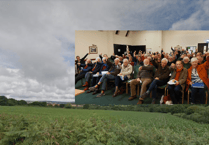
RESIDENTS turned out to pack the room of a Bodmin Town Council planning meeting which sought to discuss residents’ concerns over a proposed housing development for 58 houses.
In the meeting, those in attendance expressed their concerns that the proposals for the 58 open market dwellings of land would have on the neighbouring properties at land surrounding Pandarosa Farm.
The application was made by Wainhomes South West, which was the developer of the nearby ‘Borough View’ estate that incorporates Greenvalley Road, a highway which has been plagued with issues since its construction.
Bodmin Town Council, while only a consultee in the planning process, meaning that while it could give its views, it has no role in decision making, extended the public representation session to enable all those present to have their say.
One of those present, Geoff Lebbon, a resident of the nearby farmhouse, expressed his disappointment at the absence from the meeting of the Cornwall Council member for the area, who he said had also declined to ‘call in’ the application, meaning it would be decided by a planning officer as opposed to a committee of councillors as typically would happen.
Among the other concerns was the fact that in return for selling the land allocated for a two form primary school to Cornwall Council for £1, there would be no affordable homes on the site due to viability.
However, a clause within that agreement states that if no school is built within ten years of the agreement, Cornwall Council would be obliged to sell the land back to the developer for the same price – meaning that if the school wasn’t built, the developer would potentially have the land back to build more houses and still be unencumbered from the requirement for affordable dwellings.
Bodmin Town Council resolved to contact the Cornwall Council member and the planning officer to arrange a meeting to pass on residents’ concerns, however, the application was approved by Cornwall Council’s planning department just days later, on March 20.
After the meeting, Cllr Andy Coppin, a former mayor of Bodmin who was chairing the planning meeting, said: “One of the items of concern is the agreement between the developer and the council which relates to the land set aside for the primary school. In short – the developer will sell the land to the council for £1, and if the school isn’t built within ten years, the council is obliged to hand back the potentially valuable development land back to the developer for the same price.
“With Wainhomes getting planning approval for the 58 open market homes, there is a possibility that in a decade’s time, we end up in a situation where Bodmin doesn’t have a much-needed school in that part of the town, and the developer gets the land back to build more houses.
“There are concerning parallels with a similar situation which was on Gilbert Road a fair few years ago now. Land was set aside for a school there as part of one of the endless masterplans that we’ve all heard much about over the years, but the school was never built with the reason citing a ‘fall in the birth rate’.
“I’m sure that we will continue to make the case for the new school and hope that Cornwall Council divisional members both present and future join us in making sure it happens – as it will be more than just a missed opportunity if it does not.”
Nine dwellings refused
AN application seeking planning permission in principle for up to nine new dwellings on land to the east of Swelle Cottages, Poundstock, Bude has been refused by Cornwall Council.
The proposals sought the council’s view on if the principle of building the dwellings on the land would be acceptable – it is an alternative way to get planning permission as if the principle is agreed, a secondary full planning application including all technical details could be submitted at a later date.
The application site was described as comprising of agricultural land, located in open countryside in the parish of Poundstock.
“It is a distance from the small hamlet of Bangors Cross, the nearest substantive settlement is Widemouth Bay circa 2km away, with the larger settlement of Bude with a more comprehensive range of facilities located circa 5.5km to the north.”
Poundstock Parish Council said it objected to the application, considering it inappropriate for the site and adding that nine dwellings would represent a ‘cramped’ form of development.
Refusing the application, the council told the applicant: “The proposed residential development would be located on agricultural land within the open countryside, remote from and not physically related to any defined settlement. The site lies substantially removed from day-to-day services and facilities and would therefore result in future occupiers being heavily reliant on the private car for access to employment, services and facilities.
“As such, the proposal would represent an unsustainable pattern of development and travel, contrary to the objectives of sustainable development. Furthermore, the introduction of residential development on this site would result in the domestication and urbanising of part of an agricultural field that contributes to the rural character and tranquillity of the surrounding landscape.
Find out about planning applications that affect you by visiting the Public Notice Portal.
“The development would therefore fail to conserve the intrinsic character and beauty of the countryside and would erode the prevailing rural landscape character. In the absence of any overriding justification or special circumstances, the proposal is considered to represent unjustified residential development in the open countryside that would result in an unsustainable and harmful form of development.”
Comments
We've recently changed our login process. If you have an account for commenting, you will need to re-register on the login window.
This article has no comments yet. Be the first to leave a comment.