

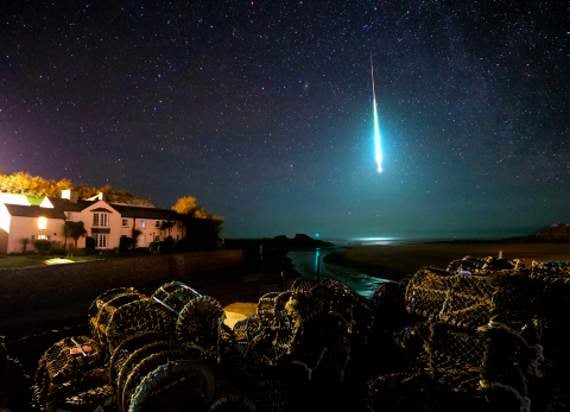
A ‘FIREBALL’ has been seen exploding over Britain, with one lucky photographer from Bude capturing it as it burst over Summerleaze Beach on Tuesday, January 21.
The bolide meteor was seen heading due west over Bude at around 11.20pm by Chris Small, a local photographer who owns Ocean and Earth Photography gallery in Bude. He said it was a ‘one chance in billions’.
The gallery owner was working on a project, taking night time photographs of the town when he witnessed the meteor ‘explode’ adding: “It lit up the whole coast.”
Experts say the ancient ball of rock and metal was probably the size of a beach ball and had been travelling at speeds of a thousand miles an hour when it exploded over the Bristol Channel.
.png?width=209&height=140&crop=209:145,smart&quality=75)



Mr Small, 34, regularly heads outdoors with his camera kit to capture the night sky over the town where he has lived for 20 years. He had been out a few nights prior taking photographs for his current project, but due to a focussing error decided to make a second trip out to recapture the images.
He said: “I’ve never seen anything quite like it. It was spectacular.
“I’ve been shooting a time-lapse of Bude at night and trying to capture different areas with the stars moving through the sky.
“That spot is an iconic view of Bude with the pink cottage, beach and harbour. I had gone out a couple of nights earlier but made an error in focus and two-and-a-half hours of shooting came to nothing. I had to delete it all. But the advantage is I went out two nights later and caught the bolide.”
He added that if it hadn’t been for the fortunate mistake two nights prior he would never have seen the incredibly rare meteor.
Chris explained that the resulting image was even more spectacular — and lucky — because he was able to catch it using a telephoto lens, which has a much narrower field of view than a normal or wide-angle lens.
Chris said: “You can see where the trail gets wider and thinner from it exploding through the atmosphere.
“I had set up two cameras and one was a wide-angle so you can see a lot of the sky and it’s not unusual to capture things.
“The other is telephoto so has a much narrower field of view so it’s extremely rare to have it go through the image — a billion-to-one chance and very lucky.
“It was extremely bright and burnt the image into my retina for about 15 seconds.”
He added: “I was actually ecstatic when I saw the results on the camera! I was shooting a time-lapse and continued shooting for another 40 minutes before I checked to see if I caught it. I spent all that time wondering, so when I finally saw the results I was extremely excited.
“I wouldn’t say it was one of my best photos but I’m very pleased with it. I spent a little while getting the composition how I wanted it for the time-lapse and the Bolide just added to it!”
Chris said he specialises in astronomy and spends around 100 hours a year under starlight: “I’ve never seen anything quite that impressive before and I spend 100 hours a year shooting under starlight.”
He added: “You see shooting stars but I’ve never seen a fireball like that. There aren’t even that many sightings of them in the whole world.”
Robert Lunsford, who is fireball coordinator for the International Meteor Organisation, said: “This fireball was a random occurrence and not associated with any known meteor shower.
“The size of this object was probably comparable to a beach ball or roughly a half meter across.
“Considering its path and the time of night, its velocity was in the neighbourhood of 15-20km per second (around 70,000 kph).
“The luminous portion of its flight occurred between 100 and 50km in altitude.
“It occurred over the Bristol Channel.”
Bolide meteors are rare because at their peak it’s more than twice as bright as a full moon and the colour at which it burns reveals what it is made up of.
The one over Bude was blue with a hint of yellow so it could have contained magnesium and iron.
Meteors become meteorites if any of the space debris survives the intense heat as it enters the atmosphere and the rock fragments land on the Earth’s surface.
A meteorite is often quite dense and heavy because of the amount of metal it contains and can be several billions of years old.
Comments
This article has no comments yet. Be the first to leave a comment.