
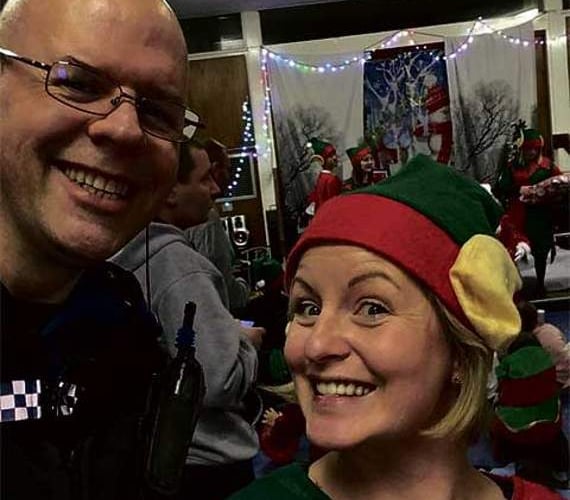
THREE of Devon and Cornwall’s PCSOs (Police Community Support Officers) have had the work they do supporting migrant workers commended by the British Academy at a presentation they attended at the House of Commons.
The British Academy report discusses social integration of both new and long settled communities and includes case studies of community projects focussed on the integration of migrants, refugees and asylum seekers. The projects highlighted include an initiative by Devon and Cornwall Migrant Worker PCSOs Steve Edser from East Cornwall, Bev Faull from West Cornwall and Mel Spiller from Mid Devon.
It is estimated Cornwall has a migrant workforce of up to 25,000, many are men under the age of 30 from Lithuania, Romania, Bulgaria, Poland, Spain and Roma backgrounds, who often need support to understand how to access basic services and integrate into British society. The group is at risk from threats posed by modern slavery including exploitation by rogue gang masters, human trafficking and illegal and exploitative working conditions.
Well aware of the cases of exploitation, Devon and Cornwall Police, in recent years, introduced three migrant worker police community support officers. It is their role to interact with migrant communities and to change their perception of the police, who are often distrusted in the countries they originate from, to help employers to protect migrants’ rights and to recognise and report crimes, to tackle hate crime and to serve as a bridge between migrants and other services.


They have created information-based welcome packs, leaflets in various languages explaining motoring laws and have done drop-ins at their places of work to ensure they are using appropriate equipment and to give them an opportunity to share any concerns they may have.
In Cornwall the PCSOs have built up an active Facebook page with 1,200 followers, which not only enables the police to target advice and reassure migrants, but gives migrants an opportunity to report hate crime.
PCSO Edser said: “When I first came into post many of the migrants would take one look at us and head for the exits. We have focused on breaking down these barriers and give regular talks about our roles organising drop-ins and events specifically for the migrant population. I’ve made friends and mixed with them socially. Now they phone me to ask a question — that’s brilliant.
“Our work with employers has really paid off. Some have observed large numbers of workers with the same home address, signalling they may be victims of exploitation. Others have reported concerns for their welfare such as domestic abuse or trafficking. Prior to us being in post this could have been overlooked because businesses did not understand the issues or know who to approach.”
Through a recent initiative the PCSOs have raised awareness with postal workers about how to recognise signs of modern slavery. This has resulted in police being informed of households with large numbers of occupants — up to 15 in one flat for example. They are also aiming to tackle hate crime, often carried out by young people, by visiting colleges and explaining the contribution migrants make to the local economy by doing long hours and physically-demanding work in the agricultural industry, for example.
One of the migrants, Miss L who arrived in Cornwall from Poland 12 years ago, summed up the good work done by the PCSOs. She said: “Before Brexit I never experienced racism. After Brexit my neighbours became aggressive towards me, I had racist and obscene comments written outside my property and my son was bullied. The police visited my home once or twice a week but couldn’t be there all the time. I found out about PCSO Edser through a Polish website and contacted him out of desperation. He has been brilliant — I no longer feel alone. I now if I have a problem he is there looking out for me. Everybody in the Polish community knows PCSO Steve, he is like a local celebrity.”
The success of Devon and Cornwall’s Migrant Worker PCSOs is now being shared with police forces across the country. The team has also travelled to Romania and Hungary to share best practices for working with Roma communities. They have built up a unique level of knowledge that can be used by others wanting to tackle modern slavery.
The Investigating Officer for the Gangmasters and Labour Abuse Authority, Martin Jones said: “The migrant worker PCSOs in Devon and Cornwall are a valuable tool in the fight against modern slavery.”
Chair of the British Academy project, Professor Anthony Heath said: “It is often said we live in a divided society, yet our research shows how small, local projects are already making difference to the lives of established and newly-arrived migrant communities across the UK. But it is clear that integration does not happen on its own. Social integration must be supported and planned, taking into account the diverse needs of specific communities and places.
“The government’s forthcoming Integration Strategy must take account of the good work that is already going on. Only then can we build sustainable and cohesive communities, where people of all backgrounds are welcomed and supported.”
Commenting on the report The Lord Bourne of Aberystwyth, Parliamentary Under Secretary of State, Department for Communities and Local Government said: “If you could do one thing…” provides practitioners, policy makers and communities invaluable and practical insights on how we can strengthen integration in local places drawing on our collective knowledge and practice.”
Chair of the All-Party Parliamentary Group on Social Integration, Chuka Umunna MP said: “I welcome the publication of this report. We need a meaningful Integration Strategy which works for all parts of the UK to celebrate and look beyond our differences. However, integration is a two-way street requiring action on the part of newcomers and host communities.
“The group which I chair, has called on the government to overcome any and all barriers to integration, by empowering local leaders to promote integration, so we can ensure the UK continues to be an open and global facing nation.”
Comments
This article has no comments yet. Be the first to leave a comment.